In an environment disrupted by U.S. tariffs, it can be reassuring to recall the sentiments expressed on a challenge coin given to me by leaders of the Canadian Consulate in Atlanta at a recent event held at the Georgia state capitol to celebrate ties between the state and Canada.
Around a circle filled with the two nations’ flags appear the words “friends,” “partners,” and “allies.” Around that circle sits another where, engraved in golden letters on a blue background, this passage appears: “Those whom nature hath so joined let no man put asunder.”
Those words were spoken by President John F. Kennedy in May 1961 when, borrowing language usually reserved for a wedding ceremony, he invoked the power of the U.S-Canada relationship in an address to the Canadian Parliament in Ottawa. “What unites us is far greater than what divides us,” he said in the next breath.
Sixty-five years later, the layers of infrastructure connecting Great Lakes territories continue to unite supply chains, fortify networks, connect communities and bridge the occasional policy divide with the common-sense wisdom that comes with everyday relationships. Here are a few snapshots of how those layers are contributing to the region’s prosperity.
Ports & Maritime
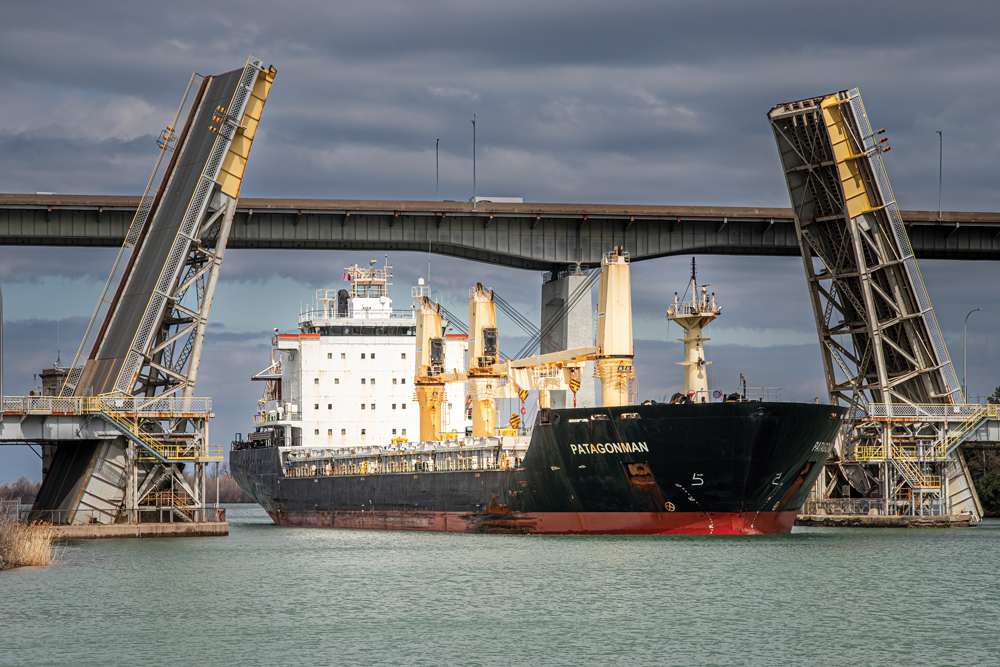
The binational St. Lawrence Seaway system, which handled 37 million metric tons in 2025, launched its 68th season during the first week of spring 2026 when the M/V Blacky operated by Canfornav served as the season’s ceremonial vessel at the St. Lambert Lock in Montreal.
“With supply chains facing new pressures, reliable marine corridors like the St. Lawrence Seaway are essential to our economic resilience,” said Canadian Minister of Transport and Leader of the Government in the House of Commons the Honorable Steven MacKinnon.
As for ports, the Port of Duluth-Superior in Minnesota and Wisconsin leads all Great Lakes ports by total cargo tonnage. In April 2026, The U.S. Maritime Administration (MARAD) announced that it awarded the Duluth Seaway Port Authority $27.5 million through its Port Infrastructure Development Program (PIDP) to fund the Duluth Lake Port pier redevelopment project. It’s the largest MARAD grant ever received by the Port Authority, and will be supplemented by $10.8 million in secured state and local funds.
“The project will transform the 7.5-acre Duluth Lake Port pier on Rice’s Point — a strategic waterfront property the Port Authority acquired in 2020 — into a future-ready supply chain asset,” the Port Authority stated in a release. The revitalized pier will leverage three strategic advantages, the Port Authority continued, on-dock rail service connecting to multiple Class I railroads, vessel berthing capacity on two docks at Seaway depth, and “a location at the heart of North America’s farthest-inland seaport.”
Highways & Border Crossings
Even as new U.S. tariffs scuttled a joint binational celebration, the long-awaited Gordie Howe International Bridge’s official opening ceremony took place on the Canadian side in July 2026 with a ribbon-cutting ceremony and a hockey game to honor the bridge’s legendary namesake. A multi-use trail was expected to open for pedestrians and cyclists in early August. The entire complex features six bridge lanes, 16 toll lanes and 60 Canada and U.S. inspection lanes — representing the largest ports of entry anywhere on the U.S.-Canada border.
“The Gordie Howe International Bridge will support increased trade and good-paying jobs on both sides of the border, adding to the $82 billion in cross-border trade that Michigan and Ontario do every year,” said Ontario Premier Doug Ford.
“After nearly 25 years of planning and construction, the opening of the Gordie Howe International Bridge marks a defining moment for Windsor-Essex,” said Drew Dilkens, mayor of Windsor. “This once-in-a-generation infrastructure project will strengthen one of the world’s most important trade corridors, move people and goods more efficiently between Canada and the United States, and unlock new opportunities for investment, job creation and economic growth. It will build on the extraordinary momentum transforming our city as one of Canada’s fastest-growing regions, and position Windsor-Essex at the center of a new era of trade, tourism, investment and long-term prosperity.”
A release from the Windsor-Detroit Bridge Authority explained that, since construction started in October 2018, “more than 15,800 individuals, including a strong unionized labor force, worked over 20.1 million hours to cross this finish line” on the project, where Bridging North America now will shift from project completion to the 30-year operations, maintenance and rehabilitation component of the C$6.4 billion project contract.
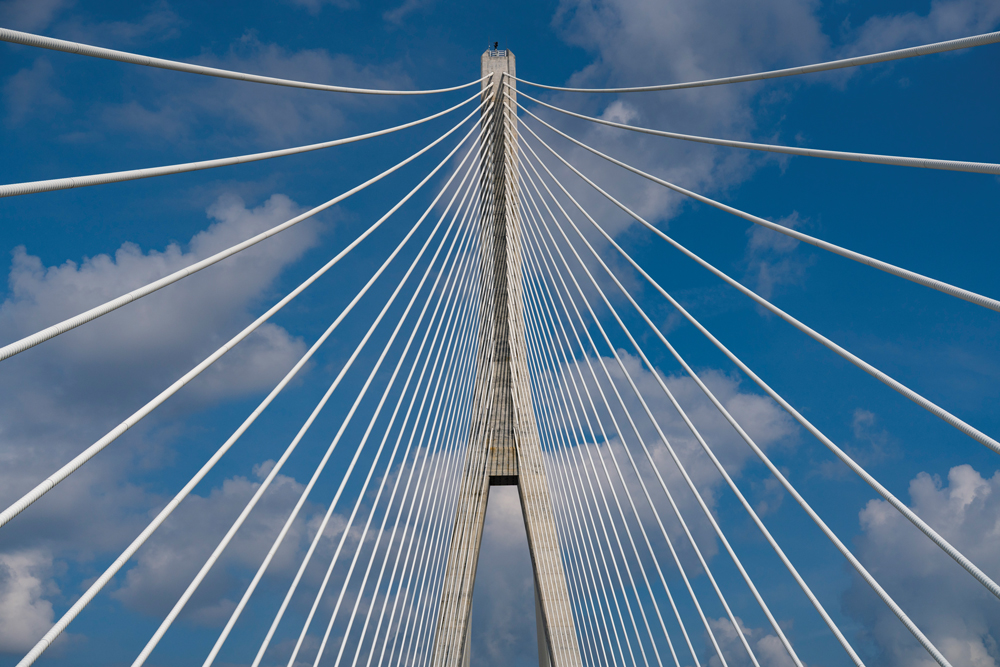
The Gordie Howe International Bridge was opened to traffic on July 27, 2026.
Photo courtesy of Windsor-Detroit Bridge Authority
International Airports
ADM Aéroports de Montréal, the Greater Montréal Airport Authority, is responsible for the operation and development of YUL Montréal-Trudeau International Airport and YMX Aerocity of Mirabel, a technology park. Activities of companies on the YUL and YMX sites combined generate C$10.3 billion in nominal GDP, equivalent to 2.37% of Quebec’s overall GDP.
Between 2024 and 2028, ADM’s planned infrastructure investments at YUL will support nearly $3.7 billion in GDP. Meanwhile, activity at YMX is primarily aircraft manufacturing and repair and the manufacture of aerospace products and parts, with five all-cargo carriers part of a cohort of some 40 companies on site.
In July 2026 at the Farnborough International Airshow in the United Kingdom, ADM Aéroports de Montréal and Concordia University signed a memorandum of understanding to leverage the expertise of the Volt-Age program to support the development of YMX Innovation, the aerospace innovation hub located in the YMX Tech Park, and its advanced air mobility program, with a focus on electrification, energy systems, energy storage and smart infrastructure.
“Volt-Age was created to leverage Canada’s leading expertise and accelerate the electrification of society,” said Concordia University Vice President of Research and Innovation Dr. Tim Evans of the program carried out in partnership with such institutions as the University of Calgary, Toronto Metropolitan University and Dalhousie University. “By connecting our partners to the unique YMX Innovation ecosystem, we are creating an exceptional environment where research is quickly transformed into technology demonstrators, industrial collaborations, new companies and concrete solutions for advanced air mobility.”
Some of those organizations are already showing up at YMX. An April release from ADM noted the backing of a new incubator called Protospace by Airbus; new advanced air mobility initiatives at the Drone Innovation Centre at Mirabel from the National Research Council of Canada; a center called ‘ARCTIC’ researching hydrogen as a clean propulsion technology from the national H2CanFly consortium; a new drone assembly plant from Volatus; and equipment installation at a new facility from WatchOut, a Franco-Swiss company that specializes in AI-driven autonomous machining cells.