
by SAVANNAH YAWN
East Tennessee’s nuclear roots run deep. Now, a new wave of private investment is building on that foundation. Companies are investing across the region, while colleges and workforce partners are building the talent pipeline needed to support that momentum.
The result is a regional nuclear cluster with unusual depth. East Tennessee has the labs, sites and technical knowledge that nuclear companies need, along with universities and community colleges preparing the workers who will help them grow.
Investment Finds Its Center of Gravity
In January, LIS Technologies (LIST) announced plans to create 203 jobs and invest $1.38 billion in an Oak Ridge facility on the former Duct Island site. According to the Tennessee Department of Economic and Community Development (TNECD), the project is intended to become the world’s first U.S.-origin commercial laser uranium enrichment plant and will serve utilities, reactor developers and national defense requirements while helping to reestablish a domestic nuclear fuel supply chain.
“This investment represents more than the construction of a single facility. It reflects a commitment to restoring a critical domestic capability, advancing peaceful nuclear technologies and strengthening the U.S.’ competitiveness in an evolving global energy landscape,” said Christo Liebenberg, president and co-founder, LIS Technologies. “As global demand for nuclear fuel grows and existing supply tightens, the opportunity—and responsibility—to act is clear. This project is a meaningful step toward reestablishing U.S. enrichment capacity and rebuilding the nuclear fuel cycle.”
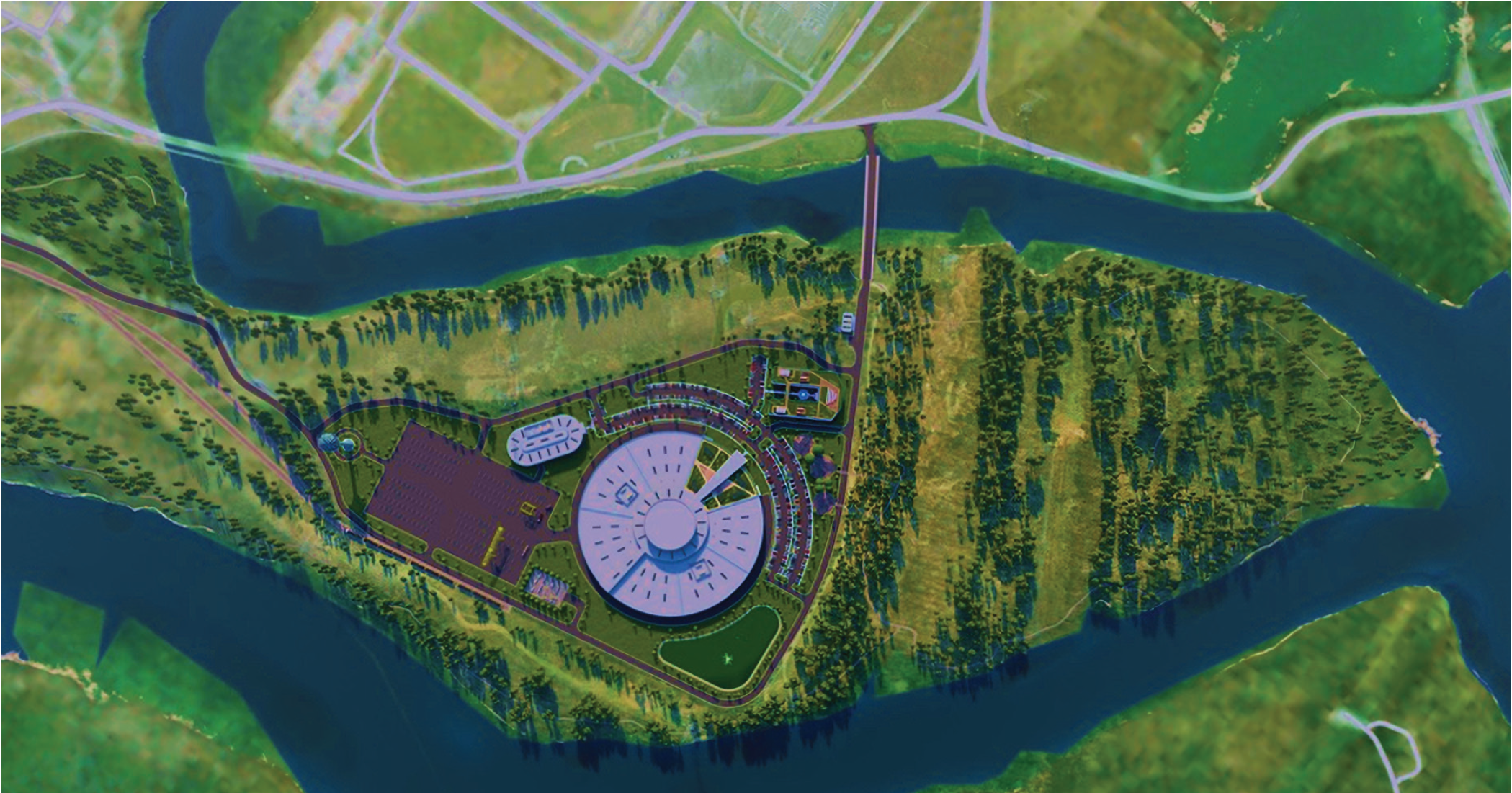
LIS Technologies Inc. rendering of LEU-3, the home Project F.U.E.L. (Future Uranium Enrichment with Lasers)
Rendering courtesy of Globenewswire.com
LIST later announced that its Oak Ridge facility, named LEU-3, would serve as the headquarters for Project F.U.E.L., the company’s effort to commercialize its U.S.-origin laser isotope separation technology. Liebenberg said the “expertise available in the Oak Ridge ecosystem is a perfect fit” as the company advances its next phase of growth.
The company is part of a broader pattern. One week after the LIST announcement, Centrus Energy announced a major expansion of its centrifuge manufacturing plant in Oak Ridge. The company plans to create nearly 430 jobs and invest more than $560 million in a project supporting the large-scale restoration of domestic uranium enrichment capability.
“We are proud to be leading the effort to restore America’s ability to enrich uranium at scale—using American technology, built by American workers right here in Tennessee,” said Amir Vexler, CEO of Centrus.
The significance of those projects is not only their scale, but their placement. In East Tennessee, nuclear companies are not arriving in isolation. They are locating in a region where the industry already has deep roots, existing technical knowledge and a community identity tied to nuclear science.
“Oak Ridge is fortunate to be home to a broad range of companies leading the nation’s nuclear renaissance,” said Oak Ridge Mayor Warren Gooch. “Whether developing and operating small modular reactors or producing nuclear fuel, these companies all come to Oak Ridge because they rely on the cutting-edge science and highly specialized manufacturing practices we have here.”
Fuel, Reactors and Manufacturing
In September 2025, Oklo Inc. selected Oak Ridge for a nearly $1.7 billion advanced fuel center expected to create more than 800 jobs. The project includes an advanced nuclear fuel recycling facility on a 247-acre site at the Oak Ridge Heritage Center. TNECD described it as the nation’s first privately funded nuclear recycling capability, designed to recycle used nuclear fuel from today’s operating reactor fleet and provide a domestic fuel supply for advanced reactors.
For Roane County, the project also reflects the economic development value of long-running cleanup work. Roane County Executive Wade Creswell called Oklo’s location decision proof that the region is successfully completing “cleanup today for a nuclear tomorrow.”
A month later, Radiant selected Oak Ridge for a $280 million investment to expand its nuclear manufacturing and research and development operations. The company plans to build its R-50 factory in Oak Ridge, supporting production of its Kaleidos portable nuclear microreactor generators which can be used for military or disaster-relief scenarios.

LIS Technologies Inc.’s LEU-3 will be the home of Project F.U.E.L. (Future Uranium Enrichment with Lasers).
Rendering courtesy of LIS Technologies Inc.
Tori Shivanandan, chief operating officer of Radiant, said, “The state’s business-friendly environment gave us the immediate regulatory certainty we needed to move fast and be up and running to meet growing customer demand for our Kaleidos nuclear generators.”
Together, those announcements show why East Tennessee’s nuclear momentum is bigger than any single project.
Training Talent for the Next Nuclear Era
Tennessee Tech University is also helping build the engineering side of the region’s nuclear workforce pipeline. The university’s College of Engineering has launched a nuclear engineering program within its Department of Mechanical and Nuclear Engineering, adding another layer to Tennessee’s talent infrastructure as demand grows for engineers, researchers and technical specialists across the advanced nuclear sector.
At the community college level, Roane State Community College is focused on the skilled technical workforce that will be needed as companies scale. Its Nuclear Technology Program offers a two-year associate degree built around real-world education, experiential learning, hands-on nuclear operations and internship connections designed to meet the region’s need for skilled workers and technicians.
“This program is connected to what I call the reimagining of the workforce,” said Dr. Joseph Stainback IV, program director for nuclear technology at Roane State Community College. “The nuclear industry may not need a four-year engineer for every role, but it does need people with two-year degrees and the right technical skill sets. That is the gap we are trying to fill. Our program is built around experiential learning so students can get comfortable with the equipment, understand what to expect and leave skilled up for the workforce.”
Stainback says East Tennessee’s advantage begins with a nuclear-friendly culture and legacy assets including Oak Ridge National Laboratory, the Y-12 National Security Complex and other institutions that have long anchored the region’s nuclear economy.
That mix of assets is what gives East Tennessee its critical mass. The region has the research base to support innovation, the industrial sites to accommodate investment, the cleanup experience to return legacy land to productive use and the educational institutions to prepare both engineers and technicians.
For companies entering the nuclear sector at a moment of rising power demand and renewed federal focus on domestic energy security, that combination is difficult to replicate.
East Tennessee helped define the first nuclear age. Now, as the U.S. works to rebuild domestic fuel capacity, commercialize advanced reactors and train the workers who will operate the next generation of nuclear facilities, the region is positioning itself to define the next one.