
Nuclear leads a growing pack of Texas energy solutions and opportunities.
When Texas Governor Greg Abbott in December 2025 looked back at a year of progress in the state’s energy sector, he saw a range of accomplishment as wide and varied as Texas itself. But one landmark stood out from the rest.
“This year Texas took a magnificent step in becoming the headquarters of the American Nuclear Renaissance,” said Gov. Abbott, who received the “Atomic Texan Award” at the 2025 Texas Nuclear Summit in October. “By solidifying our great state as a prairie for nuclear energy to thrive, Texas’ energy ecosystem is stronger than ever before. Texas is investing in the future of the world’s energy sector and protecting the petroleum industry, the lifeblood of the state’s economy, to power our state for generations to come.”
That renaissance is taking shape in both projects and policy, including the creation by House Bill 14 of the Texas Advanced Nuclear Energy Office (TANEO), led by Jarred Shaffer. The office’s accompanying Texas Advanced Nuclear Development Fund (TANDF) was funded with $350 million. Applications for TANDF funds opened in April 2026 for projects that build advanced reactors, strengthen nuclear manufacturing capacity and rebuild a domestic fuel cycle supply chain.
“It is clear that the Governor urgently understands two things,” said Texas Nuclear Alliance President Reed Clay, “the immense national security and energy security implications of regaining our status as the world’s leading exporter of nuclear technology and the exponential opportunity to bring high-paying jobs to Texas as the nuclear industry reestablishes itself.”
The Alliance itself was formed by a sense of urgency, with members coming together in 2022 in the aftermath of Winter Storm Uri. Comprising over 70 member entities today — including American Fuel Resources, engineering firm Assystem, the Texas Tech University System, the Greater Houston Partnership, the City of Bryan and nuclear energy technology company Holtec International — the organization is “based on the fundamental premise that if Texas and the world want low-carbon, reliable energy, it can no longer turn its back on nuclear energy.”
Nobody’s turning their back in Bryan-College Station, where the Texas A&M University System and Last Energy in October 2025 announced the deployment of a pilot microreactor at Texas A&M-RELLIS, the region’s applied research campus, with testing scheduled to begin in summer 2026. It’s Last Energy’s first U.S. reactor deployment and was selected by the U.S. Department of Energy for fast-tracked licensing under its New Reactor Pilot Program, following an executive order by President Trump to reform and accelerate nuclear reactor development.
“This pilot project is an example of what’s possible when we try to meet the needs of the state and tap into the latest technologies,” said Robert Albritton, chairman of the Board of Regents of The Texas A&M University System. “This is a proud moment for the Texas A&M System and a meaningful step forward to unleash American energy innovation.”
“We’re partnering with Texas A&M to usher in the next Atomic Era,” said Bret Kugelmass, Founder and CEO of Last Energy. “With fuel in hand, an optimal site at RELLIS, and DOE authorization underway, we have the ideal conditions to demonstrate a standardized, scalable microreactor product to the United States.”
Chief among those looking to deploy nuclear power in Texas is Fermi America, the massive data center and power generation project under construction in Amarillo. In March, in partnership with Texas Tech University System, Fermi Inc. announced its intention to file an additional 5-GW air permit with the Texas Commission on Environmental Quality (TCEQ). The announcement came right after the approval of Fermi’s 6-GW Clean Air Permit for Project Matador. Together, the company said, the two permits signal “the campus’ plan to achieve ~17 GW of total power including 11 GW of clean natural gas, 4.4 GW of nuclear energy, solar and battery sources.”
“Leave it to Texas to answer the call for America’s energy crisis,” said Toby Neugebauer, Co-Founder and CEO of Fermi America. “Why would we settle for 6 GW of clean natural gas when the country needs more power, not less, and our site is beyond capable of safely producing 11 GW? Fermi is pleased to steward this land and environment well, while creating additional high-paying jobs and economic development for the region.”
A major Texas utility also is embracing nuclear as one of several solutions to supply plentiful and affordable energy to one of the fastest-growing states in the nation. In its recently released performance report, Entergy noted that it is participating in state working groups in Louisiana, Mississippi and Texas that are evaluating the potential for nuclear expansion. That activity includes collaboration with Holtec to evaluate its small modular reactor technology for use in Entergy’s service area.
Natural Gas Comes Naturally
In keeping with a growing state’s “all of the above” approach to new power generation, as part of its Southeast Texas Energy Plan (STEP Ahead), Entergy continues to invest in natural gas-fired power, including the Legend and Lone Star power stations as well as the Orange County Advanced Power Station, which will generate 1,215 megawatts of power.
Others are doing the same: 2025 saw the state launch the $10 billion Texas Energy Fund (TxEF) in order to provide grants and loans to finance the construction, maintenance, and modernization of electric facilities. Among the fund’s investments so far are up to $1.12 billion to Competitive Power Ventures Basin Ranch for a 1,350-MW natural gas power plant in Ward County; up to $516 million to NRG Energy for a 721-MW natural gas power plant near Baytown; and up to $464 million to Calpine Corporation for a 460-MW natural gas power plant in Fairfield.

The Texas Economic Development & Tourism Office within the Office of the Governor notes that since the discovery of the Spindletop oilfield in 1901, Texas has been a global leader in energy production. As it happens, Spindletop continues to be a crucial location. Entergy Texas’ Spindletop natural gas storage facility in Beaumont, located directly over the oil field, proved crucial to power provision when freezing temperatures hit southeastern Texas in January 2026.
Spindletop is home to two underground salt caverns located more than 4,000 feet below ground with a combined 5.9 billion cubic feet of usable natural gas storage, “which can be used to fuel four Entergy Texas power plant units for an extended period of time,” an Entergy blog noted in February. “From Jan. 24-31 alone, using stored fuel from Spindletop saved customers an estimated $20 million.”
“Our Spindletop facility demonstrates how long-term planning and investments across all areas of our business can support both reliability and affordability when grid conditions are most challenging,” said Abby Weaver, vice president of business operations and strategy at Entergy Texas. “Because we secured this supply well in advance, we were able to rely on gas priced significantly below what the market offered during the freeze.”
No. 1 in the U.S. in the production of both crude oil and natural gas, Texas is home to nearly 472,800 miles of oil and gas pipelines (more than 14,000 for natural gas). In 2024, Texas accounted for 43% of the nation’s crude oil and 29% of its natural gas production. Oil and gas production directly and indirectly supports 1.4 million Texas jobs. “With liquefied natural gas (LNG) terminals in Freeport and Corpus Christi, Texas has become a top state for LNG exports, ranking No. 2 in the nation,” the Governor’s Office notes. Of the 28 new or expanding LNG export projects proposed or under construction in the U.S., 11 are planned for Texas.
Natural gas-fired generation got another boost in March 2026 when, on the occasion of the summit meeting between Prime Minister Takaichi Sanae and President Donald Trump in Washington, D.C., the U.S. and Japan governments announced a new batch of joint projects being pursued under the Japan-U.S. Strategic Investment plan that includes construction of up to $16 billion in natural gas generation facilities in Texas.
‘All of the Above’ Includes Renewables and Battery Storage
The state’s manufacturing prowess is naturally connected to its energy heritage. A March 2026 report from the Greater Houston Partnership found that Houston’s $126.9 billion in manufacturing output led the nation in 2024 for the third consecutive year. That sector includes petroleum refining. It also includes solar panel production, which is part of the Texas picture overall and Houston in particular, with operations recently started by Japan’s Toyo Co. Ltd. in Humble (where employment could grow from 100 to 750); by Imperial Star Solar in Tomball; and by TMEIC Corp. Americas, which moved its HQ to Houston and sited its third area manufacturing plant in Brookshire. That’s the same community where Tesla is launching operations to make its Megapack batteries, with plans to employ as many as 1,500 people.
Solar panel deployment also is on the upswing: The Solar Energy Industries Association (SEIA) in a March 2026 review of industry activity in 2025, noted that “Texas continued its dominance as the fastest-growing solar market, leading all states with 11 GW of new installations” in 2025.
Energy storage looks to Texas too: “The U.S. energy storage industry installed a record-shattering 57.6 gigawatt-hours (GWh) of new capacity in 2025,” the SEIA has reported. As of 2025, a total of 137 GWh of utility scale storage has been installed in the United States in addition to 19 GWh of commercial and industrial (C&I) storage. “Texas,” the SEIA stated, “is set to overtake California in 2026 as the largest energy storage market in the country.”
The Distributed Energy Resources State Policy Explorer from Pew Charitable Trusts and the North Carolina Clean Energy Technology Center’s Database of State Incentives for Renewables & Efficiency (DSIRE) launched in March 2026 with 443 state legislative actions tracked between 2021 and 2025 that address advancing distributed energy resources such as rooftop solar and battery energy storage systems (BESS). Texas, with 21 such measures, ranked among the top 10 states by number of legislative actions.
Hunt Energy Network, among others, is working to deploy batteries across the Texas electric grid, with 15 of its growing fleet of 36 battery energy storage systems (BESS) representing over 420 MW situated in the Permian Basin of West Texas — the very heart of the state’s oil and gas legacy and, from all signs, a primary location for future innovations in energy.
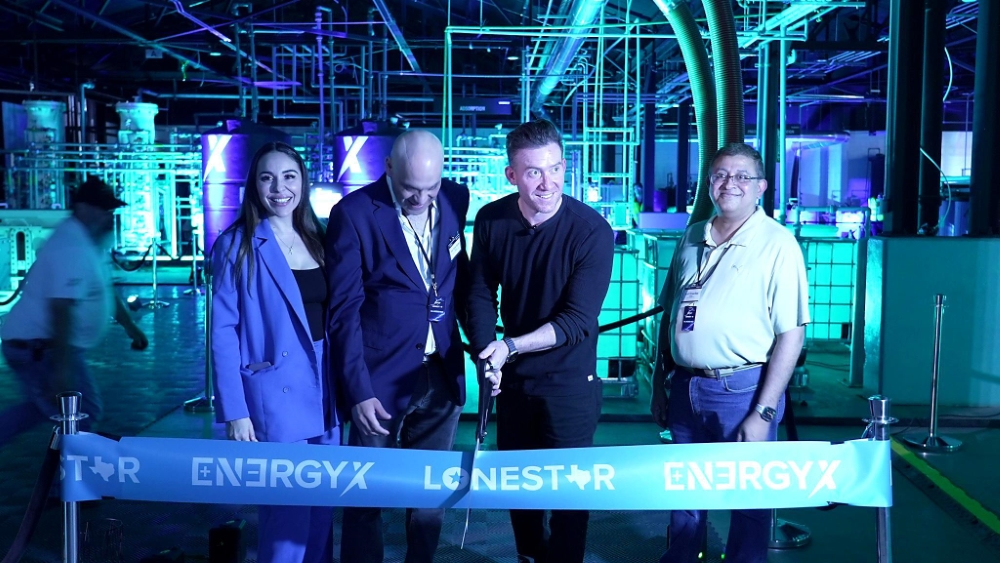
Photo courtesy of TexAmericas Center
Lithium-Ion Innovation Lands in Texarkana
Industrial park TexAmericas Center announced in April 2026 the recent commissioning of EnergyX’s $30 million Project Lonestar Lithium demonstration facility at its East campus in the Texarkana, Texas area. “The project represents a major step forward in establishing a domestic supply of battery-grade lithium,” the announcement stated, “positioning the Texarkana region at the forefront of the nation’s energy transition and critical mineral production.”
“The reason we are here in Texarkana and in northeast Texas is because the lithium is literally underneath our feet,” said Teague Egan, founder and CEO of EnergyX.
The plant has the capacity to produce 250 tons of lithium annually using EnergyX’s proprietary direct lithium extraction (DLE) technology. A planned commercial-scale operation could produce up to 50,000 tons per year within the next five years.
“This is a defining milestone for EnergyX and for the future of domestic lithium production,” said Scott Norton, executive director and CEO of TexAmericas Center. “Their technology, investment and long-term vision are exactly what is needed to strengthen U.S. energy independence, and we are proud that TexAmericas Center is where that work is happening.”