
by John McCurry
Ilinois is building strong FDI momentum with a mix of traditional industries, such as manufacturing and the promising field of quantum computing. In 2025, the Chicago metro area attracted approximately $674 million across 26 FDI projects, with promises of more than 2,000 jobs, according to World Business Chicago. Projects included companies involved in advanced manufacturing, food production, clean energy, logistics, business services and quantum computing.
Karla Orozco Toledano, vice president of economic development for World Business Chicago, observes that foreign companies are increasingly seeking a physical presence closer to their U.S. customers. That could begin with a sales office or a showroom, but lately there is growing interest in distribution, assembly and manufacturing.
“Companies are no longer asking only ‘Where is the lowest-cost location?’ They are asking ‘Where can we operate reliably, reach customers and protect our supply chain?’ especially with everything that is going with trade policies,” she says.
Chicagoland is seeing robust FDI activity at the intersection of traditional industries like manufacturing or food and beverage with technology. Another trend is companies choosing to enter the market in stages. For example, a company may begin with a showroom facility near customers, and later add employees, warehousing and production.
Orozco says foreign companies are increasingly evaluating locations through the lens of values, as well as economics. Human rights, climate policy, workforce inclusion and broader social responsibility are now part of the investment equation.
“Cost and revenue still matter, of course, but they are no longer the only variables,” Orozco says. “Companies want to operate in places that reflect their values and help them attract the talent and support for their long-term sustainability goals. This is definitely an area where Chicago and the region have a very strong story to tell.”
Illinois backs this values alignment with real financial commitment. The Illinois Department of Commerce and Economic Opportunity (DCEO) administers the Reimagining Energy and Vehicles (REV) Program, which offers tax credits to companies that manufacture EVs, EV components, or renewable energy technology. This supports the State’s own goal of 100% clean energy by 2050. For foreign investors who share that sustainability priority, REV turns strategic and values alignment into concrete financial support for their Illinois expansion.
Quantum computing is a burgeoning sector for FDI in Illinois. While the category is not an FDI leader in terms of number of projects, it is a leading strategic sector for the coming years. Orozco says it has the potential to create an entirely new cluster and attract investment across areas such as semiconductors, advanced materials, control systems, high-performance computing and specialized manufacturing. She describes it as moving rapidly from research to commercialization.
“It is fair to say quantum is still a sector defining itself,” she says. “We know the core science and its enormous potential, but the commercial applications, business models, industry standards, workforce needs and supply chains are still shaping.”
Compute This: Come to Chicago
Darin Buelow, global location strategy leader with Deloitte in Chicago, says one can count on one hand the number of states that have “legitimate bona fides” when it comes to quantum research, and Illinois is one of them.
“They’ve got Argonne [National Laboratory] and Fermi [National Accelerator Laboratory], and there’s a lot of quantum research happening there. If you’re a quantum company looking to deploy, you’re literally looking at only a couple of states that have assets like that.”
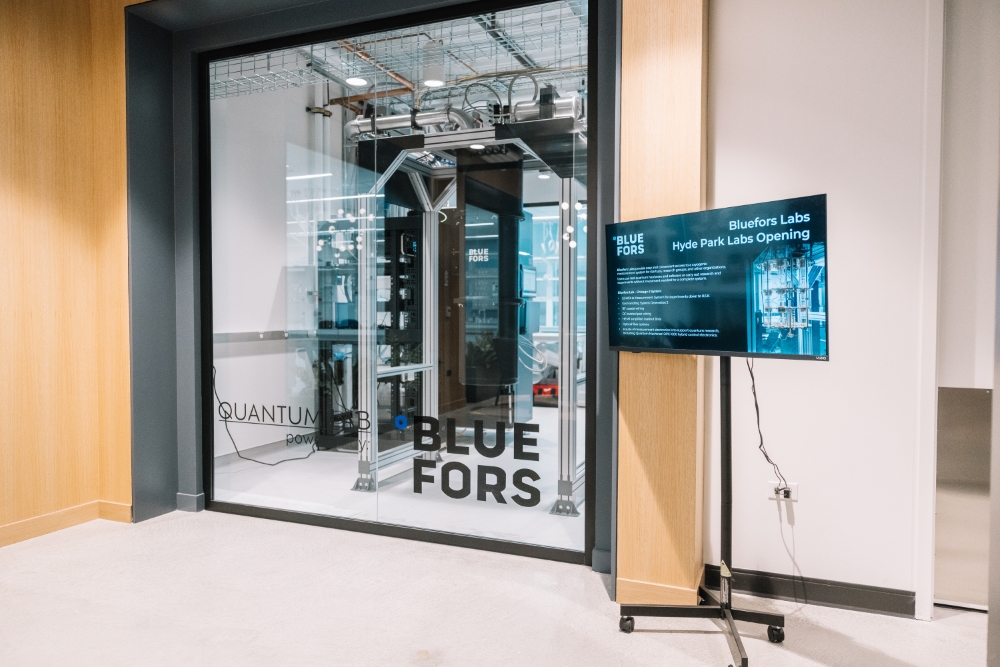
One potential building block for the quantum sector is Bluefors, a Helsinki, Finland-based manufacturer of cryogenic measurement systems and other product lines for quantum technology. Bluefors opened a second Chicago lab in 2025 at the University of Chicago Science incubator at Hyde Park Labs.
Sauli Sinisalo, vice president and general manager for Bluefors’ North American operations, says the main deciding factors for Bluefors were the easy access to talent through local universities and an active quantum and startup ecosystem, as well as a knowledgeable and supportive environment through the Illinois EDC, P33, DCEO and Chicago Quantum Exchange.
“The UChicago Science Incubator had its new premises in Hyde Park Labs open for business in June last year,” Sinisalo says. “Bluefors moved in in November and we got the first test measurements with the lab completed in January. The Bluefors Lab Chicago is currently open for customers and looking forward to helping the local quantum community with easy access to cryogenic infrastructure for quantum technologies development and R&D.”
Recent FDI wins in the quantum field for the Chicago region include plans by Israel-based Quantum Machines to establish a flagship hub at the Illinois Quantum and Microelectronics Park (IQMP). Quantum Machines develops control products for quantum computing. Pasqal, a France-based company that builds and commercializes quantum computers powered by neutral atom technology, is developing its U.S. headquarters, also at the IQMP. The Quantum STrategic industry Alliance for Revolution (Q-STAR) also announced it would parnter with IQMP, strengthening collaboration with Japanese companies and the Illinois quantum ecosystem. Canadian manufacturer Zero Point Cryogenics’ first U.S. location will also locate at IQMP.
In a more traditional field, Japan-based Rapyuta Robotics, a developer of pick-assist robotics, opened a showroom in Schaumburg in 2023. A year later, it opened a demonstration space for its automated storage system, which previously could only be experienced in Japan.
Buelow says Illinois’ FDI future is bright, pending navigation of variables such as interest rates and tariffs. If tariffs stay in place, that could motivate some foreign firms to establish production in the U.S.
“A trend here is more manufacturers are figuring out how to use robotics and take the labor cost disadvantage of the U.S. out of the equation. As they automate more, you’re reducing the share of the total cost pie that’s labor, so logistics costs become more important, supply chain costs become more important, tax becomes more important and speed to market becomes more important. That means there should be more foreign direct investment into the U.S. if they can automate some of these factories. I don’t expect things to drop off a cliff. I don’t expect things to skyrocket up either.”
Buelow says Illinois has more shovel-ready sites than its neighboring states, presenting a short-term advantage. Other states with depleted site inventories are retooling, so he says that advantage won’t last forever. But the current portfolio of sites is therefore compelling to foreign investors.