
by Sam Moses, Parker Poe, and Azad Khan & Nelson Lindsay, Parker Poe Consulting
For global manufacturers, suppliers and investors, the United States continues to represent one of the most compelling markets for expansion. Demand remains strong, customers are here and a U.S. presence is increasingly necessary for companies looking to scale.
What has changed is not the underlying opportunity, but the level of complexity required to capture it. In early 2026, foreign direct investment (FDI) activity has shown renewed momentum following a slower close to the prior year. At the same time, companies are approaching U.S. expansion with greater discipline. Policy shifts, cost pressures and labor constraints are requiring investors to be more deliberate in how and where they deploy capital.
The result is a more deliberate approach to site selection, where flexibility, planning and local insight play a larger role than in prior cycles.
A More Structured, Selective FDI Environment
Uncertainty continues to shape the current investment landscape, particularly as companies evaluate evolving federal and state policies, global cost pressures and sector-specific dynamics.
We’re seeing a lot of activity concentrated in industries such as data infrastructure, advanced manufacturing, life sciences and defense-related sectors. These projects often involve heightened regulatory scrutiny, longer development timelines and more complex stakeholder engagement.
At the federal level, policy initiatives are increasingly focused on balancing national security considerations with maintaining an open investment environment. At the same time, state-level actions, ranging from incentive program adjustments to legislation affecting foreign ownership, are adding another layer of variability that companies must account for early in the process.
FDI Update
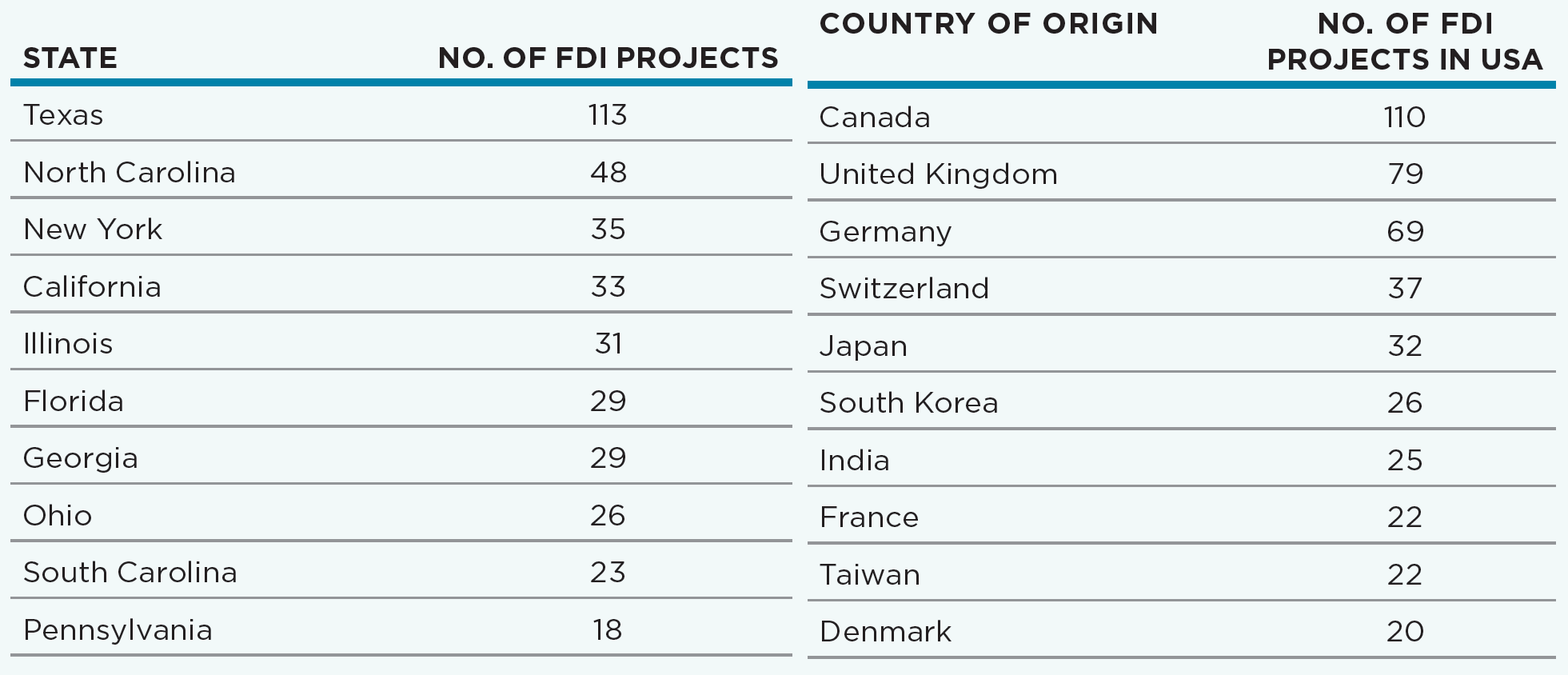
Site Selection’s Conway Projects Database tracked nearly 600 inward FDI facility location or expansion projects in the United States between January 2025 and March 2026. Here are the top 10 states:
By country of origin, Canada accounts for 110 (18.5%) of the 594 major facility investments by foreign companies. Here are the top countries:
The results align closely with the most recently available FDI data from 2024. Expenditures by foreign direct investors to acquire, establish or expand U.S. businesses totaled $151 billion in 2024, according to preliminary statistics released in July 2025 by the U.S. Bureau of Economic Analysis. Led primarily by acquisitions of existing U.S. businesses, “expenditures decreased $24.9 billion, or 14.2%, from $176 billion (revised) in 2023 and were below the annual average of $277.2 billion for 2014–2023,” said the BEA.
“By state, Texas received the most investment in 2024, with $22.8 billion in investment expenditures,” the agency stated. “Other states with significant investment expenditures included Georgia ($16.3 billion) and California ($12.9 billion).” At 32,700 individuals, Florida was the state with the largest current employment resulting from new investment, followed by Texas (18,200) and New York (14,200).
Expenditures were largest in the manufacturing sector at $67.7 billion, accounting for 44.9% of total expenditures. The country with the largest investment was Ireland ($30.1 billion), followed by Canada ($23.9 billion), with those two countries representing 80% of the total. By region, Europe contributed the most new investment, $96.7 billion, or 64% of all new investment in 2024. “Asia and Pacific was the second-largest investing region, with $23.2 billion in expenditures,” the BEA stated. — Adam Bruns
Certain federal policies, such as the Trump administration’s America First Investment Policy, are aimed at creating a less conducive environment for foreign investment from “foreign adversaries,” including China and Russia, to expand and grow here, while remaining committed to keeping a positive investment environment for allies and other partners. Meanwhile, certain states are proposing or adopting legislation that seeks to restrict foreign investment from certain countries as well.
Trump’s America First policy is a good step in the direction of supporting FDI; the challenging part remains in its implementation. Foreign investors today have new tools in their toolbelt thanks to the One Big Beautiful Bill, which offers more attractive tax benefits for expanding businesses, including accelerated depreciation of capital assets and increasing the scale of benefits available under the New Markets Tax Credit program, which is used in the U.S. by businesses to help finance qualifying projects.
But trade policies such as new tariffs are creating a chilling effect for many foreign manufactures who wish to localize or expand production in the United States. Tariffs are creating substantial additional costs for these projects as they must pay additive tariffs on equipment and raw materials that are only available from outside the United States. For investors, this does not necessarily represent a barrier to entry. However, it does require a more structured approach to diligence, planning and execution than many companies, particularly first-time entrants, may expect.
“We’re seeing a lot of activity concentrated in industries such as data infrastructure, advanced manufacturing, life sciences and defense-related sectors.”
Tariffs, Costs and Timing Pressures
Trade policy continues to influence how companies evaluate U.S. expansion, though not always in uniform ways. Some organizations are taking a more cautious, wait-and-see approach as they assess the potential impact of tariffs on capital expenditures, equipment sourcing and long-term operating costs. Others are accelerating investment decisions to establish a domestic presence and reduce exposure to import-related risks. In both cases, tariffs are not the sole driver of decision-making, but they are an important variable within a broader financial model.
At the same time, global factors, including energy prices and supply chain disruptions, are contributing to rising project costs. These dynamics are placing greater emphasis on timing. Delays in site readiness, permitting or infrastructure delivery can have a more pronounced financial impact than in prior years. As a result, companies are placing increased value on locations that can offer not only competitive incentives, but also predictability in execution.
Local Dynamics Play a Larger Role
In today’s environment, site selection outcomes are being shaped as much at the local level as they are by national trends. Communities and economic development organizations are, in many cases, taking a more selective approach to the projects they pursue. This can reflect a range of factors, including infrastructure capacity, land use priorities and public sentiment toward industrial development.
For foreign investors, this means that assumptions based on past project experiences may not always hold — a project that was approved before the COVID-19 pandemic might not get the same green light as easily. Approval timelines, incentive structures and community engagement requirements can vary significantly between jurisdictions and even between neighboring counties.
Public perception is also an increasingly relevant consideration. In some markets, industrial projects may face additional scrutiny, particularly where residential growth or competing land uses are a priority. Proactive stakeholder engagement and clear communication of project benefits are becoming essential components of the development process.
Practical Strategies for Navigating the Current Landscape
Despite these challenges, companies continue to successfully establish and expand U.S. operations. Those that do tend to take a proactive and flexible approach to site selection.
Here are some practical tips for foreign investors:
- Build flexibility into financial and operational planning: Given the range of variables affecting project costs — from tariffs to construction inputs — companies benefit from maintaining contingency within their budgets and timelines.
- Allow for longer development timelines: Permitting, infrastructure delivery and community engagement can take more time than anticipated, particularly in jurisdictions with evolving approval processes.
- Prioritize site readiness and infrastructure certainty: Locations that can demonstrate clear, achievable timelines for permitting and utility delivery are often better positioned to support project execution.
- Understand state and local policy dynamics early: Differences in how jurisdictions approach foreign investment, incentives and regulatory approvals can materially impact project viability.
- Leverage local knowledge: Working with site selection consultants and economic development attorneys who understand both the process and the legal and regulatory landscape can help companies identify risks early and navigate them more efficiently.
Looking Ahead
The United States remains a market defined by scale, innovation and long-term growth potential. For foreign companies, establishing a presence here is often less a question of “if” than of “how” and “when.”
In the current environment, success depends on the ability to navigate complexity with clarity and discipline. Companies that approach U.S. expansion with realistic expectations, flexible strategies and strong local insight will be best positioned to find success in expanding or growing their business here.
While the path to investment may be more nuanced than in previous years, the underlying opportunity remains firmly intact.
Sam Moses is a corporate and economic development attorney and co-leader of the Business Expansion + Location Solutions Team at Parker Poe (sammoses@parkerpoe.com). Azad Khan is a principal with Parker Poe Consulting (azad@pplocationsolutions.com). Nelson Lindsay is a principal with Parker Poe Consulting (nelson@pplocationsolutions.com).