


Intra-regional Competition Drives a Business Boom in the U.S.Northeast(cover) New Jersey New York Pennsylvania Massachusetts Rhode Island Connecticut Maine New Hampshire and Vermont Request Information  |

New York
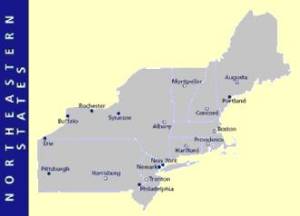
Despite the fact that some companies are fleeing the tightening space and rising rents of Manhattan's office market, New York is still the comeback kid of the century. After losing thousands of jobs in the late 1980s and early 1990s, it is now one of the few places in the nation that can win such projects as IBM's $2.5 billion chip fabrication plant -- the largest private-sector announcement in the state's history. IBM will create 1,000 new jobs at the new facility in the Hudson Valley Research Park, in East Fishkill, N.Y. The state's attraction efforts were key to IBM's decision to locate in upstate New York. Gov. George Pataki's Semiconductor Manufacturing Initiative, known as Semi-NY, provides an industry with pre- permitted, ready-to-go sites. The environmental review of IBM's site in East Fishkill, in fact, was completed nearly two years ago under the initiative. IBM's total incentives package over a 10-year span is likely to top $660 million. The package's key components are $475 million in tax breaks and $28.8 million in state grants and loans. "IBM is not just staying in New York; it is growing and investing in New York."
This is a big change from the time when IBM was considering leaving New York for greener fields, and Pataki had to convince the company to give the state another chance. "By leading the nation in tax cuts, reducing workers' comp rates, slashing job-choking red tape and making sound investments in education, we turned crisis into a comeback," said Pataki at the facility announcement. "Now IBM is not just staying in New York; it is growing and investing in New York." Pataki did not disappoint business leaders in 2000 with even more tax breaks and new incentives. Under the fiscal year 2000-01 budget, the gross receipts tax for manufacturers and industrial energy customers were eli minated, effective immediately. For other businesses, the tax will be eliminated over a five-year period. When fully implemented, the elimination of this tax is expected to create $330 million in savings. This year, Pataki's plans are to bring to upstate New York what is taking place in New York City today. He will build on last year's expansion of the Economic Development Zone, now called the Empire Zone program, which provides virtually tax-free locations within economically troubled regions in the state. In his State of the State address, he announced his plan to double the size of the 22 upstate Empire Zones. Each zone will be able to grow to 2,500 acres (1,013 hectares), including 1,800 acres (729 hectares) in areas adjoining distressed neighborhoods and 700 acres (284 hectares) anywhere the planners desire. Although upstate New York's economy has slowed since the 1990s according to many economic developers in the region, businesses continue to locate there. UnitedHealth Group's Uniprise division is investing $19.4 million and creating 1,172 new jobs in Ulster and Albany counties. Distribution seems to find upstate New York particularly attractive, especially Orange County. Kohl's is locating a 500,000-sq.-ft. (46,452-sq.-m.) distribution facility in the area, and Staples is investing some $40 million for a Northeast distribution facility in Montgomery, Orange County. Together the two projects will create up to 1,350 new jobs. The Empire Zone of Newburgh-Stewart will allow Staples to qualify for property, wage and sales tax benefits. In addition, the office supply wholesaler will be eligible for an ESD grant of $250,000.
TOP OF PAGE
|
|
©2001 Conway Data, Inc. All rights reserved. SiteNet data is from many sources and not warranted to be accurate or current.
|