Site Selection Online
Go to www.sitenet.com
A  SITE  SELECTION  SPECIAL  FEATURE  FROM  NOVEMBER 2001


The Heartland Hub

More companies are choosing Midwestern sites for logistics
and high-tech operations.

by RON STARNER
ron.starner@conway.com

C
all it the "Heartland Hub" factor. Corporate America, facing increasing pressure from Wall Street to expedite delivery of goods and services to market, is turning to the heartland of America for both logistics and high-technology operations.
      From the corn fields of Iowa to the urban centers of Detroit and Chicago, the face of commerce in the Midwestern United States is changing -- and the drive to streamline supply-chain management is making it happen.
      Never was this more apparent than in the immediate aftermath of the World Trade Center tragedy in New York on Sept. 11. Beyond the loss of life, companies in virtually every industry sector experienced supply-chain interruptions as America's air transportation network shut down. Manufacturing plants that relied upon airplanes to fulfill just-in-time inventory needs were idled for days.
      Suddenly, warehouses and ground connections -- two things the Midwest offers in droves -- were more important to business than ever.
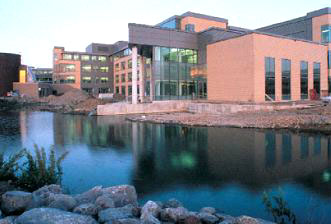
Minneapolis-based architects HGA designed the new campus for ADC Telecommunications in Eden Prairie, Minn. This Minneapolis suburb is part of a growing cluster of companies seeking an expanded presence in the Upper Midwest.

      But even before the history-altering events of Sept. 11, a growing number of American firms had discovered the advantages of locating their operations in the Midwest. In addition to its central location, the Midwest offers a number of things corporate America wants: an available supply of highly skilled labor; a telecommunications infrastructure that is second to none; road, rail and water connections that expedite delivery of goods to market; and a political environment that's putting its money where its mouth is by incentivizing facility expansions.
      Around the Midwest, these advantages abound. Consider the facts:
     
  • Chicago ranks as America's No. 1 market for business services, manufacturing, distribution centers and telecommunications. The Windy City is the country's No. 2 financial center, No. 2 in Fortune 500 headquarters and No. 3 in high-tech work force.
         
  • Cleveland ranks as one of the most wired cities in the world, with two Internet2 backbone networks and 30 Tier-1 telecommunications backbones providing an aggregate bandwidth estimated at 65.1 gigabits per second. Cleveland offers six telecom hotels providing tenants with 1.6 million sq. ft. (148,800-sq.-m.) of space in the city's central business district.
         
  • Dayton, Ohio, possesses a faster growing information technology work force than Boston Dallas or New York. From 1995 to 1999, Dayton's I.T. work force increased 24.8 percent. In a 2001 Brainbench study, Dayton ranked as the U.S. region with the seventh highest "I.T. I.Q."
         
  • Some of the best locations for small businesses call the Midwest home. According to the Small Business Survival Committee, Michigan ranks as the 12th best state in the nation for entrepreneurs, followed by No. 13 Illinois, No. 16 Indiana and No. 17 Missouri. The rankings are based on taxes, electricity costs, workers' pay rates, crimes and laws affecting labor unions.
         
  • Companies located in the Midwest grow faster than those in other regions of the country, according to the Brandow Business Vitality Review's Metro Area High-Growth Firm Index. Of the top six mid-sized metro areas in concentration of high job-growth firms, cities in the upper Midwest account for four of them. St. Cloud, Minn., ranks No. 1, followed by No. 2 Madison, Wis., No. 4 Appleton-Oshkosh, Wis., and No. 6 Duluth-Superior, Minn.-Wis.
         
  • The Midwest placed two states in the top 10 and three in the top 11 of Site Selection magazine's annual Business Climate Rankings. Illinois finished sixth, Michigan seventh and Ohio 11th.

      Numbers and rankings alone, however, can't tell the whole story behind the Midwest's revival. The real story can be found in the corporate real estate projects taking place across America's heartland.
     

TOP OF PAGE


©2001 Conway Data, Inc. All rights reserved. SiteNet data is from many sources and not warranted to be accurate or current.