

 The Heartland Hub (cover) St. Louis: The Next Memphis? Heartland Goes High-Tech ADC Brings High-Tech Look to New Midwest HQ In Michigan, a Call to Action Logistics Users Like Ohio Minnesota: Large Investments Flood Land of Lakes Request Information 
|

Heartland Goes High-Tech
Manufacturing and distribution facilities aren't grabbing all the headlines in the Midwest, however. The states in the heartland are increasingly going high-tech, and with good reason. Dennis Donovan, senior managing director of the Wadley Donovan Group, recently told a gathering of International Economic Development Council members in Philadelphia "why high-tech companies go where they go." Donovan identified the most important site selection criteria as critical mass of talent and universities; perceived quality of life; perception of the area as a high-tech locus; proximity to key supplier networks; and the availability of live/work/play campuses. "Areas not meeting these criteria must have an overwhelming uniqueness," said Donovan. "An extensive concentration within a particular region -- such as the metals industry in the Great Lakes' states -- can provide that uniqueness." In the case of the Midwestern U.S., several unique features make the region attractive to high-tech firms. One feature is the historical presence of some of the world's largest retailers, such as Sears Roebuck & Co. 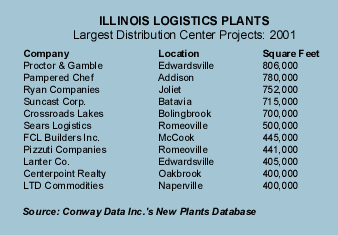
"Chicago retailers are adopting e-commerce strategies, and that will have huge implications for the high-tech sector in the Midwest," says Matthew Szuhaj, senior manager for the Fantus Consulting practice of Deloitte Touche Tohmatsu in Chicago. "But we also have a great quality of life. Chicago has an image of being cold and having long winters, but once you get people here, they realize it's a great place. Plus, with all the museums and symphonies here, Chicago is a great place for the arts." But is that enough to attract the giants of the Information Age? No, says Szuhaj. To be a real competitor in the new global economy, an area must provide an advanced telecommunications infrastructure -- the basic building blocks of the I.T. sector. In Chicago, that infrastructure includes the Chicago Network Access Point, the world's largest Internet exchange point by volume; North America's largest carrier hotel, the Lakeside Technology Center; the Science, Technology and Research Transit Access Point (STAR TAP), the only facility in the world that allows for a cooperative interconnection point among numerous international advanced networks; and the development of the most ambitious public-private fiber-optic network in the U.S., being spearheaded by the City of Chicago. "Chicago has undergone historic, radical changes in its basic industries," says Paul O'Connor, executive director of World Business Chicago. "We are no longer the steelmaker of America. We are no longer the hog butcher of the world. Today, our incomparable infrastructure in air service and advanced telecommunications set Chicago apart. Plus, we provide the diversified human capital that comes out of a diversified economy." Chicago boasts a $10.4 billion-a-year high-tech payroll and 235 percent more computer programmers than Silicon Valley. The Chicago area's business services employment has grown by 84 percent since 1990, with many of these jobs being created in the fields of software development, consulting and engineering. While the Boeing Co. headquarters relocation was the most publicized real estate deal of the year in the Chicago market (see the September Cover Story in Site Selection), it was not the largest. That honor goes to McCormick Place, the nation's largest convention center that is about to undergo a major facelift. The Illinois General Assembly passed legislation that will add more than 800,000 sq. ft. (74,400-sq.-m.) to McCormick Place. The $800 million expansion will be 70 percent financed by taxes paid by visitors to Chicago. A study by PricewaterhouseCoopers estimates that the convention center expansion will create 21,000 jobs, $2.7 billion in new economic activity and more than $80 million in new tax revenue for the city, county and state. "The expansion of McCormick Place ensures that Chicago will continue to attract large conventions and trade shows," says Pam McDonough, director of the Illinois Department of Commerce and Community Affairs. "These types of events not only provide a direct economic impact to the regional economy. They also provide a tremendous opportunity to showcase Chicago and Illinois to visitors who may plan return trips."
TOP OF PAGE
|
|
©2001 Conway Data, Inc. All rights reserved. SiteNet data is from many sources and not warranted to be accurate or current.
|