Visuals are key in driving a director’s vision forward, and lay a vital foundation for drawing an audience into the narrative’s reality.
“Yellowstone” — a dramatic television series following the lives of a complicated Montana ranching family defending their land — captivated millions of viewers across its 53-episode run. Its Western themes naturally brought Director Taylor Sheridan from California back to his Texas roots to shoot portions of the show throughout its five seasons.
At the same time, Sheridan continued to expand his production portfolio alongside Paramount Television and began capitalizing on diverse filming locations within the Fort Worth region, developing a keen interest in growing the local film industry.
Down the line, 101 Studios Founder and CEO David Glasser — who handles production for Sheridan’s projects — and Hillwood President Mike Berry met to discuss sustained film production growth in the region and the blatant lack of studio space. Hillwood, a leading real estate investment and development company, spent the next few months gaining an understanding of sound stage development.
An Ideal Coincidence
The company has been behind the development of the 27,000-acre master-planned community and global logistics hub AllianceTexas for over 30 years in Fort Worth. Berry says Hillwood’s ongoing Industrial Development Program just so happened to lead to the availability of two twin industrial spec buildings in the heart of AllianceTexas, ideally located next to the Perot Field Fort Worth Alliance Airport in Alliance Center.
“Each building was 225,000 square feet and they were side by side,” says Berry. “We sat down with Glasser and his team and we ended up designing a system which basically included three major additions to the buildings, which were not designed as sound stages but have the same characteristics.”
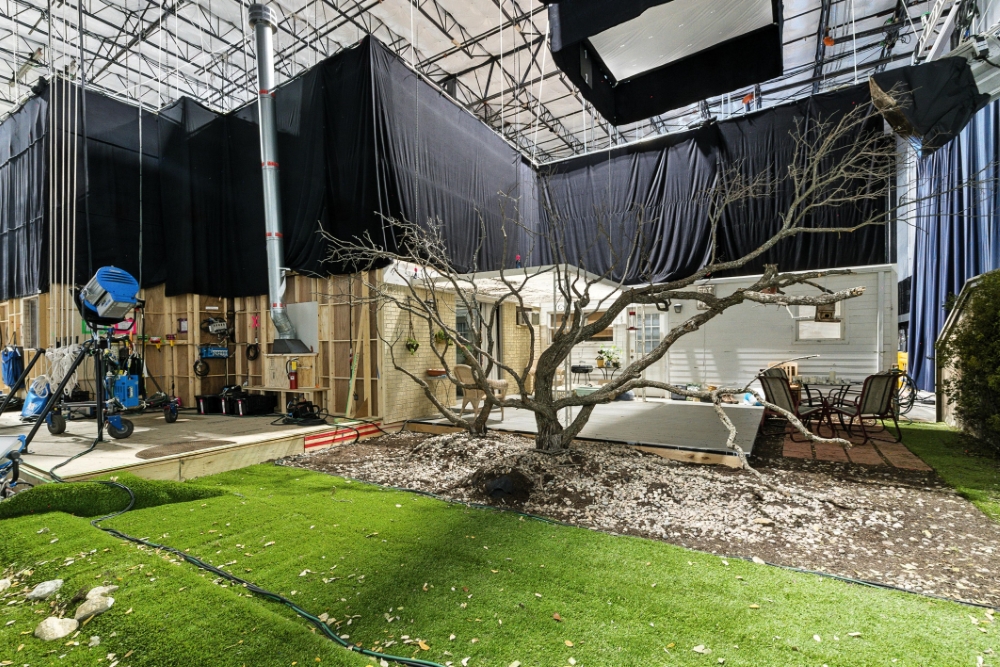
It wasn’t a matter of complete transformation but rather taking a standard industrial product and converting the interior. The three additions included building large sound walls with insulation, installing HVAC and running power. By March 2025, sound stages at the new SGS Studios site came to life filming for Sheridan’s new projects such as “Lioness,” “Landman” and “Madison.”
“They just started growing and we kept adding sound stages,” says Berry. “Now, total square footage is 450,000. We’re the largest sound stage under one roof in the state of Texas and the simple part of the story is that we did it using our standard industrial building.”
SGS Studios now houses five sound stages ranging from 20,000 to 80,000 sq. ft.; up to 38-ft. ceilings; a 256,000-sq.-ft. base camp area; and on-site parking for up to 750 workers. The site allows for production to move to and fro with ease, supported by the Perot airport and direct access to Interstate 35.
With a genuine chuckle, Berry notes that welcoming a film studio to the AllianceTexas campus was certainly not thought of in Hillwood’s original master plan, albeit the initiative ended up being a perfect fit. The “fascinating” industry is unlike any Berry has had the chance to encounter, although Hillwood’s infrastructure approach provides the flexibility to accommodate the needs of a variety of industries. In this case, Hillwood’s infrastructure ensured the region would welcome a major economic driver.
The City of Fort Worth ended up designating the SGS Studios site as a Media Production Development Zone in December 2024, allowing for a rebate of sales taxes on construction materials. Since Hillwood already had the facilities built, this incentive only helped when finishing out the shell buildings, although future expansion plans expect to take full advantage of this designation.
“We’re beginning now to talk about expanding or building a second campus,” says Berry. “We kind of maxed out this site, so we’re looking at designing and building a larger campus where we could add up to 10 additional sound stages.”
Shaping Local Talent
Aside from building up industry assets, SGS Studios has also taken an interest in how it can cultivate a robust talent pipeline to support upcoming productions.
In partnership with 101 Studios, Tarrant County College (TCC) and the Fort Worth Film Commission developed three certificates that prepare students for entry-level film industry roles. The available certificates cover Grip and Lighting, Hair and Makeup and Light Commercial Construction and are open to students at TCC’s Northwest and South campuses, as well as on its online platform TCC Connect.
“As part of this partnership, TCC and SGS Studios are exploring opportunities to align with one or more of the program’s existing certificates — or potentially the full suite of certificates currently offered and those planned,” says TCC Executive Director of Communications Cecilia Jacobs. “This collaboration underscores a shared commitment to preparing students for success in the film industry through cutting-edge curriculum and real-world experience.”
Jacobs says recent coverage of SGS Studios’ opening this year has led to an influx of inquiries about the Fort Worth Film Collaborative Certificate Program, not only from local students, but students around the nation considering relocating to the region to take advantage of this training opportunity. The initiative is still relatively fresh, although it will continue to evolve its educational training offerings as the local industry aligns.
“While state guidelines for industry and higher education partnerships under the Texas Film Commission Workforce Incentive Uplift initiative are still being finalized, TCC’s vision for this collaboration is ambitious,” says Jacobs.
The team is now working to establish advisory boards for each current and upcoming certificate program, which will play a crucial role in shaping new curriculum that aligns with the industry’s evolving standards. TCC hopes to secure advisors from SGS Studios and other leading production studios in the Dallas/Fort Worth region.
So far, over 150 students have come to TCC to pursue one of the three certificate programs, which are expected to impact more than 300 students as interest continues to grow.
“The partnership is expected to include job opportunities, work-based and service-learning experiences, and scholarship funding — creating a robust pipeline for talent and strengthening North Texas as a premier destination for film production,” says Jacobs.