by Savannah Yawn
Germany’s defense-industrial expansion is creating a new wave of manufacturing investment across the country. German defense expenditures rose from €52.4 billion in 2021 to €107 billion in 2025 and are projected to reach €108 billion, or 2.5% of GDP, in 2026, according to Germany Trade & Invest.
But Germany is not building that capacity from a blank slate.
“Germany combines rising demand with one of Europe’s deepest industrial and innovation bases,” says Christoph Mester, Germany Trade & Invest defense expert. “This creates credible entry opportunities for established defense companies, dual-use technology providers and specialized suppliers seeking to scale in Europe.”
One of the clearest examples is in Unterlüß, Lower Saxony, where Rheinmetall invested nearly €500 million in a new ammunition production facility at its existing site. The plant can produce up to 350,000 artillery shells annually once fully ramped.
A second major investment is taking shape in North Hesse. Rheinmetall announced in August 2026 that it will develop a new logistics and technology center at Kassel Airport in Calden. The investment is in the hundreds of millions of euros and includes a logistics center, as well as plans for a drone test center.
At Unterlüß, Rheinmetall says the historic site offered extensive security infrastructure, large open spaces and direct links to existing production and testing facilities, allowing the company to expand its artillery ammunition value chain rapidly. At Kassel-Calden, the deciding factors were different: strong transportation connections, proximity to Rheinmetall’s existing plant and available land.
A Defense-Tech Ecosystem Takes Shape in Bavaria
Bavaria is home to around 200 defense companies employing approximately 50,000 people, according to the Bavarian Ministry of Economic Affairs, Regional Development and Energy.
Helsing plans to acquire roughly 250,000 square meters (nearly 2.7 million sq. ft.) in Hallbergmoos for a new Resilience Factory with automated assembly lines for defense equipment. The project represents an investment in the hundreds of millions of euros and is expected to create around 300 direct jobs.
The company selected Hallbergmoos following a nationwide site search. According to the ministry, the location offered access to the Munich metropolitan area’s network of defense and technology companies and skilled talent. Proximity to Munich Airport and Helsing’s German headquarters in Munich also factored into the decision.
According to the Bavarian Ministry of Economic Affairs, Bavaria’s established manufacturers and specialized suppliers give defense-tech companies access to production capacity, experienced workers and mature supply chains that can help move technologies from prototype into series production.
The ministry points to more than €1 billion in scale-up funding for Bavarian defense startups in 2025 and 2026, including €600 million in Helsing, as evidence of the sector’s momentum. The Bavarian Defence Industry Promotion Act, effective May 1, 2026, is intended to accelerate construction and planning procedures.
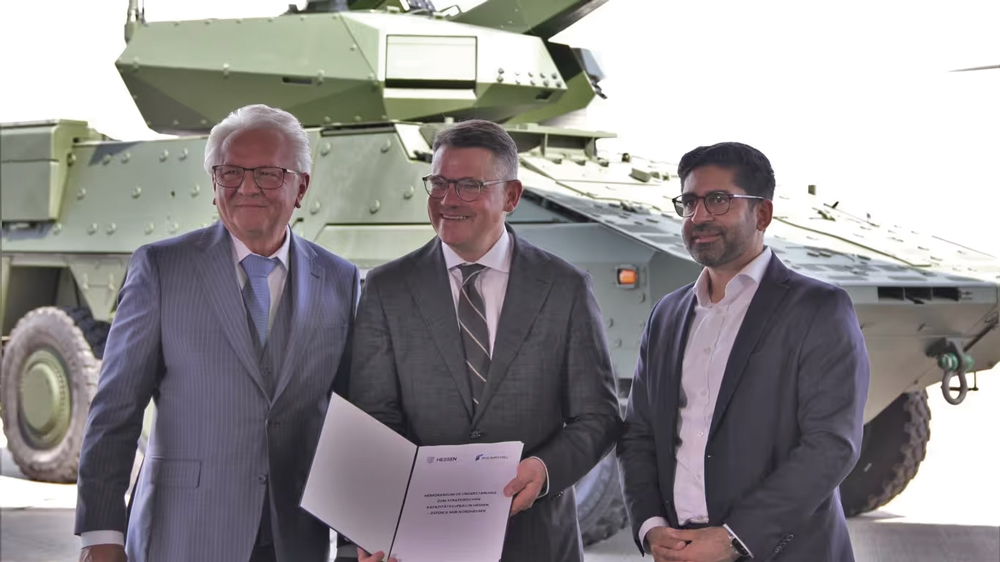
Rheinmetall CEO Armin Papperger, Hesse Minister-President Boris Rhein and Deputy Minister-President Kaweh Mansoori announce plans for Rheinmetall’s North Hesse Defence Hub.
Photo courtesy of Rheinmetall
A Faster Path to Production
In Görlitz, KNDS is converting a former Alstom rail factory into a defense manufacturing site. Since acquiring the site in February 2025, the company has converted more than half of its 70,000 square meters (753,000 sq. ft.) of production space and expects to employ about 400 people there by the end of 2026.
The site offered KNDS something difficult to reproduce quickly through a greenfield project: an existing workforce with extensive metalworking experience.
“People who have built bodies for double-deck coaches know how to weld, assemble and inspect large, complex steel structures to strict quality standards,” says a KNDS spokesperson. “That know-how cannot be bought off the shelf.”
“The biggest advantage is time,” says the spokesperson. “A greenfield plan takes years of approvals and construction. In Görlitz, first personnel transfers and the start of production were planned for the same year the agreement was signed.”
Germany Trade & Invest sees additional potential for this kind of industrial conversion elsewhere.
Mester points to the proposed new security and defense focus for Volkswagen’s Osnabrück plant as one example. Rafael Advanced Defense Systems was identified as the first prospective industrial partner.
“The case illustrates how in Germany an established automotive site, skilled workforce and industrialization expertise can be repurposed while preserving high-value manufacturing capacity,” he says.
Multiple Clusters, One Industrial Shift
Germany Trade & Invest identifies Munich and Bavaria as a center for aerospace, land systems and defense technology; northern Germany for naval systems, shipbuilding and aerospace; North Rhine-Westphalia for land systems and munitions; and Berlin for artificial intelligence, cyber and dual-use innovation.
“For investors, the result is not one single national cluster, but several specialized ecosystems with distinct market-entry opportunities,” says Mester.
Across Germany, the defense buildout is drawing on industrial capabilities accumulated over generations. Existing factories, skilled manufacturing workers and specialized regional ecosystems are giving companies ways to add capacity quickly as Europe’s security environment changes.