When Greater Fort Wayne Inc. cultivated a visionary economic development action plan for the City of Fort Wayne and Allen County — its first in over a decade — the team noted the importance of the region finding its “swagger” to achieve full economic potential.
Officially launched in January 2022, the Allen County Together (ACT) plan presented three guiding principles: accelerating high-growth economic development opportunities through targeted infrastructure investments; enhancing resources and support catered toward entrepreneurship, innovation and widespread adoption of technology; and investing into local business, talent and real estate development that ensures inclusive regional growth.
As the second fastest growing metro in the Great Lakes region for the seventh year in a row, behind No.1 Indianapolis as of 2024, the arrival of ACT has already proved beneficial in garnering further momentum.
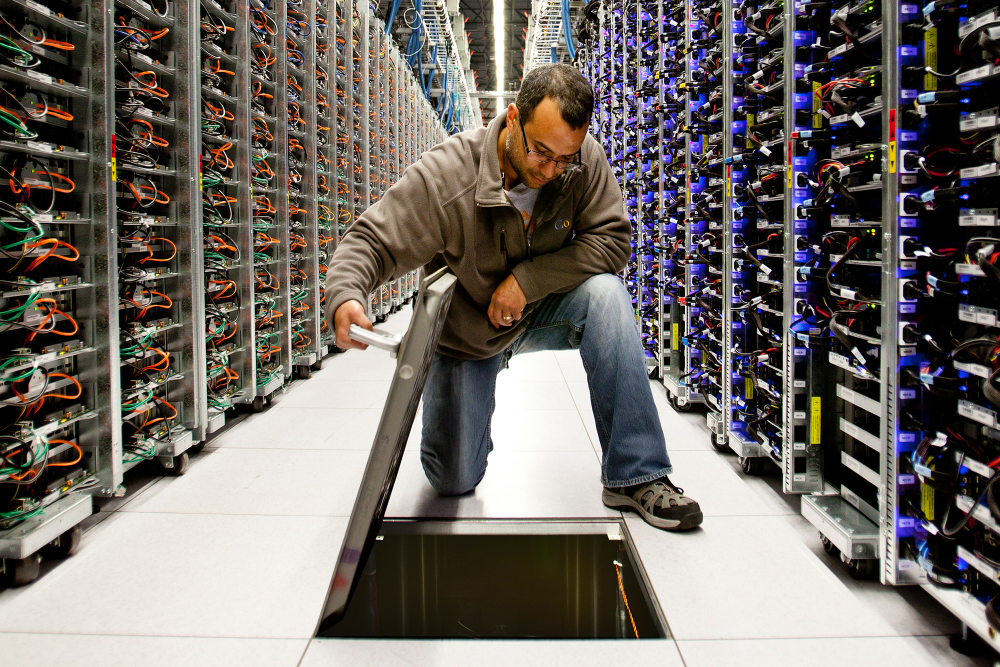
Rumors began to swirl about the major developer behind a massive 700-acre data center campus, dubbed “Project Zodiac,” coming to Fort Wayne in late 2023. A few months later, Google confirmed the company was indeed making its entrance into the city and the state, marking it with the $2 billion project investment.
Talk about swagger.
“From our perspective, Google landing a major data center here — one of the company’s largest and most technologically advanced AI data center campuses — is a testament not just to the company, but to what we have going on here locally,” says Greater Fort Wayne Inc. President and CEO John Urbahns. “Having Google here really helps prove that there’s great opportunity for tech in our region.”
Prepped For High Tech
Google broke ground on the Fort Wayne data center campus last year, located on the southwest side of the city. Initial development plans proposed to the county would bring 12 data center facilities across the site, although Google has not publicly released any additional details.
At the time of our conversation, Urbahns was unable to delve into specifics, but said the project’s first phase is still underway, noting strong construction activity continues at the site. When asked about Google’s initial site selection process, he shared that Indiana Michigan Power (I&M) played a key role in helping the company navigate its first data center development in the state.
“They were looking for opportunities to help Google grow their footprint and our relationships,” he continues. “Not just with [I&M], but also with our water utility in the community, for them to know where we were at and how we had positioned our water utility to be ready for significant heavy users. There was a good intersection of electricity and water for the site that was chosen.”
In August 2025, it was announced that Google and I&M had filed a joint contract to the Indiana Utilities Regulatory Commission (IURC) for a custom Demand Response structure agreement. Demand Response programs through I&M are available to residential, commercial and industrial customers and will allow Google to reduce or shift electricity demand for non-urgent tasks during hours the electric grid is under less stress.
“The strategy could not have materialized without Google being able and willing to engage, or without I&M’s interest in exploring the proposal,” says I&M Communications Specialist Kara Stevenson. “From our perspective, the strategy provides a unique opportunity to both support Google’s commitments to clean energy and innovation while providing long-term benefits to resource adequacy, reliability, resiliency and affordability for all of I&M’s customers.”
In the region of Google’s site, the grid is typically least stressed during overnight hours between 9 p.m. and 7 a.m., states Stevenson. This move enables I&M to reduce peak loads when energy demand surges, thus lowering energy costs for all customers. The duo’s initiative includes Google transferring capacity from its carbon-free energy resources, such as solar or wind, to I&M that will aid in meeting its resource requirements set by PJM Interconnection.
“Collaborations like this lessen the long-term financial commitments I&M needs to make to acquire and operate the generation needed to provide service to its customers,” says Stevenson. “Google remains responsible under the arrangement for many of the risks associated with the generation resources whose capacity will be transferred to I&M, lifting that burden off the company and its other customers.”
As construction continues in Fort Wayne, Google and I&M await approval from the IURC, which is anticipated to be finalized in the first quarter of 2026. Aside from delivering fresh digital infrastructure, Google has already partnered with Ivy Tech Community College’s Fort Wayne campus to launch its Skilled Trades and Readiness (STAR) Program.
Google’s project will create 200 direct jobs once complete, although the greatest community impact comes from the over 1,000 construction-related jobs created in the process. STAR provides paid short-term training, averaging five to six weeks, for entry-level construction and skilled trades careers. Trades of focus students can explore besides construction include carpentry, mechanical, electrical and fiber-optics programs. In December 2024, 12 students graduated from Ivy Tech’s initial cohort, each securing a role at either the Google site or with a sponsor company on a local community project.
“Having Google here really helps prove that there’s great opportunity for tech in our region.”
— John Urbahns, President and CEO, Greater Fort Wayne Inc.
“It’s not just tech jobs at Google, it’s all the trades that go into the building of the facility. This is going to be, potentially, a 10-year construction site with more than 1,000 people working there daily, so electricians and other contractors are big suppliers to that growth,” says Urbahns.
The arrival of Google in Fort Wayne subsequently served as a catalyst in attracting new potential data center developments to the region. Urbahns recalls an influx of interest following the project’s original announcement, although he says the city is remaining cautious of how these initiatives move forward.
“We’re making sure we’re working with our energy and water partners to support the growth that we have. Google is our first large-scale data center,” he says. “We’re open, but we’re cautious in making sure that water and electric loads are where they need to be. We can only grow at the pace of the growth of those utilities.”