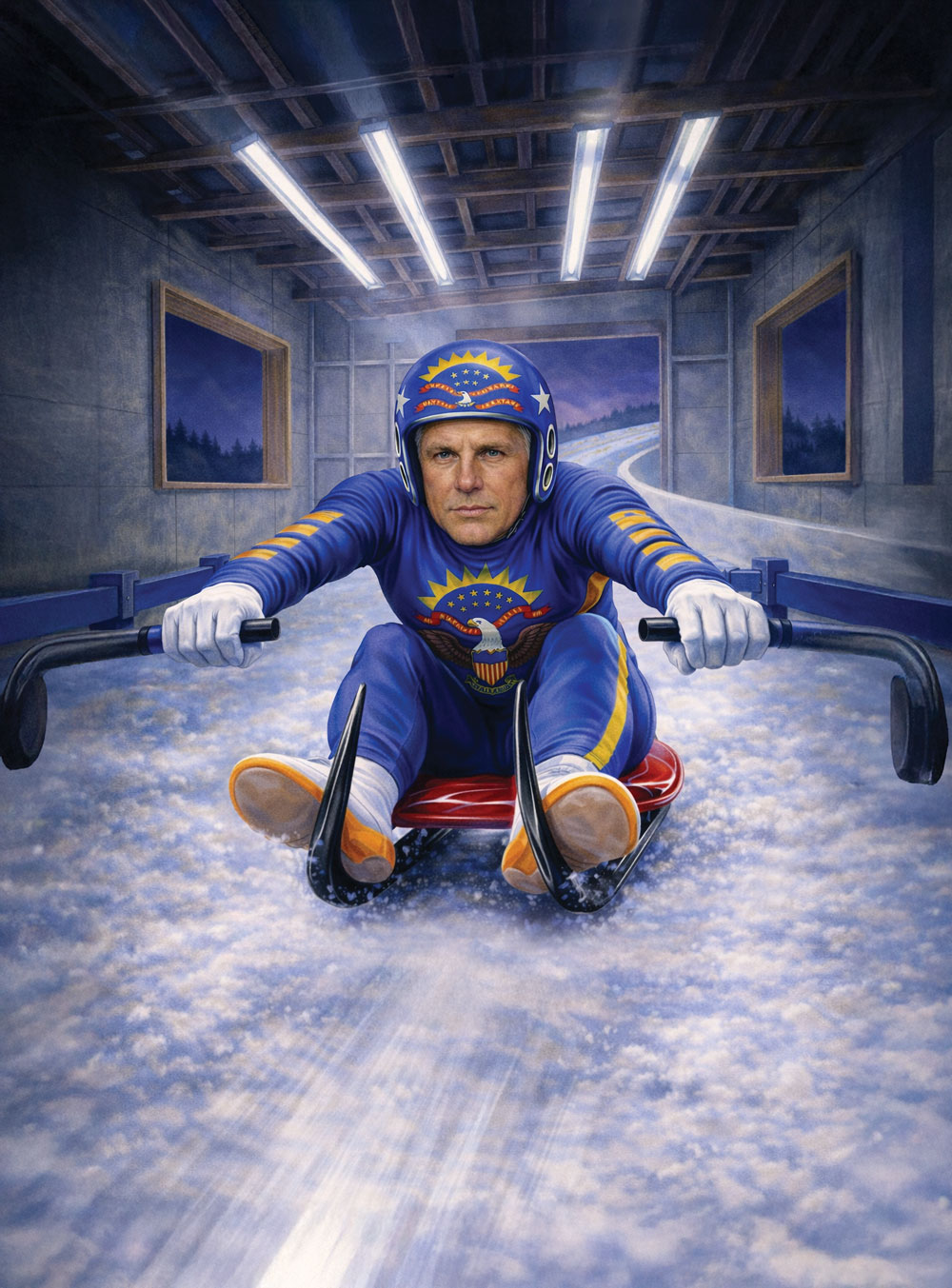
North Dakota unseats South Dakota to grab the per-capita Governor’s Cup.
Upstart North Dakota has rocketed from a formerly low-ranked state for corporate facility projects to this year’s per-capita Governor’s Cup winner. It’s tempting to think the state came out of nowhere. But it’s always been somewhere special. Just ask all the people making it home.
“North Dakota continues to see steady growth and attract new residents as one of the best places to live, work and raise a family,” said Governor Kelly Armstrong in January in announcing the state’s official population had grown for the fourth consecutive year and was nearing 800,000. “From historic property tax relief and reform to phone-free schools and robust economic development, our state made significant progress this past year to improve the quality of life for our citizens, which will always be our top priority.”
The state’s working-age population also has grown for three straight years to 473,249, the highest since 2020. North Dakota ranks No. 14 in the nation for per capita population growth, growing about 50% faster than the national average. The state has grown by nearly 19% since 2010.
Growing places, growing crops and growing companies were among the topics covered in my recent conversation with Gov. Armstrong, an avid baseball fan, during Super Bowl week. I said that meant it was only a couple weeks until pitchers and catchers showed up for spring training, to which he replied, “Correct. Everybody in Seattle is rooting for the Seahawks, everybody in Foxboro is rooting for the Patriots, and everybody else is rooting for Opening Day.”
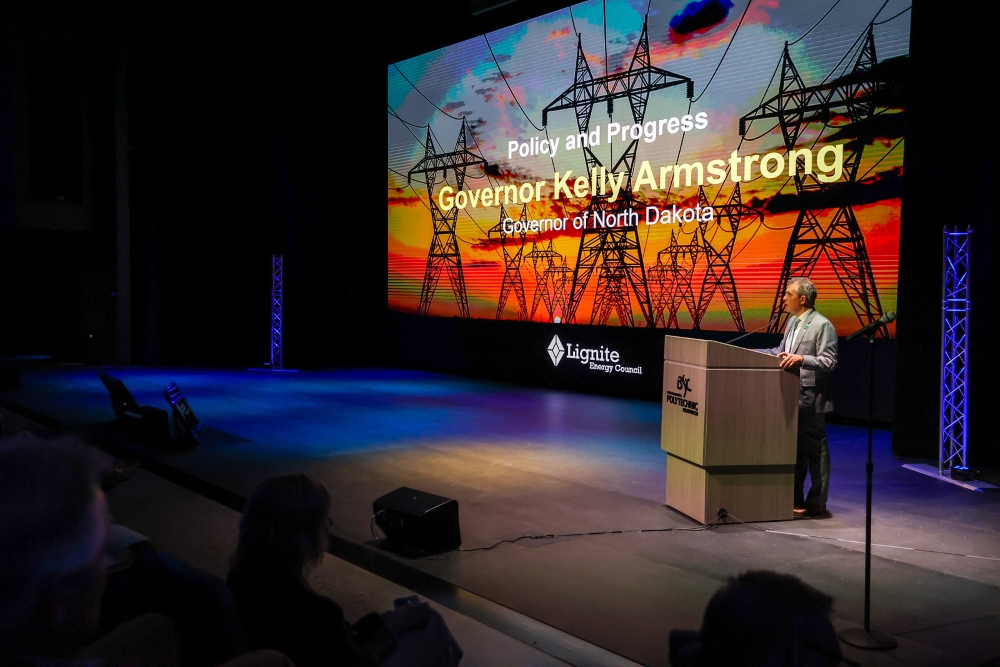
North Dakota Gov. Kelly Armstrong spoke to the Lignite Energy Council at the organization’s annual meeting in November.
Photos courtesy of the Office of the Governor
This Q&A has been edited for clarity and brevity.
Site Selection: In interviewing Texas Governor Greg Abbott, whose state once again has won our Governor’s Cup for most projects, I was asking him about similarities between the two places — a sense of freedom, a really strong focus on AI data centers and energy. What are your observations about similarities between Texas and North Dakota?
Gov. Kelly Armstrong: This goes to when I was in Congress. I used to do a lot of events with a lot of the Texas delegation, because there are so many similarities between the Permian and the Bakken and all of that, and I used to tell everybody, “I do the job of 34 Texans.” It’s ag and energy. It’s not the whole state for energy, but it still drives a lot of the revenue there. The vast majority of site locations for any oil well in either Texas or North Dakota are in either ag land or pastureland. We don’t have Houston or Dallas, but in those two spaces, we have a lot of the same companies — there’s just not that many companies that drill into shale rock, right? So the companies that are up here are the companies down there, and for all of the heat they take in some circles, they’re actually really good corporate citizens, and they’re smart about how they do things. When you have a massive shale play, whether it’s the Permian or the Bakken, that expands as quickly as those two expanded, and you have conservative states, you need a new regulatory environment, but you need to be careful that you don’t over-regulate and micromanage. That was always my frustration in D.C. We want regulation that’s adaptable and easily changed to take new technology into account, and you can do that significantly better at the state level than you can at the federal level. Federal regulation is not nimble, whereas out here, if one of these companies develops a better thief hatch, we want results-driven regulation, not technology-specific regulation. I think they’ve done a really good job of it, and we have as well. They’re a little closer to market than us, so that’s a pretty good advantage. They have winter every three years. So that’s an advantage. But we we learn from each other. Hydraulic fracturing and horizontal drilling were invented in Texas. They were perfected in North Dakota.
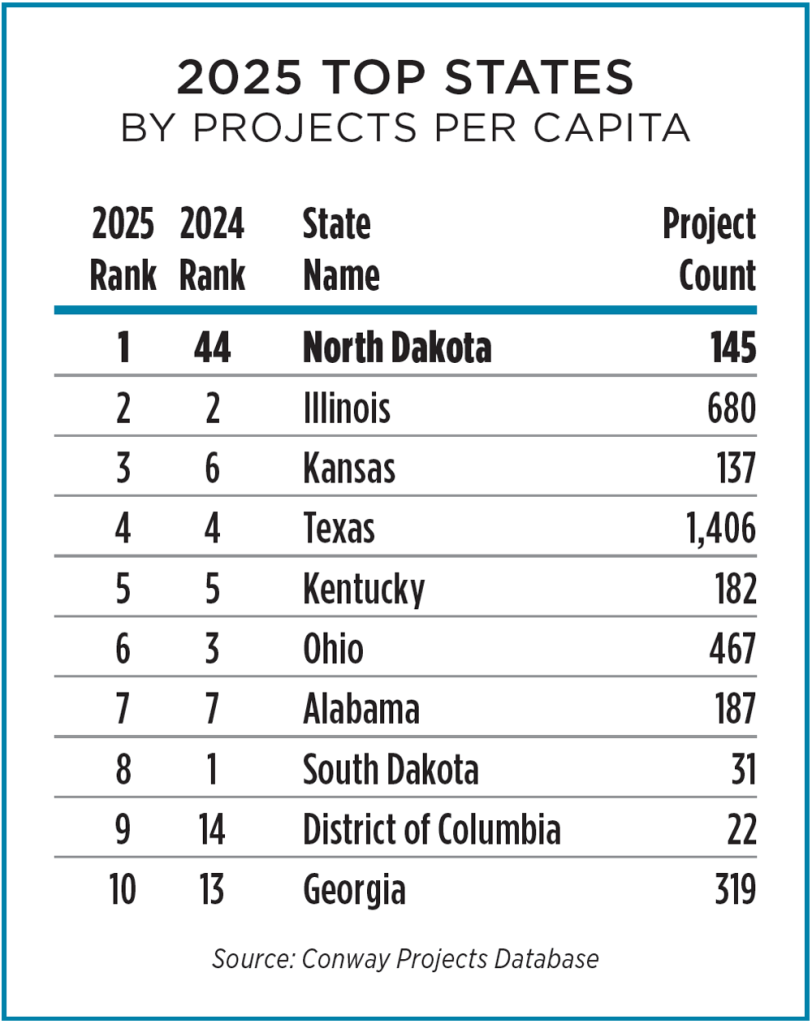
We do this tally of qualifying corporate facility projects every year. For the past several years in a row, we had very low numbers from North Dakota and then saw a dramatic rise this year. How do you account for the state coming out of nowhere to top our per-capita rankings?
Armstrong: From your side, we came out of nowhere. I don’t think we really did come out of nowhere. This is how we approach things — build the infrastructure out, make sure you’re ready to create the infrastructure before you bring these things in. I’m the first governor in my lifetime that didn’t run on jobs, jobs, jobs. We want a holistic approach to economic development, and so you have to build out the infrastructure. Where a lot of the natural resources are is not necessarily where a company not from North Dakota is looking to settle, right? You think North Dakota, you think Fargo, you think Bismarck, you think Grand Forks. I think the groundwork for this was set over the last two or three legislative sessions and under Governor [Doug] Burgum’s leadership, and then we get to come in and really operationalize things that were put in play a long time ago.
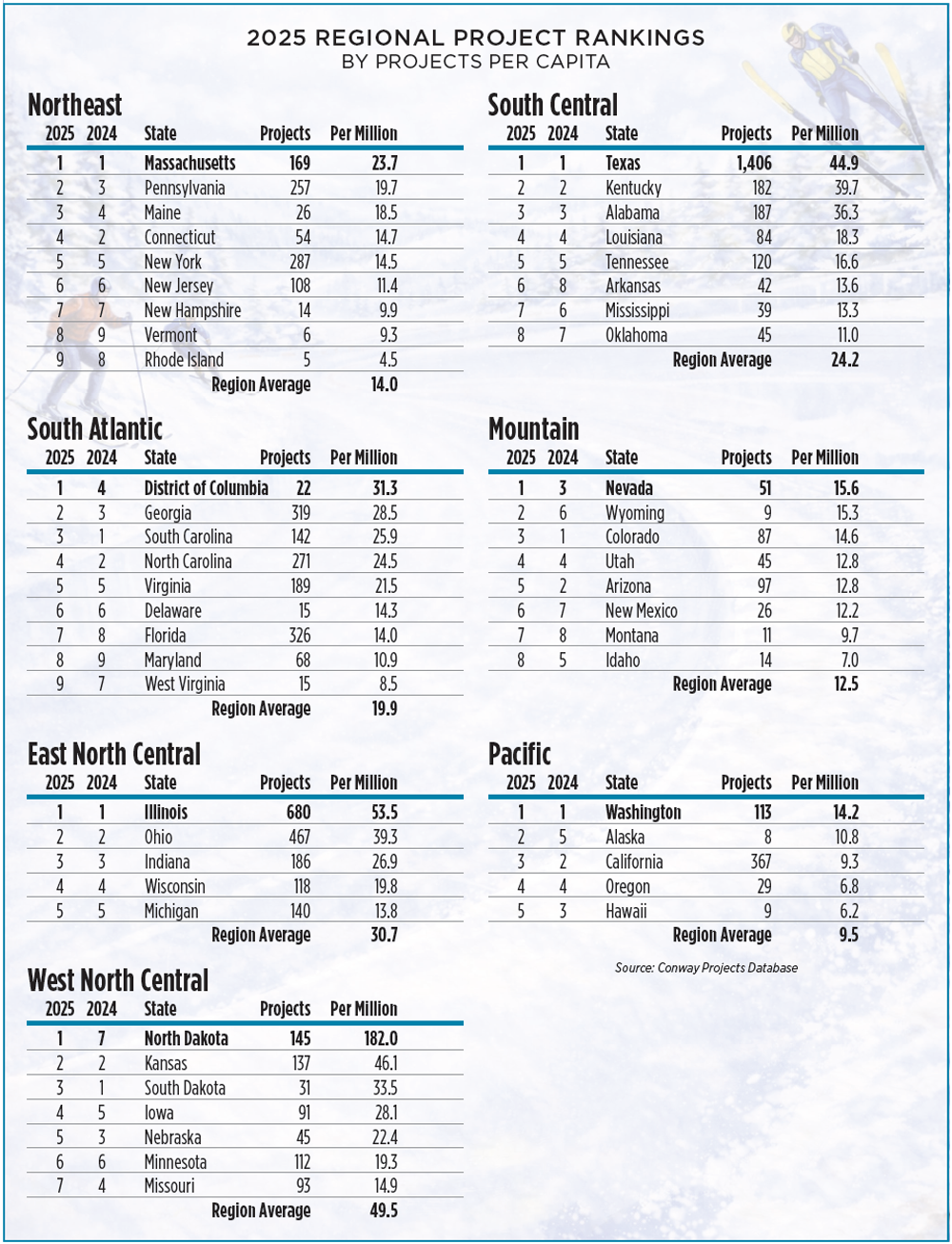
Photo: Getty Images
Our rankings in this issue also include top-ranking metro-area numbers from Fargo, Grand Forks and Minot in their respective population categories. What are your observations about economic momentum in various cities across the state?
Armstrong: You just picked three that are very different, but they have one thing in common. They have really good local support for this type of stuff. For economic developers who are trying to bring somebody in, I’m the closer. You can’t bring somebody in if the community is not engaged in doing it. There’s just no way to do it. You have to have local buy-in. You have to have forward-thinking county commissioners, city commissioners, economic development councils. All three of them are great, but I’ll use Grand Forks specifically as an example in that they’re always thinking about how to use the synergies up there, from the Air Force Base to Grand Sky to a really engaged business community to also being in the Red River Valley, which is the most fertile farmland in the world. When they make missteps, they don’t go back and start from zero. They start from 70% of the way there. They’ve really recognized that dynamic failure is part of this equation. And so instead of just going back to the drawing board, they get to “All right, where did this go offline a little bit?” And they start there and work their way forward again. The Agristo project up there is a really good example of that. It’s a potato processing plant that went in an area where they had had a previous pretty significant and eventually politically charged economic development plan that fell apart. Instead of just abandoning it and taking the politically easy route, they just went right back to work to try and recruit somebody in the similar vein to come in and utilize the things that are available around there. [Belgium-based Agristo is investing $450 million in the project, backed by incentives supported by a new law passed last February. A ceremonial groundbreaking is scheduled for April 2026.]

“I don’t think I’ve ever been accused of not having the political courage to tell people things they might not want to hear.”
— Kelly Armstrong, Governor of North Dakota
One aspect of our project tallies is that a $1 million food processing plant in a rural county counts the same as a multi-billion-dollar data center building. What’s your perspective on rural economic development?
Armstrong: I think for as big as North Dakota’s growth has been for the last 20 years, the one thing we’ve noticed is our larger communities are growing, but we have a lot of our smaller communities that are either treading water or shrinking, and the ones that are doing well have that one corner business. I have two overall general philosophies for rural economic development. You don’t have to hit a grand slam in the bottom of the ninth. A double off the wall is great. If you have one of those corner businesses in one of in our small towns, those are the towns that end up doing well. I think what [North Dakota Commerce Secretary] Chris Schilken and Commerce are doing in working with those communities in those areas, and engaging their economic development councils on site readiness, is something that’s going to be really important moving forward.
From the state level, we’re trying to move natural gas from the northwest part of the state all the way to the eastern part of the state. As valuable as gas is to everybody, it’s a waste product for associated oil, right? It’s associated gas. When you strand gas, you get less oil production, and nobody wants to flare anymore. We have communities all across that pipeline that, once they have access to reliable power and they have a good site readiness proposal, those are two of the basic ingredients to coming out and recruiting people.
Then you have other options. In Spiritwood, we have a soybean crushing facility. It’s two of our great corporate sponsors and citizens, ADM and Marathon, so it’s ag and it’s energy. We’re taking Red River Valley soybeans, we’re crushing them in Spiritwood and we’re creating renewable diesel in Dickinson, North Dakota. It isn’t east vs. west. It’s using the natural resources we have, putting it together in a place that really could utilize that economic input. We’re really proud of things like that, because they use what North Dakota does well. We want to recruit companies that fit into the North Dakota business landscape. Data centers are different, and AI factories are different, because we just, quite simply, have so much of the natural resources that they’re looking for. But when you’re talking about small town economic development, you don’t always need Applied Digital, right?
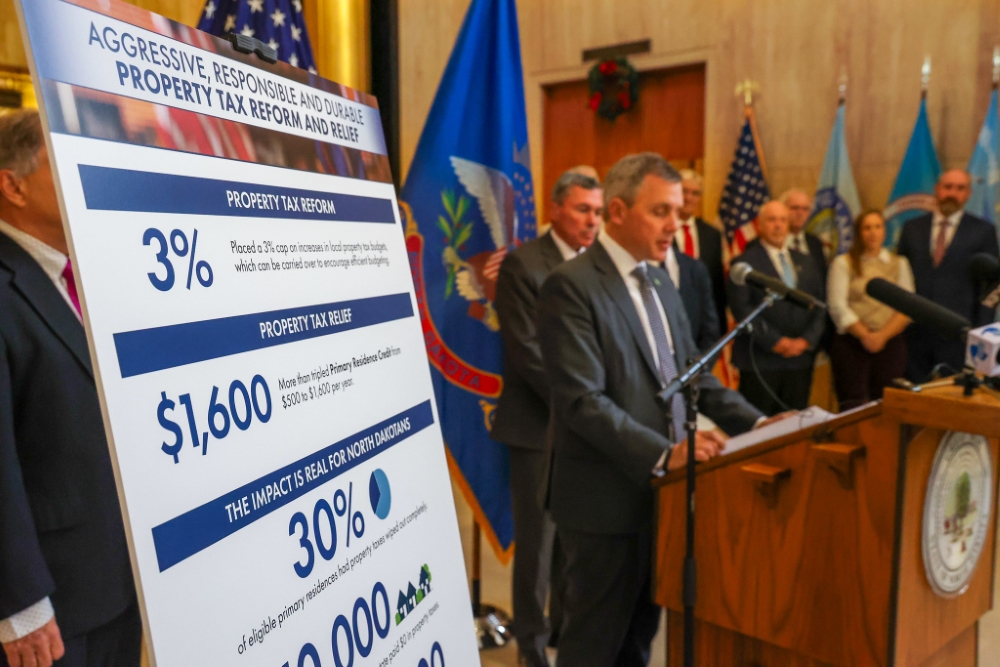
Gov. Armstrong in December highlighted relief being provided by the $1,600 Primary Residence Credit (PRC) approved last spring, while also emphasizing the need to grow the credit in future legislative sessions to eliminate property taxes for even more households.
Walk me through an example or two of company location or expansion projects that came to fruition last year that involved you in the site selection negotiations.
Armstrong: We have a biannual legislature, and Agristo turned into a real issue because I had been elected governor but hadn’t been sworn in as governor yet, and we were competing with another state in a real, meaningful way. Because Grand Forks had done such a good job in recruitment and communication with this company, we had set up several different calls and meetings with them, and I’m in the untenable position of telling them, “Nobody’s calling a special session right now. We’re going into session in three weeks. I’m not even sworn in as governor yet, so I can legitimately make you no promises, but I can tell you that you have the right local group that is working with you in in Grand Forks Economic Development. And I can tell you, you have a governor who’s getting sworn in in a couple of weeks that’s going to be really excited about this project.” Instead of having your normal political conversations, my takeaway from that was, one, Grand Forks had done 98% of the work. What they needed from me is a 2% guarantee that I couldn’t give the company — I couldn’t give it to them! I think the blatant honesty and the enthusiasm and the small town, small city family values really stuck with that company, and they’re here now. In the negotiation, there was one side giving the guarantees, and there’s one side who couldn’t give guarantees. And we still landed that plane, and they’re still coming to Grand Forks. I used my old defense attorney persuasion, I guess. But I’m serious, I was 2% of that equation. Grand Forks — it never would have happened if they wouldn’t have done the work on the front end.
When you speak with executives from North Dakota companies or from international conglomerates, what are they telling you is important to them?
Armstrong: Site selection. I think that is really huge. And then natural resources. We’re blessed with water and natural gas infrastructure. I think the other answer, which is a little less definite, is there’s a lot of “not in my backyard” on everything right now. So having a government that’s open for business. I also think they like our thoughtful approach. Our version of economic development is, “You can’t come in and poach all my teachers and cops.” We want a synergetic effect to how you come in. They like the fact that people want them in their community, but they want them to be a part of their community. I mean, it’s hard to convince somebody to move to Ellendale, North Dakota. But once they get here, they like it. It’s not for everybody. If you’re not good at winter, that’s fine, but it turns out, we’re welcoming communities. When people are excited to have you here, that makes it a lot easier for your temporary workers who build it and your long-term workers who stay here. You know, everybody who loves a big city, by the time they’re 32 or 33 and have two little kids at home, five star restaurants and Broadway plays aren’t really part of the equation anymore. Now it’s about how good are your schools? How safe are your communities? How welcoming are the places you’re coming to? I think that’s just one thing North Dakota offers in spades. And a government that wants to find a way to get to yes, instead of just saying, “No, you can’t do that.”
Chris Schilken has said you want the state to be more operational than aspirational. Give me a concrete example of putting that thought into action.
Armstrong: The gas pipeline is a good example. And by the way, when I say operational versus aspirational, I have the luxury of doing that because I’ve had four governors before me that have helped create this massive growth. My point is we have to be able to operationalize that. CTE schools, kids graduating from college at NDSU [North Dakota State University in Fargo] and Valley City State that are interested in the types of jobs that these companies are bringing in, particularly in the tech space, creating those synergies. You’ve got Grand Farm in Fargo starting a tech park. You’ve got Bobcat in Wahpeton, so you can train your robotics engineers, your robotic technicians. You’ve got a great international company that will, when you create those synergies, be more interested in buying into that, so we’re making sure we’re deploying the human resource and the ability to structurally do that. The other thing that I think, from an operational standpoint, is really important to everybody as a whole is we’re creating the universe so everybody has a fair shot. We’re creating the highways and the pipelines and the power and the ability, and that’s where the local economic development councils come into play. I want to put my thumb on the scale for anybody. I want to create an open playing field where everybody who’s looking at this space and dealing with a community and dealing with the infrastructure knows that there’s not secret deals being done in the governor’s office that have already picked your opponent … When you’re recruiting and attracting people to come here, we want them to know they all got a fair shake, and they have every opportunity to do this. And then we advocate for them. It’s almost never the majority in any community … it’s a really loud minority that don’t like anything. And so we’re here to help them, you know? We’re not spinning a narrative, we’re telling the truth. We’re there to back them up, and they know that, and that’s helpful. I don’t think I’ve ever been accused of not having the political courage to tell people things they might not want to hear.
What’s the most compelling workforce or industry partnership you see emerging from the state’s universities and community colleges?
Armstrong: There’s one in West Fargo that is going to be great. There’s a company called Magnum Electric out there that built their own CTE school [PowerHouse]. They didn’t ask for any state money. They don’t require them to work for Magnum Electric. They’re just like, “We have to have more electricians.” Up in Grand Forks you’ve got the Cavalier Space Force Station at Grand Forks Air Force Base. You’ve got the best aviation school in the country — I don’t care what Embry Riddle tells people. And you’ve got FAA line-of-sight waivers and Grand Sky and an unmanned aircraft ecosystem. They’re doing low orbit satellites. We’re training pilots. You’ve got the military side of that with the Global Hawk mission. So we create those synergies that exist in that space. Our president at the University of North Dakota is a former Air Force Academy guy. Instead of competing against each other in a 20-mile span, everybody’s working with each other to create an ecosystem that’s really, really impressive to people. Whether it’s Amazon delivering practice packages with drones, or whether it’s hardening facilities against drone attacks, we have the ability to do all of that up there.
I think the Beulah-Hazen areas are really interesting. They do coal production. They have natural gas production. They’re close to the Bakken. Coal Creek is the only non-utility-based power plant, so they can move faster sometimes than utilities, and they’ve already got the industrial footprint there. So if you want to put a data center there, or pig iron facility there, all the natural resources are there, and it’s a bunch of people that know how to get stuff done.
“Instead of competing against each other in a 20-mile span, everybody’s working with each other to create an ecosystem that’s really, really impressive to people.”
— Kelly Armstrong, Governor of North Dakota
About 15 years ago I spent a week in the state and learned about the unique instrument that is the Bank of North Dakota. How does BND improve your competitiveness?
Armstrong: Every one of those value-added ag facilities requires North Dakota farmers. I’ve been paying attention: The farm economy is not great right now. Plus we had bad F5 tornadoes and really bad straight-line winds this summer. In my first year, the bank has been able to create four different programs. One was temporary grain storage, because a bunch of the permanent grain storage got wiped out in storms. And now we have two different programs with our local community banks in order for farmers to come refinance. The one big difference between the farm crisis now and the farm crisis in the ’80s is the value of land hasn’t tanked. So we’re going to keep our farmers in business in a bad economy, and that’s going to help all those projects.
The other one — and this one is a unique project that has really worked well — is we’re buying capacity on the pipeline to move gas from Williston to Fargo. I want that gas to Fargo, but the last mile of pipe doesn’t get built until the first mile of pipe gets built. One of the problems with those companies that do that is it’s hard to get end-use contracts when they’re 10 years out. One of the ways we can help that, we can only do with a bank. If we didn’t have the bank, it would be impossible to do what we did. So we buy capacity on the line, which signals to everybody else that North Dakota believes in this project. It’s not just the money part of it. It’s a lot easier for the guys building the pipeline to go recruit other people to sign contracts when they can look at them and say, “The State of North Dakota is into this for millions and millions of dollars, which means they believe in it as well, and that’ll get that pipe built as fast as you can build a pipeline anywhere in the country.” I never knew I was going to be a banker, but it turns out I am now.
Every state has concerns about data centers gobbling up energy, even as they contribute to the tax rolls and boost digital infrastructure. What is your level of concern?
Armstrong: I am abundantly clear, strict, threatening, pick whatever word you want, with these guys when they come here: We will not increase consumer rates on energy to build a data center in any community in North Dakota. So your business plan has to exist in a way that doesn’t force the cost of that consumption onto my consumers. We’re clear about it from the front end. We are adamant about it. We’ve learned. We don’t always get this right … But we learn from our mistakes. We make sure those types of things never happen again. We have the ability to provide the natural resource. And what I’ve found with the guys that are doing this, they’re not looking for the cheapest rate. They’re looking for reliable and redundant power. And if they have reliable and redundant power, they’re willing, and they have a community that wants to work on them, first of all, they don’t have to cool as much. Here, we save them lots of money — lots.
It is the only piece of that puzzle that I think we are adamant about, because if that happens in a meaningful way, the political fallout from that will be that there won’t be ones in other communities. There won’t be utilities that are interested in in doing that business. And it’s the only way I know I have to combat a lot of the misinformation about them that exists nationally. The only guarantee I ask from them is to please not steal all of my essential employees in that small town to go work for them. I don’t want them to be the leopard that eats their own face, right? In our engagement with them, they get it.
Quality of life is a North Dakota selling point. Describe a lesser-known aspect of quality of life that people don’t know about until they come and see for themselves. And tell me what your ideal day off from work in North Dakota would be like.
Armstrong: If you’re 30 years old and like to hunt and fish, this is the best place on the planet. Pheasants, grouse, turkeys, deer, white tail, mule deer, walleye fishing, great big fisheries, the Missouri River, Devil’s Lake. We have small fisheries that exist all across the state. If you enjoy the outdoors, North Dakota is a fantastic place to be. We have really good rural schools. We don’t end up in the some of the more politically charged environment conversations about K-12 education. We have safe communities. We’re a little bit of a unicorn in rural America. I mean, we can always do better, but we have great rural health care. We have a lot of opportunities to do a lot of really cool things and engage and participate in that stuff. That’s also how we look at recruiting and filling those jobs. If you’re from the Midwest and you like to do those things, this is a great place to be. We’d love to have you back. I think that’s the piece people don’t necessarily know. It’s because all the locals want to keep their local fishing hole secret, you know. But the outdoor activity and opportunities in North Dakota here are really great. Another side, one that I don’t think most people think about, is we have some of the best high school Babe Ruth and American Legion baseball fields in the country, all over the state. We also have a summer league for college kids to come play in. The cool thing about those leagues is those teams don’t keep the same kids. You don’t follow a player, you follow the team. There’s kids on the field for three different inning breaks. They create an experience. They have great food. If it’s a Tuesday night at 7 p.m. and you’ve got nothing to do, go down to the ballpark. Your kids are going to have a blast. You get to watch good baseball, but it’s not just sitting in the seats watching a game. They make these things events, and they’re just really great things for a community. There’s lot of ways we don’t have enough summer, but the summer up here is really, really fun.