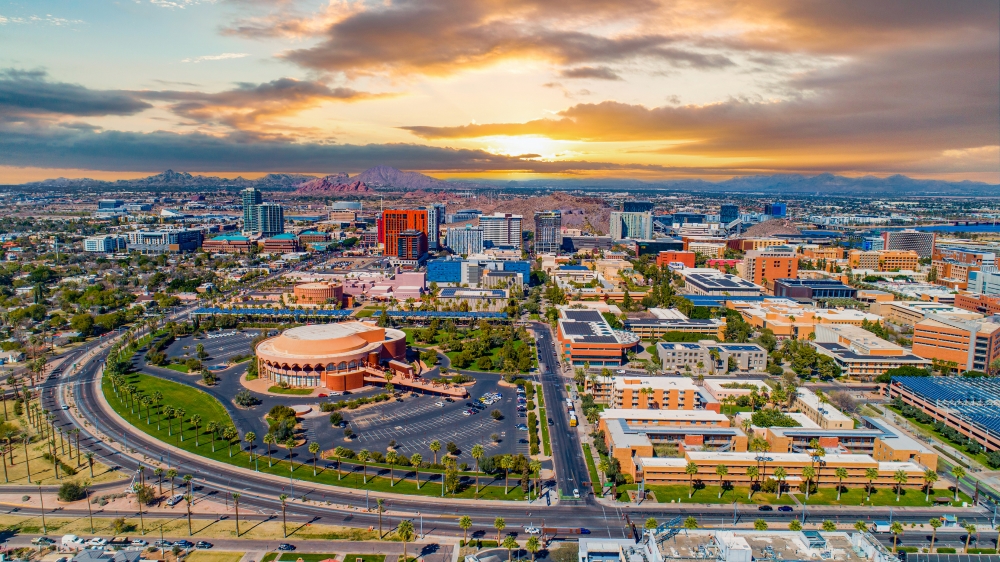
If Moore’s Law stated that the number of transistors on an integrated circuit doubles every two years, there’s a corollary in the number of company operations fitting into the increasingly integrated semiconductor economy of Greater Phoenix.
Phoenix’s semiconductor ecosystem has accumulated more than $200 billion in investments since 2020.
Amkor in May 2026 celebrated the news that its $7 billion advanced semiconductor packaging and test campus in Peoria, Arizona, had been named the No. 1 deal in North America in this publication’s annual Top Deals rankings, drawn from Site Selection’s Conway Projects Database.
“This recognition reflects the scale and strategic importance of the project, as well as the collaborative effort that made it possible,” the company stated. “When we announced plans to grow the project from an initial $2 billion investment to $7 billion, we were responding to the accelerating demand for advanced semiconductor packaging and test capabilities and the opportunity to support a stronger domestic supply chain. The project is expected to create approximately 3,000 high-wage jobs with an average annual salary of $90,000.”
Among the strong partners Amkor pointed to were the City of Peoria, Peoria Economic Development, the Arizona Commerce Authority, Greater Phoenix Economic Council, Arizona Public Service and Western Maricopa Education Center, among others. Phase one will open in 2028, with the facility anticipated to become one of the largest advanced semiconductor packaging facilities in the world.
“The recognition from Site Selection Magazine is a meaningful acknowledgment of what this project represents: long-term investment, high-quality jobs and a stronger semiconductor future for the United States,” the company said. “For Amkor, it is also a reminder of what is possible when industry, government and community partners work together toward a shared goal. We are proud to be building in Peoria and proud to support a project with impact that will extend well beyond the campus itself.”
Ah, but if a jump from $2 billion to $7 billion makes an impact, what about another leap to $12 billion?
That’s exactly what happened in September, when the company announced phase 2.
“Driven by strong customer commitments that have surpassed the 33,000 square meters of cleanroom capacity planned for phase 1,” the company said, “the phase 2 expansion is expected to add 60,000 square meters and bring the campus to approximately 93,000 square meters [over 1 million sq. ft.] of cleanroom space.” The capacity boost is expected to support a overall workforce of more than 3,500 Arizona-based employees.
“This next phase reflects the confidence our customers have placed in Amkor, the critical role advanced packaging plays in enabling the future of semiconductor innovation, and the strategic importance of our Arizona campus,” said Kevin Engel, president and CEO of Amkor Technology.
Amkor says its Arizona campus is the first OSAT production site in the U.S. for advanced packaging in high volume, giving customers access to a full domestic turnkey manufacturing platform. Construction of phase 2 is anticipated to begin late 2027, with completion expected by the end of 2029.
And, just in case: “Amkor’s Arizona 170-acre campus allows for further expansion as needed to support customer demand.”
Worldwide Connectivity and Integration
Prior to that news, Tempe-based Amkor, which has longtime manufacturing ties to the Republic of Korea, was among the participants in an August economic delegation to Korea led by the Arizona Commerce Authority (ACA), alongside representatives from the City of Peoria, Greater Phoenix Economic Council (GPEC) and other Arizona partners. (The most recent Korean company investment in Greater Phoenix is the $121 million, 876-job battery manufacturing project from LG Energy Solution in Queen Creek.)
Another ACA semiconductor-focused trade delegation of more than 100 people visited Taiwan in September, where they attended the American Institute in Taiwan (AIT) Workforce Summit and a SEMICON Network Summit organized by Taiwan’s Ministry of Economic Affairs. The ACA also hosted an Arizona Forum with nearly 200 attendees, highlighting the state’s business advantages, semiconductor leadership and workforce strengths. Taiwan is Arizona’s second largest trading partner, surpassing $21 billion in total trade in 2025.

“This next phase reflects the confidence our customers have placed in Amkor, the critical role advanced packaging plays in enabling the future of semiconductor innovation, and the strategic importance of our Arizona campus”
— Kevin Engel, president and CEO of Amkor Technology, in September as the company raised its planned investment in a new site in Peoria, Arizona, to $12 billion.
Subsequent events included SEMICON Taiwan, where more than 1,200 semiconductor and tech companies were expected to convene, the 2026 Taiwan-U.S. Summit on Technology Talent, Innovative R&D and Industrial Investment Cooperation organized by international education and talent development platform Taiwan Aeon Corporation, and a visit to Neihu Technology Park in Taipei.
“Arizona’s longstanding partnership with Taiwan continues to be one of the most important international partnerships anywhere in the world,” said Sandra Watson, president and CEO of the Arizona Commerce Authority. It was the ACA’s third delegation to Taiwan in 2026, and followed the July announcement that Taiwan’s Ministry of Foreign Affairs planned to open a Taipei Economic and Cultural Office in Phoenix. The ACA opened the Arizona-Taiwan Trade & Investment Office in 2023 in Taipei.
Semiconductor investment comes from Oceania too: In April 2026, Australia-based Syenta announced the opening of its first U.S. facility in Tempe, noting support from the ACA, GPEC, the City of Tempe and Arizona State University (ASU). Located at ASU Research Park, the new 3,500-sq.-ft. facility will support 200 new roles in semiconductor engineering, systems architecture and advanced manufacturing.
“Tempe is a natural choice for our first U.S. operations,” said Jekaterina Viktorova, CEO and founder of Syenta. “The city offers world-class talent, research collaboration and an ecosystem that allows us to scale our advanced packaging technology in support of AI system performance worldwide.”
Arizona State University was one of eight universities selected to lead a national initiative focused on preparing the next generation of workers to advance American manufacturing. The Foundry School, a U.S. Department of State initiative in partnership with the U.S. Department of Labor, is designed to develop, train and prepare the next generation of manufacturing leaders.
Meanwhile, the University of Arizona and National Sun Yat-sen University in Taiwan have launched a joint research and education center, known as SPARK, which “will bring together university research and industry together to accelerate semiconductor commercialization and workforce development. The center also will train the next generation of semiconductor and photonics professionals in Southern Arizona and Taiwan.”
The showcase for this exploding ecosystem will not only be at companies throughout Greater Phoenix, but at the massive SEMICON West event, which with a new annual spring schedule will make Phoenix Convention Center its long-term home beginning March 30-April 1, 2027.
“The move to a spring schedule marks an exciting new chapter for SEMICON West,” said Joe Stockunas, president of SEMI Americas, when the news was announced in July. “By establishing Phoenix as the long-term home of our flagship North American event, we’re creating greater consistency for attendees while building on the tremendous momentum of Arizona’s rapidly expanding semiconductor ecosystem.”
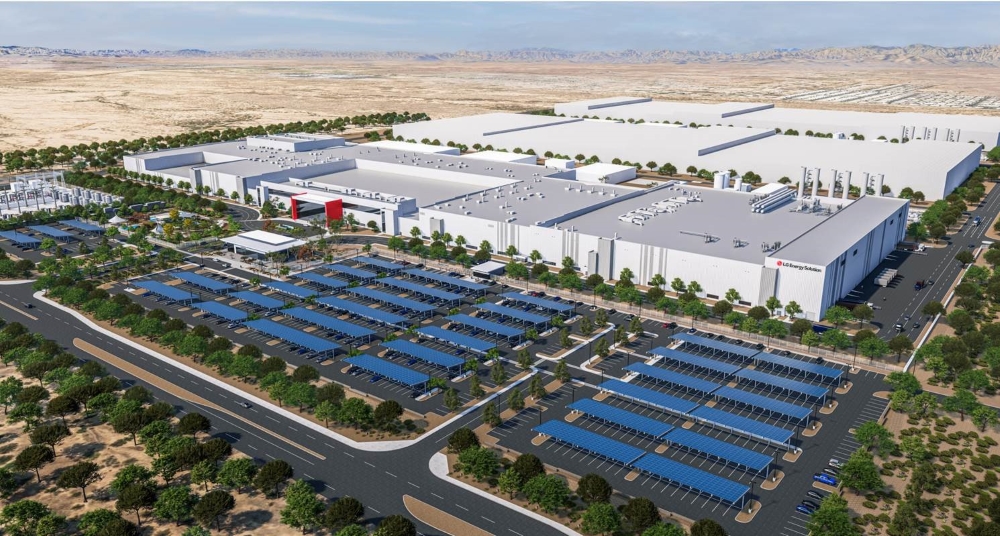
When construction was half-complete in 2025 on its cylindrical battery manufacturing facility in Queen Creek (rendering pictured), LG Energy Solution celebrated the opening of a new workforce training center established under Arizona’s Future48 Workforce Accelerator program in partnership with the Arizona Commerce Authority, Pinal County and Central Arizona College.
“By 2027, we will create 1,500 new employment opportunities overall, significantly thriving the local economy and further cementing Arizona’s growing reputation as a hub for advanced manufacturing,” said President of LG Energy Solution Arizona Richard Ra.