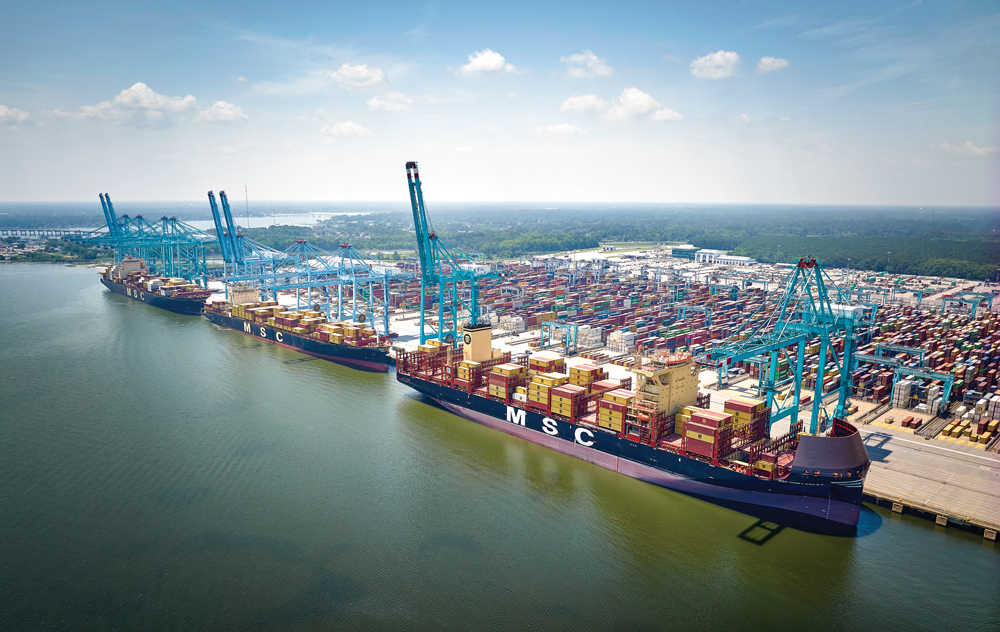
Armed with massive assets, a population steeled in military discipline and a playbook geared toward action, Hampton Roads is literally a region on the make.
Home to 1.8 million people, the Hampton Roads region — also known as the Virginia Beach-Chesapeake-Norfolk, Virginia-North Carolina metro area — is the 37th largest metro area in the United States. That’s about the same size as Jacksonville, Florida or — notably for its innovation potential — Silicon Valley.
But the region, known for the power of its military bases and personnel, punches well above its weight in economic development strength. Last year Site Selection’s Conway Projects Database tracked 31 qualifying corporate end-user facility investments in the area that involved at least $1 million invested, 20 new jobs created or 20,000 new sq. ft. of space. That’s nearly as many as Orlando, a region with 1 million more people. And it pairs nicely with the 47 projects Site Selection tracked last year 90 minutes down the road in Richmond.
The Hampton Roads Alliance reported it supported 22 project announcements totaling $1.18 billion in investment, part of a five-year total of 62 projects representing $3.3 billion in investment and more than 7,400 jobs. Conversations with three influential individuals shed light on what’s been unfolding in the region and what’s still to come, all within the framework of the Alliance’s new playbook, which features a focus on “DEAL” (Defense, Energy, Aerospace, and Logistics) and a set of eight projects the Alliance calls “transformative” that are less about big plans and more about concrete action.
Right on cue, Hampton Roads Alliance President and CEO Doug Smith notes, “Taken together, Hampton Roads’ story is less about aspiration and more about execution at scale. The region’s engineering depth, modernized infrastructure and defense-anchored operating environment allow complex projects — whether offshore wind, shipbuilding, logistics or allied defense manufacturing — to move from concept to construction with speed and certainty.”
Rather than one big city dominating the conversation, that capability is reinforced, Smith says, by a polycentric governance model in which military-informed civic leadership prioritizes collaboration over competition, and by universities that align talent and research directly to industry demand. “The result is a region that functions as an integrated platform” he says. “One where global companies, entrepreneurs and allied partners can plug in quickly, manage risk and deliver in sectors critical to U.S. economic and national security.”
A key factor in all four DEAL sectors is engineering talent. Asked to share an example of how that factor has come to bear directly on particular company projects over the past year or two, Smith doesn’t hesitate.
“A clear example is the Coastal Virginia Offshore Wind [CVOW] project,” he says of the project from Dominion Energy that saw its first offshore substation, all 4,000 tons of it, arrive at the Port of Virginia’s Portsmouth Marine Terminal in January. “CVOW requires a rare mix of marine, electrical, systems and construction engineering, along with port operations, heavy-lift, QA/QC and marine construction expertise. Hampton Roads is one of the few U.S. regions where that full stack exists at scale, because the region’s shipbuilding and naval sustainment industries do comparable, complex work every day. That depth has allowed CVOW to move through onshore transmission and offshore construction without needing to import an entirely new workforce model.”
Has the White House’s opposition to offshore wind affected the sector’s day-to-day activity in the region?
“In practice, the offshore wind supply chain in Hampton Roads is staying the course,” Smith replies, noting that CVOW is well into execution. “While federal actions have introduced uncertainty into the industry, multiple court rulings have narrowed or reversed attempted pauses,” he says. “Offshore construction is underway, turbine installation is active, and capital and supply-chain mobilization continue.”

Chesapeake Mayor Rick West presents a street sign to executives from LS Cable & System. In December, the company announced a $689 million project expected to be the single largest capital investment in the history of the Hampton Roads region and create over 430 new jobs making copper wire products and rare earth magnets. The project is the company’s second investment in the region after a $681 million, 330-job project to make cable.
Hampton Roads’ engineering bench is anchored by Newport News Shipbuilding’s workforce of around 26,000, a handy resource when large defense or energy projects come calling, Smith explains. “The region employs roughly 1,800 marine engineers and naval architects — more than 40 times the national concentration,” he says, “alongside strong aerospace, electrical and mechanical engineering pipelines actively deployed on defense, energy and advanced manufacturing projects.”

“This is textbook 21st century economic development. It’s driven by evidence. The projects build off an authentic base. And you have a clear sense of the path to capital and delivery.”
— Bruce Katz, Co-Founder, New Localism Advisors, and founding director of the Brookings Metropolitan Policy Program, on the Hampton Roads Playbook
Bruce Katz, co-founder of New Localism Advisors, founding director of the Brookings Metropolitan Policy Program and an advisor on the region’s new Hampton Roads Regional Investment Playbook, has studied urban areas most of his life. He says while industrial activity in many metro regions is located on the periphery, in downtown Norfolk or Newport News, the scale and capability are front and center. He recalls a 2024 visit by the mayor of South Yorkshire in England, part of the work behind the AUKUS trilateral security pact among Australia, the United Kingdom and the United States with a focus on submarines.
“He stayed at the Sheraton on the waterfront in Norfolk and he came in on a late night flight, so he didn’t really see anything,” Katz remembers. “When he got up in the morning, he drew the blinds and there was a major battleship right outside his hotel. When I saw him later in the morning, he said, ‘I’m stunned.’ ” A helicopter ride later in the day cemented awareness of how connected everything is. “They’re of a scale that just blows you away,” Katz says of the region’s assets. “Then when you realize that so much of modern manufacturing is so technologically driven by next-generation technologies, you realize this is not just an end-assembly place. This is a place that’s becoming very technologically innovative. My sense is there’s going to be a reshuffling of the hierarchy of cities and metros, and Hampton Roads exemplifies the kind of place that has been revalued by these big market and political dynamics. They’re not running from it. They’ve studied it, they’ve analyzed it, they understand what they need to do to move up the value chain … and they’re doing it. We’re re-militarizing, we’re reshoring, we’re re-energizing. These are big macro trends that come to ground in very transformative ways in a place like Hampton Roads.”
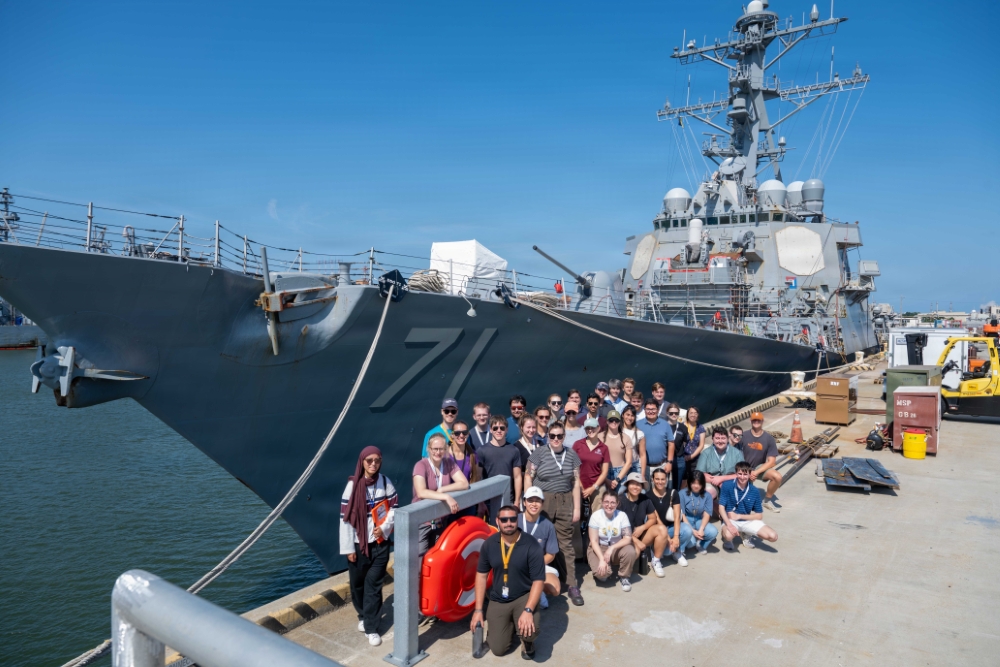
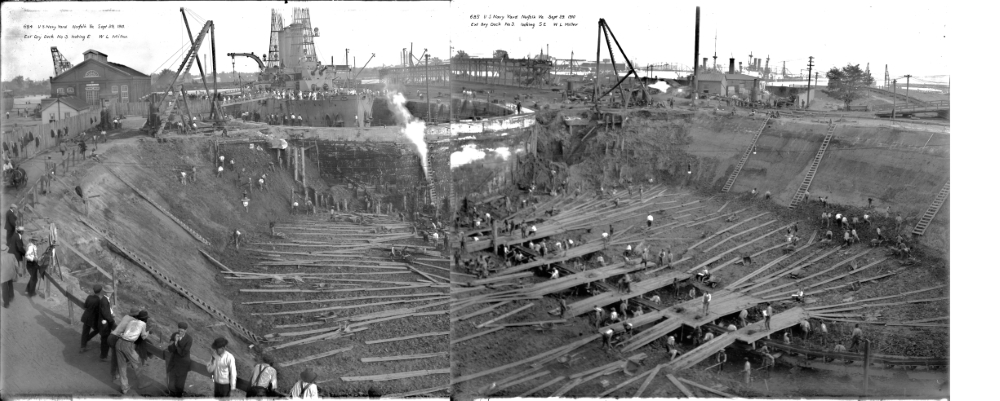
The legacy of workforce development at Norfolk Naval Shipyard goes back generations, from visiting Naval Research Enterprise interns today to World War II veterans learning drafting skills in 1945 and the construction of the drydock itself in 1910 (opposite).
Photos courtesy of U.S. Navy and Norfolk Navy Shipyard
Infrastructure investment is central to that transformation, from the Port of Virginia’s $1.4 billion Gateway Investment Program (including deepening the harbor to 55 feet) to the roughly $7.58 billion in financing issued or programmed by the Hampton Roads Transportation Accountability Commission toward major corridor improvements, tunnel and bridge expansions, and express lanes project commitments. A long-range plan to 2045 totals about another $11.94 billion. “These funds are driving transformational corridor projects such as the Hampton Roads Bridge-Tunnel expansion and the I-64 to Richmond widening programs,” Smith says, “and are designed to accelerate site competitiveness, congestion relief, labor access and freight reliability across the regional network.”
The eight transformative projects in the newly hatched playbook include an AUKUS Center of Excellence located at the College of William & Mary (a delegation will visit the UK this spring to do targeted business development); the NEXUS innovation hub to accelerate autonomous systems across air, land, sea and space; and a regional ambassador corps of former military leaders led by retired Rear Admiral Chip Rock. Smith says the most advanced of the eight projects include the Hampton Roads Maritime Training System (HRMTS). “Already operating at scale, HRMTS trains more than 5,000 workers annually in critical maritime trades, with a clear path to doubling capacity as demand grows,” he says. Publicly launched through the Virginia Tech Corporate Research Center, the Secure Energy Future Center (SEFC) is also well on its way. “SEFC will be moving beyond concept into applied R&D, pilot projects and commercialization tied to energy security and industrial demand,” Smith says.
Katz says there is one unifying thread to the eight projects: “They are authentic. They reflect how companies are experiencing a surge in production and how the region writ large across the public, private and civic sectors is realizing a newfound relevance. This is textbook 21st century economic development. It’s driven by evidence. The projects build off an authentic base. And you have a clear sense of the path to capital and delivery.
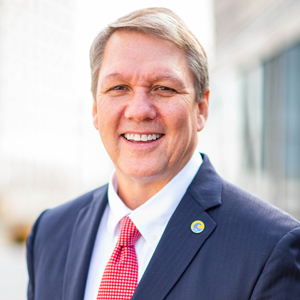
“Hampton Roads is a region that functions as an integrated platform where global companies, entrepreneurs and allied partners can plug in quickly, manage risk and deliver in sectors critical to U.S. economic and national security.”
— Doug Smith, President and CEO, Hampton Roads Alliance
“This is not a report, it’s a playbook,” continues Katz, who has seen more urban regional visioning and planning than the average human. “These are not projects that sit there to be admired. The test is market momentum and action, not how well it was written. I was at Brookings for many years. You can tell the difference between a place that ordered a report to discuss and a place that has devised a playbook to execute. Those are two different things. Hampton Roads has the latter.”
Repping the 757
Retired ambassadors are influential. But testimonials from the younger crowd carry significant weight as project execution kicks into gear. Some of that energy will come out of industry partnerships with universities, such as Virginia Tech’s Tech Center in Newport News, Norfolk State University’s Cybersecurity program and Old Dominion University’s supply chain, logistics and maritime operations programs. And some will come from young professionals like Kali Luthra, 27, senior defense program manager and Mid Atlantic Tech Bridge Defense Technology Accelerator Lead at 757 Collab, located in Assembly Norfolk, a “cool and lively” space downtown filled with cutting-edge innovators and startups. The accelerator propels early-stage companies to scale breakthrough technologies for the Navy and Marine Corps, and has a cohort of 12 firms in the program.
“The programs that we do at 757 Collab are really focused around bridging the gap between entrepreneurs and going to market or going to get their capital or going to get a first contract,” she says, noting that 757 Angels, an angel investor arm focused for now solely on Virginia companies, is among the most active angel investor networks in the country. “We’re trying to create a more seamless ecosystem to allow these entrepreneurs and ventures to thrive,” she says, “to not just gain access to resources, but actually build off of those resources.”
One company that’s experienced every stage of 757 Collab is Crunchy Hydration, a maker of healthy sparkling water drinks that came through the organization’s startup studios, went through the accelerator to get capital-ready and has now been funded by 757 Angels. As for the defense cohort, dual-use is the order of the day, i.e., companies that have worked with the government but want to commercialize and also commercial companies that want to prepare for bidding on government contracts.
A native Atlantan, Luthra lived and worked in Washington, D.C, and Los Angeles before coming to Hampton Roads in 2025.
“I’ve only ever known big cities,” she says. “I’ve only ever known sitting in your car for so long in the traffic.”
Once she found Norfolk on the map, she thought she’d be road-tripping up to D.C. on the regular to see friends. But she quickly found out Hampton Roads has its own vibe. Now she’s getting ready to move into a new apartment and stick around. “I’m loving it so much,” she says. “Whenever my friends come down to visit me from D.C., the one thing they always say is that the people here are genuinely happy … People want to collaborate. When you say, ‘Hey, we should do something to help these entrepreneurs,’ you’ll see a meeting on your calendar with 15 other people the next day because people genuinely want to make a difference and make something happen.”
Her feelings were echoed by the cohort when they came to visit last August.
“They loved the people, they loved the vibes, they loved how many connections they were able to get as well,” she says. “It’s been really refreshing living here. There’s a lot of momentum for a place that I didn’t know about a year ago.”
Combine that momentum with military ethos and tradition and you get what Katz calls a “radical” inclination toward collaboration among municipal and civic leaders that other regions don’t possess. Doug Smith couldn’t agree more.
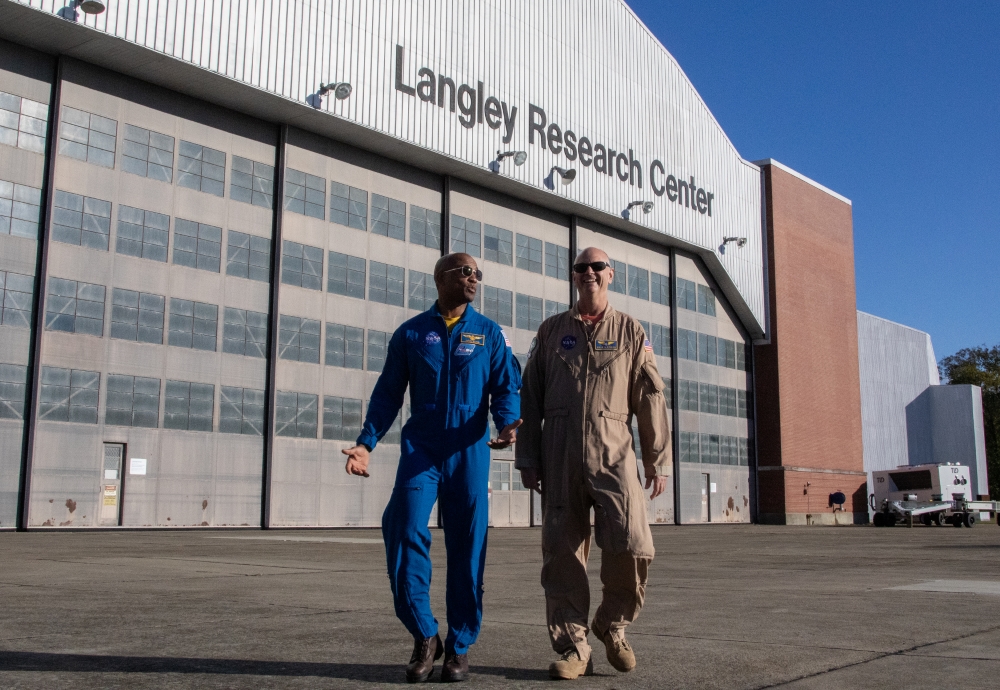
TOP TALENT: NASA test pilot Nils Larson (right) reunited with former student and current astronaut Victor Glover in 2023 during an open house at NASA’s Langley Research Center in Hampton, Virginia. Langley comprises nearly 200 facilities on 764 acres and employs some 3,400 civil servants and contractors.
Photo by Dave Bowman (Kristen Hatfield) courtesy of NASA
“Many local leaders bring military experience into civic leadership, which creates a shared operating mindset — mission clarity, trust and collaboration across jurisdictions,” he says, noting that Virginia Beach Mayor Bobby Dyer and Newport News Mayor Phillip Jones are former Marines. “Rather than zero-sum competition, there’s a strong norm of shared responsibility for regional outcomes, which is uncommon in peer metros.”
In the end, that uncommon norm could propel an area economy ready to weigh anchor.