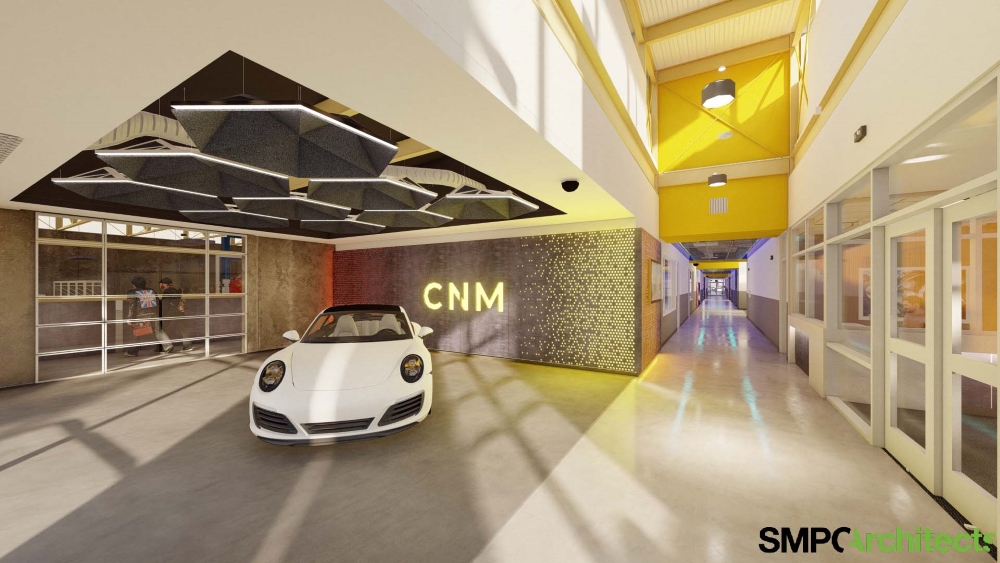
Students are leaving behind classroom desks for real-life workplace experiences.
What is one of the most effective ways to encourage young people to pursue a promising career? Let them create their future with their own hands.
This works by providing pupils with the dedicated space, advanced technology, relevant equipment and expertise to determine a preferred industry direction. That is precisely the approach Rio Rancho Public Schools (RRPS) and Central New Mexico Community College (CNM) are delivering in Central New Mexico.
Through the creation of a future-focused Career Technical Education high school campus, dubbed RioTECH, high school and adult students now have the opportunity to explore high-demand skilled trades and technology careers in an environment designed to simulate real-work experiences.
RioTECH opened its doors to the first cohort of students in August 2025, serving up to 250 RRPS students ranging from sophomores to seniors. By participating in CNM’s dual credit program, students can earn credits from college-level CTE courses at no cost, translating to credentials, certificates and associate degrees needed to land a new role.
The campus houses a variety of labs designed to introduce students to many career possibilities. These labs cover a range of trades, including welding, plumbing, HVAC, electrical and carpentry, in addition to technology labs covering computer science, cybersecurity and digital media careers. By next year, RioTECH’s portfolio will offer CNM’s Automotive Technology, Electric Vehicle Technology and Diesel Equipment Technology programs, stationed within a new 43,800-sq.-ft. Transportation Technology Center.
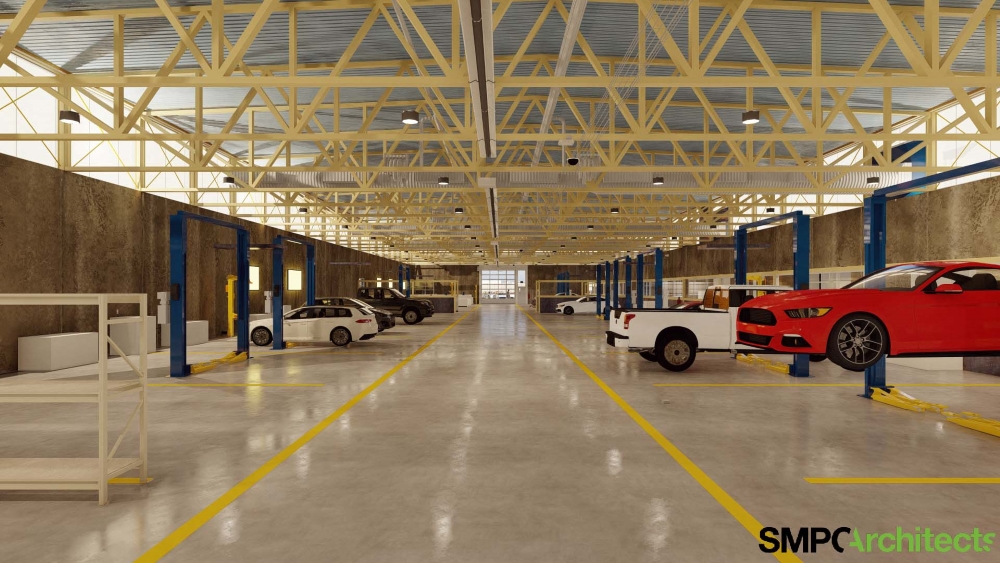
CNM’s new facility investment aims to meet a growing demand for skilled automotive, light-diesel and EV technicians in New Mexico.
Rendering courtesy of Central New Mexico Community College
CNM President Tracy Hartzler says multiple locations were considered for the new facility as the college looked to grow its transportation programs to meet a statewide employer need for skilled automotive, light-diesel and EV technicians. The decision to locate the facility at RioTECH — leveraging its faculty, facilities and public resources — presented the greatest opportunity for impact.
“We’re working to attract more students who are eager to build, repair and create with their hands, while also strengthening the skilled workforce that supports our employers and the region’s economic growth,” says Hartzler. “With state-of-the-art labs, industry-grade tools and modern learning environments, students will have access to the best possible preparation for the evolving world of transportation technology.”
The new facility will feature labs designed to emulate professional repair shops; classrooms adjacent to every lab; an EV lab with tool room and battery storage; an Automotive Systems lab; exterior fleet storage for 85 vehicles and a community outreach and showcase space.
CNM’s EV Technology program is the only community college program of its kind in the state, which has allowed CNM to collaborate with industry giants like Ford, Toyota and General Motors on career exploration programs. While its Automotive Technology program has been a pillar of CNM since 1965, recent EV industry growth and the state’s investments into renewable energy and EVs has placed a spotlight on sustainable transportation. Partnerships with companies such as Snap-on Industrial, COATS Equipment and Rotary Solutions are just one way CNM is set up to equip the new labs with the latest technology and tools students will encounter in the automotive industry.
“Our Automotive Technology program already has a strong reputation among employers throughout central New Mexico,” notes Hartzler. “With this new facility, the high-quality instruction and the advanced equipment our students will train on, we’re confident the Transportation Technology Center will fuel industry expansion and job growth in the region.”
Map It Your Way
In nearby Nevada, virtual reality technology is transforming the way the Silver State’s talent engages with the elements of a new role — and now, it’s caught global attention.
Over the past decade, the Nevada Governor’s Office of Economic Development (GOED) has brought together librarians, workforce experts and technologists to develop its Individual Career Mapping Methodology (ICM) program. What began as an idea to connect individual entities, such as educational providers and employers, on a common platform now provides high school, college and adult students a unique approach to enter STEM-related fields.
In 2020, a grant from the U.S. Department of Education’s Reimagine Workforce Preparation program provided the opportunity to develop and test the innovative platform. Nevada GOED Senior Director of Strategic Platforms and Innovation Karsten Heise says that the move to integrate VR as a ICM tool was the most cost-effective way to get information to an individual to enhance “labor market literacy.”
By definition, this means one’s ability to identify, understand, interpret and utilize labor market information to make an informed career decision. The ICM program, available through the state’s public and community college libraries, allows students to build their own data-backed career plan that enables them to assess their skill strengths. Students step into real-world industrial environments through 35 diverse VR field trips across Nevada’s five leading sectors — advanced manufacturing, health care, skilled trades, IT and logistics — supported by a career-readiness assessment and one-on-one mapping sessions to navigate labor market data.
“It’s hard to get into a health care facility. It’s hard to go to an advanced manufacturing facility. You can read up on it, you can Google it, but you get an incomplete set of information,” says Heise. “We asked, ‘How can we transport someone into an environment to get a higher level of information to that individual?’ And we found VR was a good tool for full immersion.”
The technology allows students to participate in job shadowing and stores a virtual course companion, or VR textbook, that provides instant role insights and need-to-know information from subject matter experts at Nevada community colleges. Heise shares that outside of Nevada, states like Tennessee and Connecticut have taken notice of the ICM model and have begun their own exploration and data gathering with the technology.
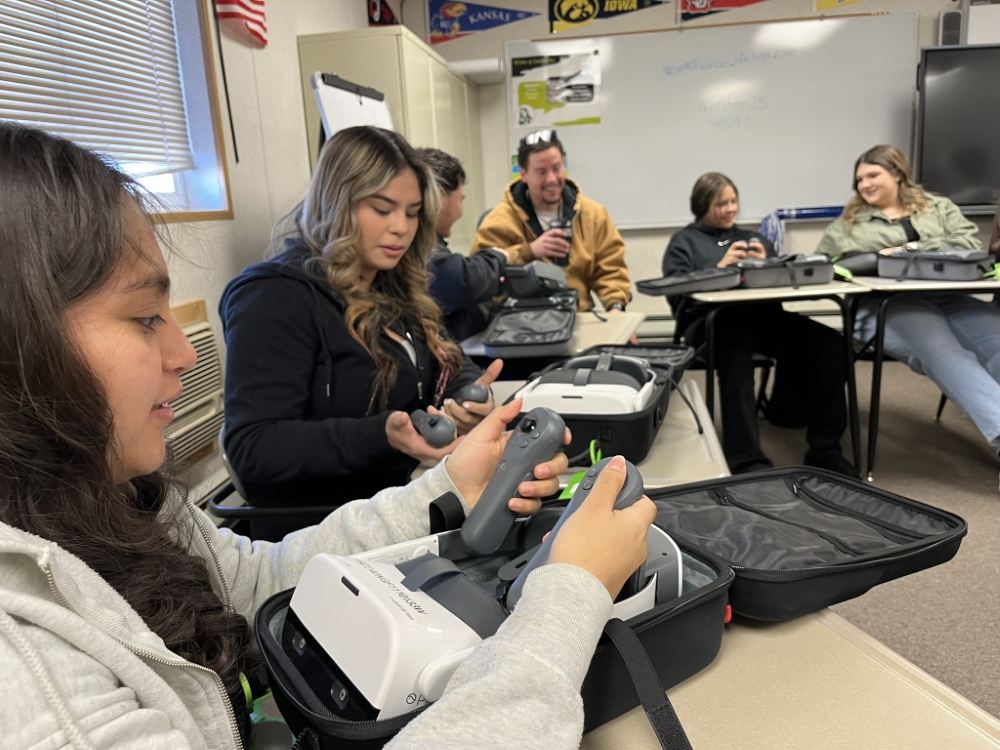
For two years, students at Jackpot High School used VR to gain a better understanding of technical skills required in a preferred career field.
Photo courtesy of the Nevada Governor’s Office of Economic Development
Near the Idaho state line, Jackpot High School students went through the complete ICM sequence, in which every participant earned an ACT WorkKeys National Career Readiness Certificate. These students were immersed in industrial sites, hospital rooms and advanced manufacturing facilities to practice hands-on actions like putting on safety gear, assisting patients and operating machinery. Paired with individual mentorship, students were able to assess data gathered on field trips to identify skills and career interests ahead of the certification exam.
Nevada GOED Senior Workforce-Librarian-in-Residence Tammy Westergard says that 17 additional VR field trips are currently under construction within advanced manufacturing, with a specific focus on the mining industry.
“We believe we have created a solution, a method that actually does increase labor market literacy levels,” says Westergard. “When you can read the labor market, just like when you’re reading in the library, you can go anywhere you want.”
In April 2025, the Nevada GOED team took the ICM program international to the Aspen Institute Central Europe’s Annual Young Leaders Program. Participants from Czech Republic, Slovakia, Poland and Hungary were able to interact with the ICM model, showcasing how this technology can shape global workforce development and labor market understanding.
“These are problems that are persistent all over the world. They’re all driven by the same thing — automation and AI,” says Westergard. “These are future policy makers, so it’s important to understand this idea of labor market literacy and then individual career mapping as the solution.”