From coast to coast, this Central Florida freeway drives economic growth.
Want to know why so many people and companies move to Central Florida? Look no further than the ever-expanding impact of Interstate 4. From Tampa to Daytona Beach, this 132-mile-long freeway bisects the nation’s fastest-growing state while expediting commerce in Florida’s fastest-growing region.
Peppered along this busy commercial corridor are the rapidly growing towns of Plant City, Lakeland, Winter Haven, Haines City, Clermont, St. Cloud, Sanford, Daytona Beach and many more. As these cities grow in population, the demand for everything from housing and education to everyday goods and services explodes.
How fast is the region growing? Consider this: The combined population of the six counties along I-4 — Hillsborough, Polk, Osceola, Orange, Seminole and Volusia — now stands at an estimated 5.6 million people. Just 10 years ago, it was 4.1 million, meaning the I-4 region has grown by 36.6% over the last decade.
To put that into perspective, Florida’s population increased from 20.6 million in 2016 to 24.3 million today, putting the Sunshine State’s growth rate over the last decade at 18% — roughly half the growth rate of Central Florida’s.
“The main economic driver will always be people. They need places to live, places to eat, places to shop and warehouses to bring all of these things to them. An estimated 25 million people live within a five-hour drive of Orlando.”
— David Hungerford, Senior Advisor, Saunders Real Estate
It’s no wonder that corporate investors flock to communities along the I-4 corridor, gobble up prime parcels as fast as they can and develop new business facilities to serve the region and beyond.
Polk County, home to the Lakeland-Winter Haven metro area smack dab in the center of Florida, is Exhibit A in this real estate boom. David Hungerford, senior advisor at Lakeland-based Saunders Real Estate, says that 15 to 20 years ago, “the growth of the I-4 corridor was more of a concept than reality. But it has totally reshaped our communities positively since the global pandemic of 2020. Everything shifted after COVID. I started getting calls from California, New York and all over the country from investors. We are now at the forefront of industrial development in Florida.”
With a population of 910,290, Polk is no longer a secret to investors, he adds. “Lakeland is now mentioned in the same breath as Jacksonville, Orlando, Tampa and Miami,” says Hungerford, whose firm is the largest land transaction deal-closer in the Southeast.
Beverage Firms Hitch a Ride at Rail Park
Asked where the next growth boom is likely to occur, Hungerford names Plant City, Loughman, Clermont, Groveland and Fort Meade. “Plant City in eastern Hillsborough County has ample land available. They’ll see a lot of development in coming years,” he notes. “The Central Polk Parkway expansion will have a major impact on residential growth.”
Hungerford is referencing the $134 million project of the Florida Turnpike Enterprise to expand the Central Polk Parkway (State Road 570B) in Polk County by constructing a 2.6-mile, four-lane toll road from U.S. Highway 17/State Road 35 to State Road 60. Expected to be completed by early 2031, the extension is being designed to reduce traffic congestion and divert trucks from downtown Bartow on their way to I-4.
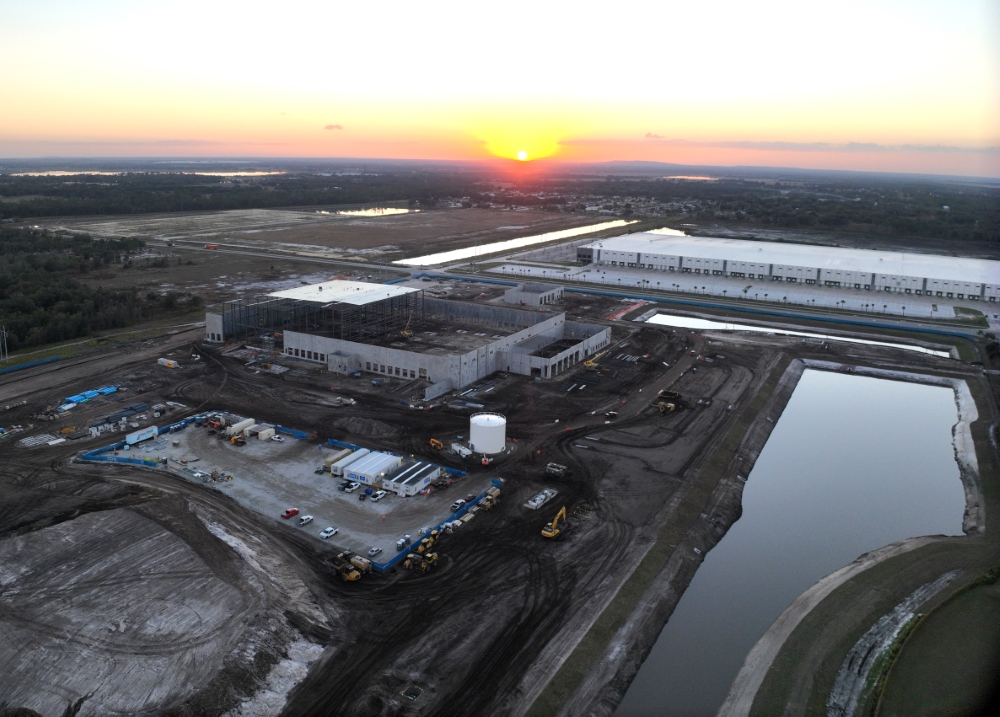
The project will directly benefit tenants in the Central Florida Integrated Logistics Park — a 1,500-acre zoned industrial park that features 8 million sq. ft. of space including a CSX Rail Intermodal Facility — near State Road 60 in Winter Haven. Anticipating the new connecting route to I-4, major corporate end-users are lining up to take large parcels in the park and build giant plants for warehousing and distribution. Three of the biggest new investors are Chick-fil-A Supply, Niagara Bottling and PepsiCo.
CFA Supply is building a $150 million cold-storage distribution center of 244,000 sq. ft., where it will hire 180 full-time workers. Adjacent to CFA are two other projects: a 1.2 million-sq.-ft. PepsiCo facility and Niagara Bottling’s site on which it plans to build a $422 million, 1.45 million-sq.-ft. facility and employ 100 full-time workers later this year. The exact investment of the PepsiCo deal is not known at this time, but the global soft drink and consumer foods brand has signed a lease to occupy all 1.2 million sq. ft. of space developed and completed by Tratt Properties of Phoenix in 2023.
Bruce Lyon, president of the Winter Haven Economic Development Council, says that the residential growth boom in East Polk drives industrial expansion. “Winter Haven has more than doubled in size in the last 12 years to 62,000 residents,” he says. “Legoland continues to invest each year in new venues at its theme park in Winter Haven; and the downtown is thriving with several hundred million dollars in new investment.”
Lyon says a grant of $1.5 million from the Governor’s Office helped Winter Haven land the 44-acre CFA Supply deal. “The Job Growth Fund money will be used to extend a freight rail line to the CFA site,” he says. “The Niagara deal happened because we have all the water, electric power, natural gas and wastewater treatment capacity they need to build in the park. We knew we had competition around the state, but we checked every box.”
Hungerford says the time to invest in Central Florida real estate is now before the best sites are taken. “Finding good land can be a challenge,” he says. “Tampa and Orlando are pretty well built out. Stuff along I-4 in Lakeland has been gobbled up. Infill opportunities in Tampa and Orlando will be more expensive. There is a large business park being built by Parkway Properties near the Publix headquarters in Lakeland. With permits for up to 5 million square feet of industrial space, that is one of the biggest developments on the Polk Parkway.”
Known as Lakeland Central Park, the development is a 730-acre project that includes permitting for up to 500,000 sq. ft. of mixed-use space and a 708,000-sq.-ft. warehouse. It is near the Polk Parkway and Old Tampa Highway just west of Airport Road.
Hungerford says that as long as people keep moving to the I-4 Corridor, real estate demand will climb. “The main economic driver will always be people,” he says. “They need places to live, places to eat, places to shop and warehouses to bring all of these things to them. An estimated 25 million people live within a five-hour drive of Orlando.”
From Phosphate Mining to Data Harvesting
Hungerford adds that “Florida offers a pretty friendly business climate. That is a perfect storm for companies looking to grow their footprint in the Southeast.”
It’s also why Central Florida is being considered for projects formerly foreign to the region: large data centers. “A huge one is being proposed in Fort Meade,” says Hungerford. “The big reason — they have access to power.”
Bohler Places LLC, a project of Maryland-based developer Stonebridge, received unanimous approval in November 2025 from the Polk County Commission for an ad valorem property tax exemption and performance agreement. The 10-year, $150 million tax break paves the way for a project that could reach 4.4 million sq. ft. in size on a 1,163-acre site and cost $2.66 billion to build.
The first of eight planned data center buildings on reclaimed phosphate land is expected to be operational to serve AI and cloud platforms by early 2028.
“This is transformational for Fort Meade,” County Commissioner Bill Braswell said.
If all goes as planned, the end-user will employ up to 456 full-time workers at an average annual salary of $107,000 — roughly double the average yearly wage in Polk. The project is just west of State Road 17/Highway 98 in the small rural town of Fort Meade, home to about 5,000 people in a remote part of southern Polk.
The site is adjacent to Duke Energy’s 2.267 GW Hines Energy Complex, which is important, since the anticipated energy demand of the data center campus will be close to 1.3 GW.