A highway construction project in the I-77 corridor’s leading county for corporate facility growth adjusts on the fly.
Put pedal to the metal and you could knock out the entirety of Interstate 77 in one day’s drive. But with so many compelling places to visit or invest, why would you want to go and do a thing like that?
The data say North Carolina’s Queen City is the most alluring of all, even if major improvements planned for I-77 itself in Charlotte on first blush seemed to cause a temporary blemish.
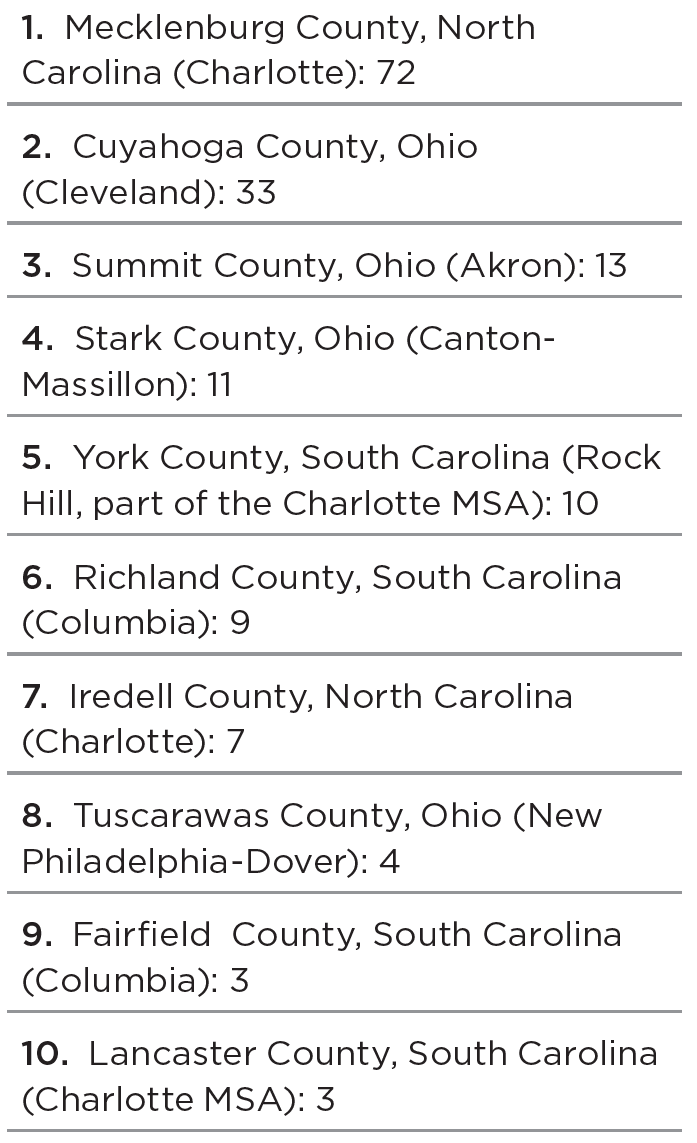
Since January 2025, Site Selection’s Conway Projects Database has qualified more than 170 major corporate facility investment projects in the counties that adjoin the 610 miles of Interstate 77 between Cleveland, Ohio, and Columbia, South Carolina (technically, the town of Cayce). Here are the 10 counties that show the most project activity:
Automotive projects top the corridor’s biggest capital investments, from GM in Parma, Ohio, to Scout Motors’ 1,000-job plant in Richland County, South Carolina, and its HQ in Charlotte. A total of 27 of the 175 projects tracked since January 2025 (15%) are located in the five counties that comprise the South Carolina I-77 Alliance: Chester, Fairfield, Lancaster, Richland and York. Those projects also include nine of the top 20 by capital investment.
The 13 projects in Alliance territory on the immediate South Carolina side of the official Charlotte MSA demonstrate how growth in the region continues to be a bi-state phenomenon. So it’s no surprise that the North Carolina Department of Transportation is moving forward with a $3.2 billion plan to upgrade 11 miles of I-77 from the South Carolina state line to I-277/N.C. 16 (Brookshire Freeway) in Mecklenburg County.
Reducing Collisions, Reducing Impact of Collision Solutions
Like a speed bump or traffic circle, that forward motion is being shaped by community input, owing to concerns over neighborhood impact, particularly in some of Charlotte’s historic Black neighborhoods. In February, after a year that included two formal public meetings and nearly 30 smaller meetings, NCDOT announced it had landed on what it called the “least impactful design option”: constructing the express lanes above or to the side of the existing Interstate lanes in the uptown area of Charlotte, which it said “significantly reduces property impacts to the McCrorey Heights and Wesley Heights neighborhoods, minimizes effects on Frazier Park, and avoids impacts to Pinewood Cemetery.”
In background documents about the project, NCDOT noted that the project was included in a long-range transportation plan assembled in 2014, and addresses what it calls “one of the most congested corridors in the state, with a crash rate 2.8 times higher than the statewide average for urban interstates. On average, there are five crashes daily and five fatalities annually on the corridor.”
At the same time, causing the crash of neighborhoods has become a flash point, just as it has in many major highway projects across the nation since the advent of the Interstate system. “NCDOT recognizes the historic harm caused by past highway projects,” the agency said. “This is precisely why vertical design is being prioritized.”

The Iron District in Charlotte aims to deliver up to 4 million sq. ft. of office space over four phases.
Rendering courtesy of Trammell Crow and Charlotte Pipe and Foundry
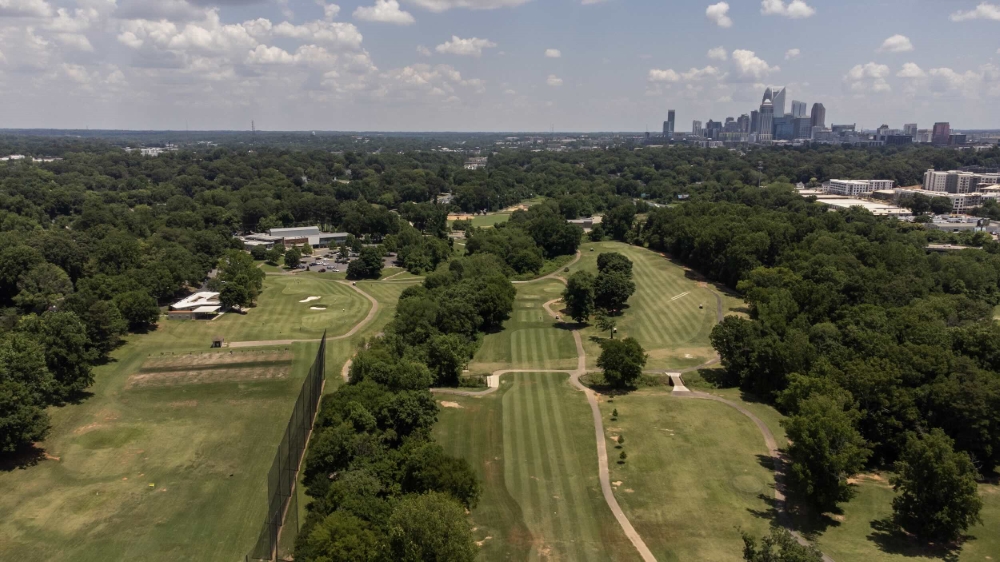
Detailed planning documents outline steps to minimize impact to such locations as Sifford Golf Course, named for the pioneering Black professional golfer Dr. Charles L. Sifford, where petitioners in the 1950s won a lawsuit to allow Black citizens to play on the course. It’s not the first time the course and I-77 have collided: The course, originally named Bonnie Brae and then Revolution Park Golf Course, lost its second nine holes when I-77 was originally completed 50 years ago in 1976.
The evolving plan for the highway project also is taking steps that will lessen impact on emerging new development locations such as the Iron District, a massive redevelopment by Trammell Crow and partners of the historic property around Charlotte Pipe and Foundry that in addition to residential and amenity development aims to deliver up to 4 million sq. ft. of office space over four phases.
Some wanted NCDOT to relocate I-77 to an underground tunnel. But after reviewing such tunnel projects as the Big Dig in Boston and Alaskan Way in Seattle, NCDOT concluded that “relocating I-77 underground would cost billions of dollars per mile (10-20x NCDOT’s annual capital budget). Additionally, maintenance costs would be more than $50 million a year (nearly all of NCDOT Division 10’s annual maintenance fund for bridge and roadway maintenance, potholes, etc.).”
NCDOT Division 10 Engineer Felix Obregon said of the decision, “NCDOT’s priority is to deliver transportation improvements in partnership with the region that respect the history of the neighborhoods along this project corridor. Community feedback has been critical in shaping this project and the elevated design option balances regional mobility needs with meaningful reductions in neighborhood and environmental impacts.”