

HEAD ON A SWIVEL
It’s summertime and the living’s easy. That’s what I wish I could say to all of you.

While enjoying warmer temperatures is always appreciated, the world continues to change and at a pace I don’t think most of us are used to. Staying informed and in touch with what’s impacting business decisions is core to IAMC’s mission. One way for our Corporate Members to do that is by attending the monthly webinars. These are great venues to hear from your peers about what challenges they are facing and how they are thriving.
Connecting with IAMC members was central to the recent IAMC London Forum I was fortunate enough to attend in June across the pond in jolly old England. This was the 10th anniversary of this event. It was a great opportunity to hear about global issues impacting industrial real estate.
In typical IAMC fashion, relationships came first and I met a lot of great people for the first time, but hopefully not the last. We realized the challenges we’re facing are not unique to the parts of the world we’re conducting business in. The issues are similar no matter which sandbox we play in. I would encourage anyone interested to attend a future London Forum. It’s a high-quality event with an intimate audience of high-caliber individuals across industrial real estate.
I’m already looking forward to the next IAMC Fall Forum occurring October 17-21 in Columbus, Ohio. We’ll be in the midst of football season and you can bet the Buckeye fans from The Ohio State University will be excited to welcome us to their home city. The event will feature amazing keynote speakers along with plenty of IAMC signature programs. These forums are really the magic of IAMC and where lasting connections are made.
Until I see you again in person, remember what an old football coach of mine used to say: “Stay low and keep your head on a swivel.” Essentially, be ready for anything and nothing will surprise you!
— Matt M. Boehlke
Building Industrial Expertise with IAMC’s PILLAR
By Charlene Manuel
Industrial corporate real estate (CRE) is not a generalist discipline. Gaining a competitive edge and expanding expertise often comes through on-the-job experience, but IAMC’s new professional education programs are designed to complement that learning with timely, relevant content professionals can immediately apply within their roles and organizations — delivering practical value from day one.
Professional Development Designed to Accelerate your Industrial Expertise
PILLAR, which stands for Professional Industrial Learning in Logistics, Assets & Real Estate, is designed to accelerate your industrial expertise. PILLAR was built to meet industrial CRE professionals exactly where they are — and take them further than general training ever could.
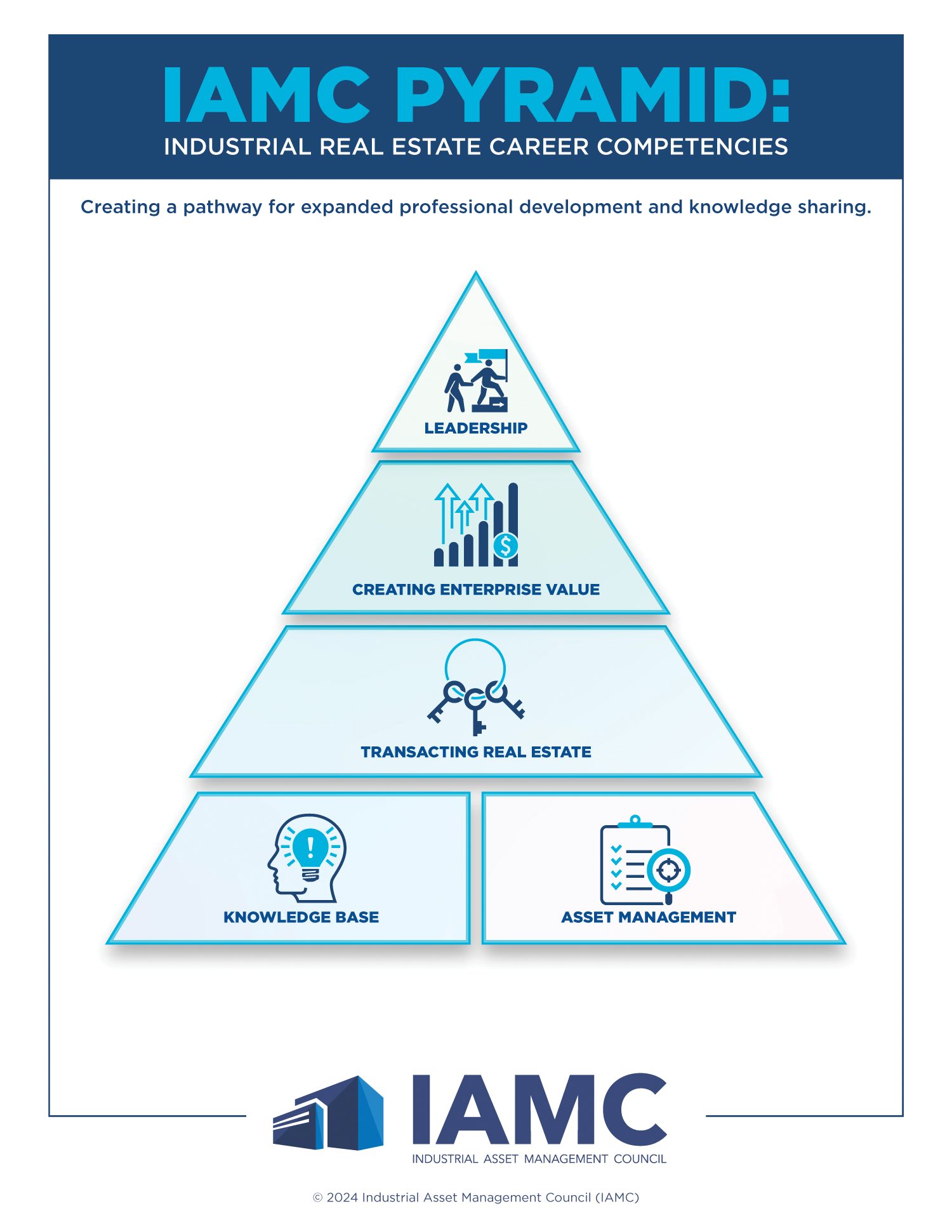
All of PILLAR’s offerings draw on IAMC’s Content Pyramid, with every program aligning with one of the five broad categories that impact excellence in corporate real estate:
• Leadership
• Creating Enterprise Value
• Transacting Real Estate
• Asset Management
• Building a Knowledge Base
Every program has been created in collaboration with IAMC members at the top of their fields, leveraging true expertise and proven best practices of the profession. While every business has its own processes, goals and objectives, PILLAR aims to provide industrial CRE professionals with what they need to know as well as offer tools and frameworks that can support professionals with the challenges they currently face as well as those to come.
“To be a trusted resource in your organization, one must keep learning and have their finger on the pulse of what is going on in our industry,” says Katie Matthews of Tricorbraun. “Investing in yourself is important, so it’s exciting to leverage IAMC’s new continuing education opportunities where I can learn from seasoned industry professionals, but also from our peers, which is always my favorite part of engagement at IAMC.”
Excellence in Industrial Real Estate Demands Specialized Knowledge
Industrial CRE demands highly specialized, nuanced expertise, yet many professional development offerings fail to reflect the complexity and specificity of this field.
Jonathan Majors of Graphic Package International, LLC, a CRE professional with more than 20 years of experience, puts it plainly: “I noticed a lack of professional education tools and resource materials specifically tailored to the industrial side of the industry.”
That observation reflects a broader reality across the profession — and it’s exactly the gap PILLAR was built to fill. Whether you’re an owner’s representative navigating a facility transition, a corporate end user presenting a business case to your CFO, or an economic developer working to bring a project across the finish line, tapping into peers’ collective knowledge and experiences can only strengthen your approaches.
“I continuously listen, read and learn on a variety of subjects for the knowledge, and take on special projects that are not quite in my wheelhouse also for the learning to be gained as well as the challenge,” says Richard Tyler of Smurfit Westrock. “The initial session of PILLAR supported keeping my expertise sharp by reminding me of a strong way to approach, organize and present a strong business case. Even if we’re not always in a lead or comprehensive role on the business cases, the PILLAR program put us in a position to ask critical questions and assist others in building the business case.”
Katie Matthews, who transitioned into portfolio management after establishing a project management office for her organization, described another challenge familiar to many in the field: finding development opportunities that aren’t driven by an agenda. “It is difficult to find truly valuable development opportunities,” she notes. “This program shined as an educational platform where I could gain the knowledge and new tools from experienced, like-minded professionals without the noise.”
PILLAR isn’t designed for one type of professional. Corporate asset managers, economic developers and service providers all operate within the industrial CRE ecosystem — and all bring different perspectives, pressures and knowledge gaps to the table. Skills Paths are designed to bring these roles together, creating cohorts where the diversity of experience is itself a learning asset.
What Collaborative Learning Actually Looks Like
At IAMC’s recent Spring Forum in Little Rock, Arkansas, graduates of PILLAR’s pilot cohort completed their capstone presentation, presenting an industrial business case recommendation to a simulated panel of executives. The interactive experience helped culminate a three-month learning journey that left participants not just with new information, but with a sharper framework for work they were already doing.
“Learning in the group setting was one of the greatest sources of value in this program and reminded me of a miniature version of my MBA experience, which I enjoyed,” says Brett Von Bergen of Penske. “Hearing validation of some phenomena I see at my own company, hearing new ideas and approaches to problems, and taking on the capstone project with multiple perspectives are just some examples. I believe it’s hard to replicate this type of experience.”
Jonathan Majors highlighted something less visible but equally valuable: the relationships built through the process. “I left the capstone group project with two new industry connections — friends — who I feel confident I could call to exchange ideas and perspectives.”
Multiple Learning Formats
What distinguishes PILLAR from a single course or a conference session is the range of formats it offers — each designed for a different kind of learner, schedule and goal.
For those ready for a more immersive experience, Skills Paths offer a structured, three-month cohort-based journey with peer collaboration, guided reflection and a culminating capstone project that puts learning into practice under real-world conditions. Current offerings include “Building & Selling Your Industrial Business Case” and “Executing Industrial Real Estate Projects.”
Richard Tyler of Smurfit Westrock, whose path into industrial CRE wound through the Atlanta and Salt Lake City Olympics before landing in facilities and real estate, describes how the program fit into the rhythm of a demanding professional life: “While I knew it could be challenging some of the time, for the most part what the program required — both formally and informally — was not terribly difficult to manage. I took the perspective that anything worthy of learning would require extra time and attention, and that was part of the challenge.”
For professionals who want to build or refresh foundational knowledge on their own terms, on-demand courses are also available. These include “Know Your Industrial Real Estate Portfolio” and “Using Data to Drive Strategic Industrial Real Estate Decisions,” which are self-paced, immediately accessible and designed for busy professionals who need flexibility without sacrificing rigor.
PILLAR also offers webinars and intensive, in-person workshops held at IAMC Forums.
Your Next Step Starts Now
Industrial CRE is evolving. The professionals who will be most effective in the years ahead are those who invest in deepening their expertise, broadening their perspective and building the skills to translate knowledge into confident action.
Explore available programs and enroll today at pillar.iamc.org.

Charlene Manuel is a strategic leader with more than 20 years of experience helping organizations align priorities, navigate complexity and deliver high-impact initiatives. Known for her enthusiasm and collaborative leadership style, Charlene serves as IAMC’s Director of Education & Research, holds degrees from NYU and Georgia Tech, and is currently pursuing an EdD at the University of Georgia.