
Cash rebates, tax credits or both can significantly lower your overall tax bill.
The Oklahoma Department of Commerce lays out a very simple value proposition for every company considering an investment opportunity in Oklahoma: Invest in us and create high-quality jobs, and we will invest in you.
The department even says this on its website: “In Oklahoma, your investment works harder,” Commerce states. “Ranked among the best in the nation for tax climate and cost of living, Oklahoma offers a streamlined path to profitability for expanding and relocating companies. We provide a unique, dual-track incentive system where qualifying businesses can leverage cash rebates, tax credits or both to significantly reduce their tax burden. From initial site selection to long-term expansion, our team provides the individualized expertise needed to navigate our numerous programs and secure your competitive edge.”
To learn more about how this works in practice, we interviewed Jared Cooper, director of rural services for Oklahoma Commerce. “We’re focused on job growth and expansion,” he says. “We connect local businesses to a state agency. We have resource partners that can help. We support local businesses through state incentives. We sit down with companies and talk to them about our Quality Jobs Program and our Investment Tax Credits.”
The state offers several groupings of incentives, he notes.

“Employers like our
Quality Jobs incentives
because they are all cash-back programs. They also like our Business Expansion Incentive Program because it provides annual cash payments to help existing companies expand in Oklahoma.”
— Jared Cooper, Director of Rural Services, Oklahoma Department of Commerce
“One is a new Investment Tax Credit for manufacturers. It is equal to up to 1% of your new investment for up to 5 years — or you can choose up to $500 for each new job created. For deals in Opportunity Zones or Enterprise Zones, it is double that amount,” says Cooper. “We also offer sales tax exemption permits from the Oklahoma Tax Commission for manufacturers buying equipment; and we have a Freeport Exemption on taxes paid on goods brought into Oklahoma on a freeport exemption. That is how our tax credit program works.”
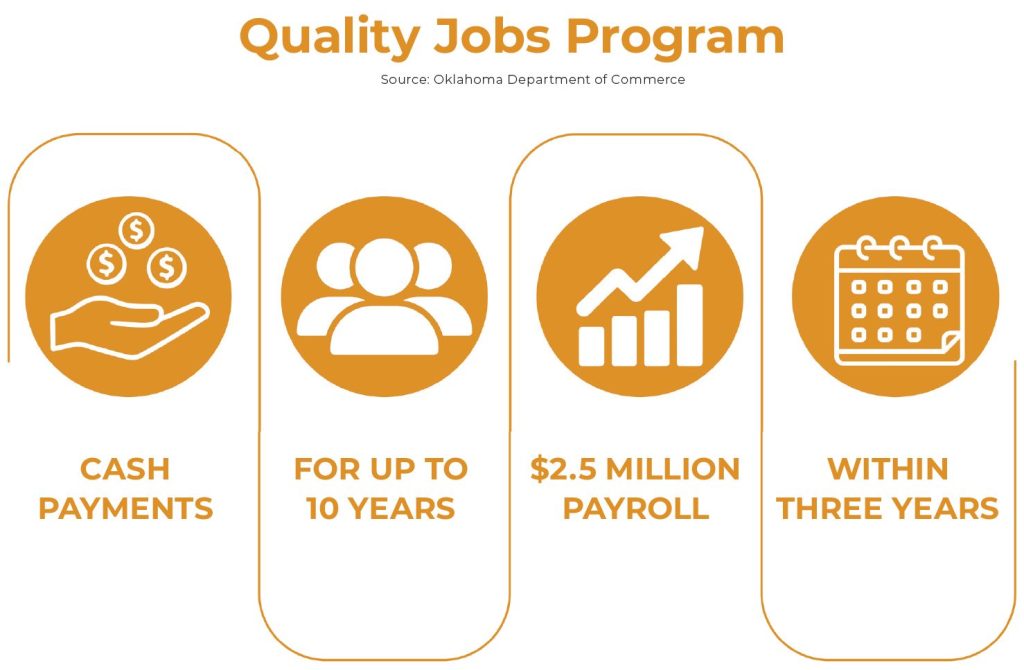
The crown jewel incentive program in Oklahoma, though, is the Quality Jobs Program. It provides cash payments to the company for up to 5% of new payroll for up to 10 years. To be eligible for this cash benefit, a company must establish a minimum payroll of $2.5 million within three years. These must all be new full-time positions in Oklahoma, and the wages must be above the state average.
“We tell the company what their projected award amount will be based on the number of jobs they plan to create and the wages they will pay,” says Cooper. “You can receive up to 5% of your payroll paid back to you in cash on a quarterly basis. We also offer a targeted quality jobs program for small employers. They do not have to prove out-of-state product sales if they are a manufacturing firm. But if they are a services firm, they do.”
Quality Jobs Equal Cash Back
Commerce also administers a 21st Century Quality Jobs Program that requires qualifying employers to pay a minimum annual wage of $130,723 per employee and create at least 10 new full-time positions within three years. It also requires that at least 50% of the company’s sales each year be to out-of-state customers.
“Employers like our Quality Jobs incentives because they are all cash-back programs,” says Cooper. “They also like our Business Expansion Incentive Program because it provides annual cash payments to help existing companies expand in Oklahoma. It requires at least $2 million in capital investment and $2 million in existing payroll.”
The BEIP targets major capital investments in depreciable items like equipment and buildings. Qualifying companies may choose to receive direct cash payments or payments that service private bonds.
A research team at Commerce analyzes the data to ensure that “everything we do results in a positive net investment for the state of Oklahoma,” Cooper says. “We came up with the BEIP incentive program during the pandemic of 2020 and 2021. The Oklahoma Finance Authority sat down with Commerce and said, ‘How can we help our existing businesses get through this?’ That’s when we came up with BEIP.”
Commerce fields applications from businesses during a two-week period each year. “This enables us to support smaller existing businesses in Oklahoma,” says Cooper. “If you have a $625,000 payroll and a $50,000 capital expense, you can apply for aid. We had several hundred businesses that we helped this past year through the BEIP program. We can support any Oklahoma company through this program.”
To date, Oklahoma has seen nearly 4,000 new jobs created through BEIP.
Other notable incentive programs paying dividends for Oklahoma are the Cybersecurity Software Workforce Tax Credit, Aerospace Industry Engineer Workforce Tax Credit and Civil Engineering Workforce Tax Credit. Cybersecurity software employees who have received a degree from an accredited institution in Oklahoma can receive a tax credit of up to $2,200 annually, or $1,800 annually for qualifying employees who are awarded a certificate from a technology center. The credit may be claimed for up to seven years of employment.
The aerospace workforce tax credit allows aerospace companies to receive a tax credit equal to 5% of the compensation paid to an engineer until January 1, 2031, or 10% if the engineer graduates from an Oklahoma college or university (up to $12,500 per employee per year), plus another credit of up to 50% of the tuition reimbursed to the employee until January 1, 2031. Additionally, the engineer hired receives a tax credit of $5,000 per year until January 1, 2031. The civil engineering workforce tax credit provides the same benefits.
Legislature Adds to Toolkit
Cooper emphasizes that all award applicants are scrutinized by an incentives evaluation commission before any award is granted. “Each incentive proposal goes before this commission. A report on each project is put together,” he says. “The majority of our programs are designed to help existing Oklahoma employers grow, but they can also be effective tools in attracting new employers to invest in Oklahoma.”
This is why Oklahoma Commerce never stands pat. In the most recent legislative session, Commerce worked with lawmakers to pass several bills aiding economic development efforts statewide. These measures included:
- HB 2781, which created the Reindustrialize Oklahoma Act, paving the way for Emirates Global Aluminium to announce an investment of $4 billion that creates the first new aluminum production plant in the U.S. in 45 years.
- HB 2110, which created the Bringing Sitcoms Home from Hollywood Pilot Program, the goal of which is to promote live episodic TV shows being recorded in Oklahoma.
- HB 2374, which makes improvements to the Filmed in Oklahoma Act, which has generated a $531 million economic impact for the state to date.
Cooper says Commerce constantly monitors what other states are doing to ensure competitiveness in the Sooner State.
“We believe that companies want to look at their overall costs of doing business,” he says. “At the end of the day, what is the bottom-line long-term benefit of a company coming here and investing in Oklahoma? When you look at what we offer in land costs, taxes, power costs, etc., I believe that companies choose Oklahoma because they know they get the best deal right here.”