
by AKANKSH CHANDRA SHEKAR,
SENIOR RESEARCH ANALYST, TRACTUS INDIA
Apple assembles at a greater scale in India than any other foreign manufacturer, with the deepest incentives and the most experienced contract partners in the country. Even so, Reuters reported in April 2025 that iPhone manufacturing costs in India ran 5% to 8% above China, rising to 10% on some models, largely because components still arrive as dutiable imports.
Indian assembly wages are a fraction of Chinese wages. The wage gap did not survive contact with the rest of the account. If it does not survive for Apple, it is worth asking why it would survive for a first-time entrant with none of those advantages. Every China-plus-one presentation opens with a wage chart, and India always sits at or near the bottom of it. The chart is right. However, the conclusion is not. India is not cost-effective. India is low cost in exactly one line item: wage.
Direct labor is a modest share of delivered cost in most engineered products. Power, logistics, duty and working capital, by contrast, are not. A location can be 20% cheaper on wages and 8% more expensive delivered.
The First Question: What an Investor Is Actually Measuring
Five numbers matter more than the wage rate, and in most board packs we are asked to review, at least three of them are missing or wrong. An example from our own client work makes the point. Tractus was asked to assist in selecting a site for an apparel manufacturer setting up its presence in India, comparing two states. The incentives line carried the headline value of the state schemes as though it were money in hand. It did not account for what the schemes actually require: eligibility thresholds, the timing of disbursement and the conditions attached to each claim. Corrected, the two states no longer ranked in the same order.
- Man-hours, not hourly rates. Analysis published by Prosperiti in March 2026 puts the Indian factory at approximately 47.2 man-hours against 40 in Vietnam. The Indian unit is around 18% more expensive in man-hour terms, and Vietnamese factories complete a comparable order 23% faster.
- Logistics is no longer the objection it was. India’s logistics cost is now 7.97% of GDP on the NCAER assessment for the Department for Promotion of Industry and Internal Trade, in the same band as the United States, Germany and Australia. The national average, however, is not the number that decides a site. KPMG’s 2025 analysis puts export process dwell time at between 46.3 and 149.4 hours depending on the port, a spread settled by the choice of district long before it is felt in the freight budget.
- Power is where India quietly loses. This is the one investors are least prepared for. Work published by the Centre for Social and Economic Progress finds commercial and industrial users paying well above the cost of serving them, precisely because bulk users are inexpensive to serve and politically straightforward to charge. Cost-reflective pricing, the same research argues, would mean lowering those tariffs, not raising them. In July 2026, the Southern India Spinners Association asked the Tamil Nadu government to recalibrate industrial tariffs against actual factory utilization, arguing that fixed charges had risen from around US$3.70 to US$6.80 per kW and that peak hour duration had been extended from eight hours.
- Duty on your own inputs. According to the Centre for Social and Economic Progress in April 2026, India’s 10% to 15% most favored nation tariff band covers US$242 billion of imports, some 54% of total import value, and 66% of those tariff lines, worth US$138 billion, are intermediate and capital goods. The result is a structure that raises the input cost of the very goods a manufacturer intends to export.
- Compliance is a line item, not an overhead. TeamLease RegTech’s case study of a single solar plant with a corporate office in another state counts 799 unique obligations resolving into 2,735 compliance instances a year, 83 of which carry imprisonment provisions, mostly for procedural lapses under labor law. Those instances resolve into roughly 11 discrete actions on every working day. The Occupational Safety, Health and Working Conditions (Central) Rules, 2026 require every factory ordinarily employing 250 to 500 workers to appoint a welfare officer, with a further officer for every additional 500, and set qualification standards for the role rather than leaving it a designation. In our experience a single-state plant of 300 to 500 workers runs three to five full-time equivalents on compliance once HR and EHS administration are counted, before a second state is added.
The Second Question: Where Inside India the Number Holds
In Nasscom’s “Beyond the Metros” analysis of India’s global capability center market, tier two locations offer a 20% to 30% salary differential and real estate costs 40% to 50% below metro levels, with attrition at 12% to 15% against 20% to 25% in the metros.
None of this makes tier two the automatic answer. Randstad’s 2025 to 2026 salary data put the senior professional gap at 12%, against the 20% to 30% differential Nasscom reports across roles generally. Tier two delivers on scale roles and much less on leadership roles, which is precisely the layer that determines whether the site works at all.
For manufacturing, geography settles it rather than salary. Inexpensive inland land is not inexpensive if it sits 300 kilometers (186 miles) from the export gateway, and freight to port tends to consume the land savings within the first lease cycle.
Take a garment plant near Bengaluru shipping 500 containers a year to Chennai. Our analysis shows the current road rates put the 350-kilometer (217-mile) haul at about US$190 for a 32-foot container. Move the site 150 kilometers (93 miles) further inland for cheaper land. Incremental kilometers price below the average, since loading, detention and port entry are fixed, so at around US$0.42 per kilometer against an average of US$0.54, the extra haul adds about US$63 to every container. That is roughly US$31,500 a year every year, against a land saving taken once.
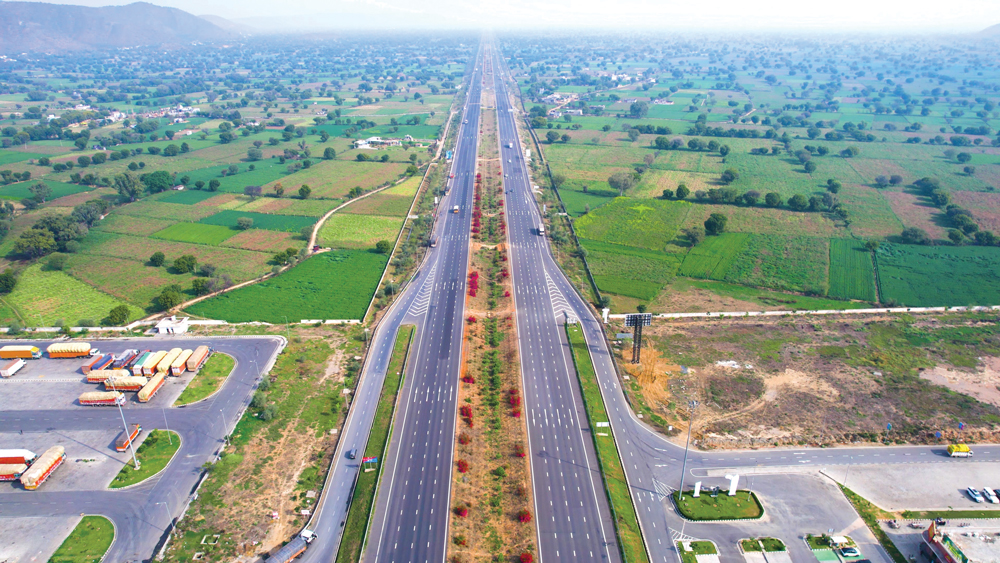
Logistics is no longer the objection it once was in India, thanks in part to projects such as this 8-lane highway near Mumbai. But moving inland for less costly land can still be outweighed by the cost of getting freight to a port.
Photo by amlanmathur: Getty Images
The Third Question: Who India Is Really Being Compared With
India is being compared to countries that have already repriced while the wage chart stayed still.
Vietnam is the instructive case, because it is the location most often held up as the alternative. CBRE puts northern tier one industrial land at approximately US$143 per square meter for the remaining lease term in the second quarter of 2026, up from US$137 at the end of 2024, with tier one occupancy at 81.3%. Vietnam remains an excellent manufacturing location. It is no longer an inexpensive one.
Indonesia competes hardest on industrial power tariffs, which is precisely where India is weakest. According to Indonesia’s Ministry of Energy and Mineral Resources, Jakarta has frozen electricity tariffs for three consecutive quarters through September 2026, with the energy ministry stating explicitly that the freeze is intended to protect industrial competitiveness even where its own adjustment formula would have permitted an increase.
The Fourth Question: What to Measure Before the Decision
First, build a delivered cost model, not a wage model. It must include the effective tariff at the point of supply, including open access charges, cross-subsidy surcharge and state electricity duty; duty exposure on imported inputs assessed at the tariff line; inland freight to the designated export gateway; and the compliance headcount set out above, with attrition costed at two to three months of lost productivity per departure.
Second, price the curve, not the entry point. Run every candidate location on a 10-year escalation basis. Locations that look identical in year one routinely diverge by 20% or more by year seven.
Third, treat incentives as something to negotiate, not something to receive. This is where the real differential sits, and it is the element most companies leave on the table. State capital subsidies, SGST reimbursement, electricity duty exemption, stamp duty waiver, land at concessional allotment rates and skill development support are all negotiated instruments, and the terms available to a well-prepared investor bear little resemblance to published policy. A credible local partner usually pays for itself on this line alone.
The negotiation rarely runs through the published scheme. It runs through the state investment promotion board, which can approve a customized package outside it. Published policy sets the floor for a routine applicant.
What moves is rarely the headline percentage. It is the ceiling on total disbursement, the definition of eligible fixed capital investment, the reimbursement period and the land terms. Secure them in the sanction letter rather than a summit memorandum, and negotiate before the site is committed and before the announcement, because the announcement is the only currency the investor holds and it is spent once.
Why India as a Country Choice
What India offers is scale, a deep engineering and managerial base, a domestic market that most of the peer set cannot offer on any terms, and a cost position that is good rather than exceptional once everything has been counted. That is still a strong proposition.
The sequence is simple. Decide what the site is for, count everything that mandate actually touches and run the count across the life of the asset rather than the life of the business case. Do that and India will win a good number of mandates on merit and lose others honestly, which is a considerably better outcome than winning one on a wage chart and losing it in year two.