When translating an innovative concept from scribbled paper into a functional product, sometimes entrepreneurs need a lift.
In North Dakota, leadership places capital behind the state’s Legacy Investment for Technology (LIFT) approach. The LIFT loan fund program was implemented to aid in diversifying the state’s economy, providing low-interest debt financing to innovative companies in need of a funding boost to pursue applied research, experimentation and operational testing.
It targets key industries — such as advanced computing, agriculture technology, autonomous and uncrewed vehicles, energy, health care, value-added agriculture and value-added energy — that present the best opportunity for diversification pinpointed by the LIFT Committee. The program is open to innovators aiming to grow in North Dakota, whether already located there or interested in moving into the state to commercialize intellectual property.
“This program underscores the state’s ability to compete at the highest levels,” says North Dakota Department of Commerce Economic Development & Finance Program Manager Carla Valentine. “It also highlights the entrepreneurial spirit driving growth and transformation in our region.”
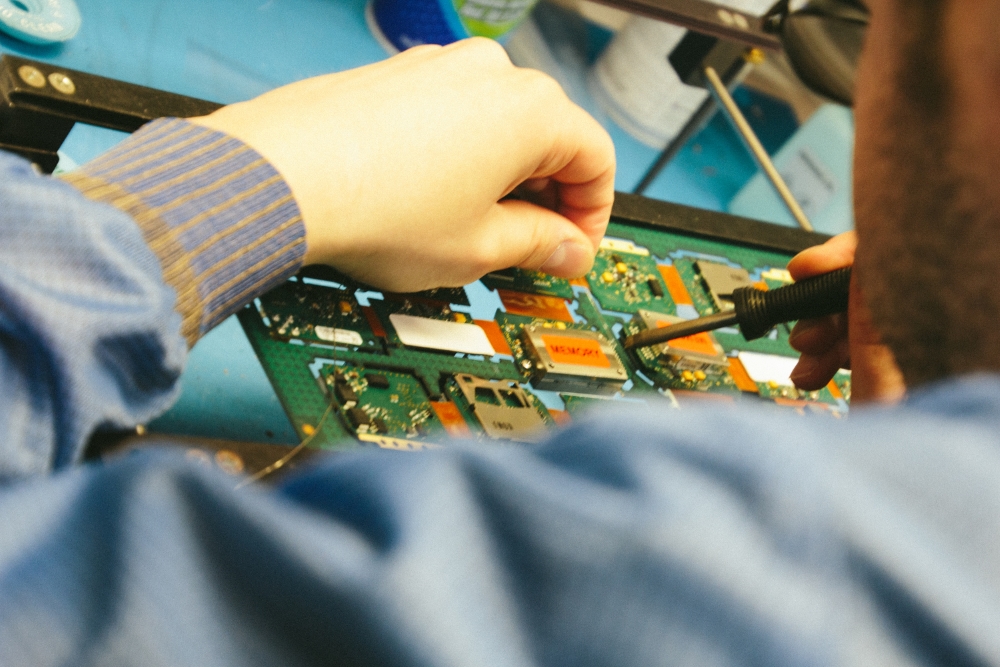
Appareo Systems leveraged its LIFT loan to develop a new product that later led to the company being acquired by AGCO Corporation.
Photo courtesy of North Dakota Commerce
Since its launch in 2019, the revolving LIFT fund has distributed over $47 million toward 75 awardees, supported by a $50 million allocation from the North Dakota Legislature. The five-year loan carries a 0% interest rate in its first three years, rising to 2% in year four until complete payment by the end of year five. This model has proved beneficial for smaller companies operating in the state, as it reduces early financial pressure while supporting critical growth stages.
“Offering interest-free debt financing for the first three years enables companies to commercialize their intellectual property using non-dilutive capital,” Valentine continues, “essentially providing cost-free funding until they achieve consistent revenue post-commercialization.”
For businesses that have already reached post-revenue commercialization status, she notes the LIFT loan fund structure allows them to begin commercializing “on the shelf” technologies. In this case, the interest-free period allows them to accelerate development and move these technologies into the market faster.
According to an economic forecasting and impact analysis using the REMI TAX-PI model tailored to North Dakota’s economic regions, economic activity supported by LIFT funding is anticipated to increase North Dakota’s economic output by $514.9 million in 2026, resulting in an estimated $305.2 million per year increase to the state’s GDP and the creation of 2,320 direct and indirect jobs.
Reaching the Next Level
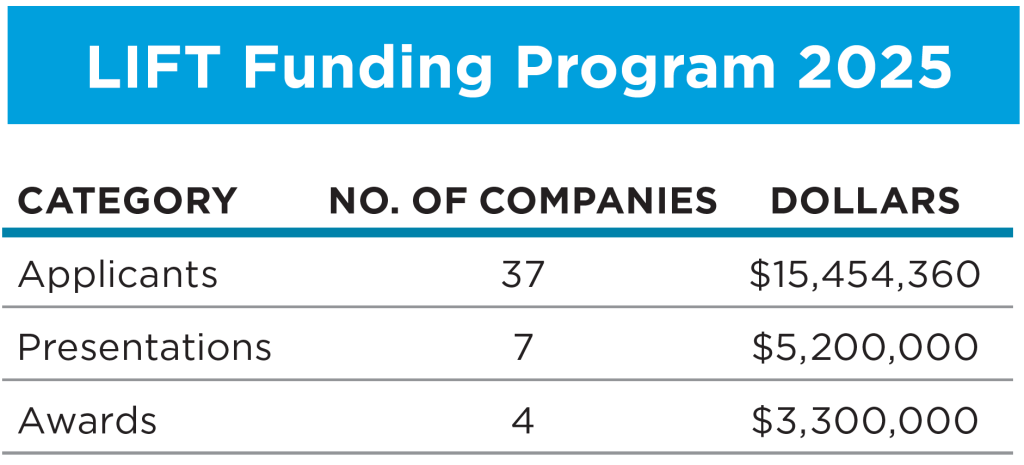
In 2025, two LIFT funding rounds were conducted. A total of 37 companies applied, of which seven were invited to present to the LIFT Committee. Ultimately, four companies received awards. In all, this represents more than $15.4 million in funding requests, $5.2 million in presentations, and $3.3 million awarded.
To date, the highest number of LIFT loans have been awarded to advanced computing & data management, health care and agricultural technology. These are the sectors that have shown the highest interest since the program’s inception, according to Valentine. Uncrewed aerial systems, energy, value-added energy, value-added agriculture and manufacturing follow close behind.
The committee aims to select projects that can use LIFT funding to streamline commercialization or secure a patent for their technology; or create or expand companies that attract products, investment or jobs in North Dakota; and select companies that showcase the ability to repay the loan. Funding cannot be used for capital investments, equipment purchases, workforce training, administrative expenses or academic research.
One standout LIFT success can be found in the story of Fargo-based electronics manufacturer Appareo Systems. The company was awarded $2.5 million through LIFT in the program’s inaugural year, applying the funds toward a pivotal product development which led the company to hire 70 new employees.
“Ultimately selling to AGCO Corporation,” Valentine says, referring to AGCO’s acquisition of Appareo Systems in 2021. “Which brought a Fortune 500 equipment manufacturer presence into North Dakota. This is exactly how LIFT is designed to work—convert applied innovation into jobs, scale and strategic industry growth.”
FlowCore Systems leveraged its $750,000 LIFT to scale oil and gas automation in Williston. The company specializes in chemical-injection automation solutions, providing high-precision measurement technology for the oil and gas industry. LIFT enabled the company to expand its R&D capabilities in 2021 to develop two new products that are now marketed domestically and internationally.
In addition, FlowCore expanded its team with three new employees as the company continues to advance its FlowSite IoT platform.
“FlowCore deepened partnerships with North Dakota businesses and integrated new automation and measurement technology into product development,” says Valentine.
Each year the committee sends out a post-award survey to companies with active LIFT loans. In 2025, 56 active loans were held by 45 companies in North Dakota, 40 of which responded to the survey. LIFT-supported companies currently employ 455 residents, translating to 153 net new jobs since receiving funding. Those same companies reported a $34.4 million annual revenue increase, leveraging over $80.9 million in additional investment attributed to their LIFT award.
For the state these outcomes demonstrate that LIFT continues to serve as a catalyst for both job creation and retention, driving innovation-led economic diversification and strengthening North Dakota’s competitive position in emerging industries.
“The LIFT initiative has shown that North Dakota is home to an impressive and diverse innovation ecosystem. We’ve seen groundbreaking ideas emerge across critical industries such as agriculture, energy, uncrewed aerial systems (UAS) and life sciences —alongside advancements in technology and data management,” says Valentine. “These sectors demonstrate that North Dakota’s innovators are not only solving local challenges but also creating solutions with national and global impact.”
Innovation Grows
Much of the fresh innovation coming out of North Dakota is driven by the needs of the local community. In central North Dakota, on the Fort Berthold Indian Reservation, the Mandan, Hidatsa and Arikara Nation (MHA Nation) was looking to enhance food sovereignty by establishing a greenhouse.
After three years of construction, the MHA Nation introduced phase one of its Native Green Grow (NG2) greenhouse in November 2025. The facility was built on a substantial portion of a 38-acre site near Parshall, in an effort to return to indigenous agricultural roots as a way to keep tradition alive and provide tribal citizens with a healthy, reliable food source.
“It’s one of the keys to ensuring that we survive, to ensuring our Nation will go into the future,” said MHA Nation Chairman Mark Fox. “Growing our own crops, generating our own power, maximizing our water sources and creating products to export so that when times do get rough, we’ve got a system in place that can really survive any difficulties that might lie ahead.”
NG2 is anticipated to produce up to 2 million pounds of food each year, featuring non-GMO and pesticide-free strawberries, cucumbers, lettuce and bell peppers to start. In order to grow these crops — aside from allocations from the Western Area Power Administration — the greenhouse will utilize electricity generated by compressed natural gas taken from oil wells within the Bakken formation oil fields on MHA lands.
The greenhouse is strategically based on greenhouse agriculture practiced in the Netherlands, which also uses this method for year-round, sustainable produce growth.
Phase one of the project included a nearly 5-acre greenhouse, although plans for additional phases will see an expansion of this facility and another adjacent greenhouse. At full buildout, NG2 will have the capacity to grow over 10 million pounds of food annually.
In February 2026, NG2 opened its own retail store on site, offering fresh produce, herbs and merchandise to the local and tribal communities. As site development continues, MHA looks to integrate warehousing, a heating plant and space for a seasonal farmers market. In order to expand economic development opportunities for MHA tribal citizens, an educational classroom will also be in the works at NG2 to teach the techniques of this growing method.
This initiative will enable the MHA Nation to not only meet local needs but open opportunity to expand international trade and connect with new domestic buyers.