
KY Innovation and KSTC bridge the gap between idea and growth capital.
From Kentucky Fried Chicken to the Corvette Stingray, innovative products and services flow from Kentucky as swiftly as legendary racehorse Secretariat ran away with the Kentucky Derby and the Triple Crown five decades ago. But a large stable of world-class technology startups and high-growth companies have also run their winning race in Kentucky over the last several decades.
Have you ever stopped to think about what produces these game-changing business ideas? Does Kentucky just have more creative people per capita than other states? Are they better marketers and promoters of their ventures? Or is it something else?
David Brock, executive director of KY Innovation, says Kentucky’s innovators compete with the best in the world because of the unique ecosystem that has been fostered and funded for many years across the Bluegrass State. Strong collaboration among public and private entities dedicated to advancing technology innovation-based economic development sets Kentucky apart.
“The Kentucky Science and Technology Corporation (KSTC) has been a powerful partner in building the state’s innovation economy for decades,” Brock says. “KSTC’s has been and remains critical to identifying, supporting and funding many of the state’s most promising technologies and startups.”
The KY Innovation Hubs are one of several programs KSTC helps manage and support alongside the Cabinet. Brock says the Hubs are a crucial entry point for startups seeking everything from coaching to connections, whether that is to capital, customers or the one relationship that can change the trajectory of a young company.

The independent organizations also act as a unifying force for each region’s unique assets, bringing together and helping entrepreneurs navigate universities, accelerator and incubator programs, investors, established companies and other key stakeholders. The six hubs — Amplify, Blue North, SOAR, Awesome Inc., CREATE and Sprocket — collectively serve startups in all 120 Kentucky counties.
KSTC works with the Cabinet to implement a number of other key initiatives supporting companies on the path to success. Those include the Kentucky Science and Engineering Foundation’s (KSEF), which advances technologies and early-stage companies with an emphasis on preparing them to compete for federal Small Business Innovation Research (SBIR) grants and contracts.
Kentucky Commercialization Ventures, is a first-in-the-nation initiative that allows faculty, staff and students at all public higher education institutions to turn their ideas into breakthrough products and companies.
“KSEF and KCV are excellent examples of how Kentucky is on the forefront of turning ideas into economic development impact,” Brock says. “Both programs have become national models for ways to drive commercialization and increase access to high-level expertise. Many of Kentucky’s most successful tech firms got their start with a boost from working with KSEF and our SBIR/STTR Matching Funds program. We are already starting to see the transformational effect KCV can have in encouraging innovation on our campuses.”

“We have a chance to grow and build clusters in Kentucky. We can take a big step forward when it comes to high growth. Along with KSTC, we have been growing the Kentucky technology sector for the past 25 years.”
— David Brock, Executive Director, KY Innovation
Measuring the Impact
In fiscal year 2025, KSEF offered more than 1,200 consultations to companies that secured 34 SBIR/STTR awards totaling more than $16 million. In the last fiscal year, KCV provided more than 550 coaching sessions, connected innovators to more than 150 funding opportunities and lead proposals that were awarded more than $1 million for participating faculty, staff and students. In the last two years, KCV has also secured more than $9 million in federal award to expand university ability to pursue research and commercialization funding and initiate internship programs for Kentucky students.
KCV created a startup internship program for students in addition to building a successful fellowship program that funds university innovators in a number of ways. In fiscal year 2023-2024, KCV produced a total of 12 successful ventures and secured $8.6 million in funding to fuel more innovation at Kentucky colleges and universities.
Investing in Kentucky’s innovators
Brock adds that KSTC has been central to Kentucky’s early-stage venture capital system for many years. Keyhorse Capital, KSTC’s venture arm, manages the state-sponsored Kentucky Enterprise Funds, which has invested in more than $59 million in 558 companies since its creation. That funding has led to more than $3.2 billion in follow-on investment.
In 2023, Kentucky qualified for $117 million in funding from the U.S. Treasury through the State Small Business Credit Initiative (SSBCI). Brock says that award, which is also managed by Keyhorse Capital, has provided a once-in-a-generation infusion of early and growth-stage capital for the state.
“We devoted 70% of that money to investment capital and Keyhorse and KSTC have helped ensure we are meeting the significant growth-stage demand and taking advantage of new opportunities we wouldn’t have been able to retain or grow her in Kentucky in the past. The impact of KEF has been massive. The SSBCI funding has allowed us to create a pipeline of future economic development success stories in Kentucky.”
‘Conveners and Collaborators’
Terry Samuel, president of KSTC, says that about half of his organization’s programs are closely affiliated with the Kentucky Cabinet (CED) and are funded by CED.
“Those programs include a K-12 STEM Education Program and a program that we run for tech startups,” he says. “Our work covers a wide variety of programs. We run a program that helps exiting military service members enter into good jobs in Kentucky. But our biggest role, from Paducah to Pikeville, is that we are conveners and collaborators. It is all about what we can do for Kentucky. That is the biggest part of what we do.”
KSTC focuses its efforts on helping tech startups and tech-enabled companies grow. Samuel and his team collaborate with KY Innovation and multiple other programs to identify entrepreneurs and startup ventures that need help; and then they get to work.
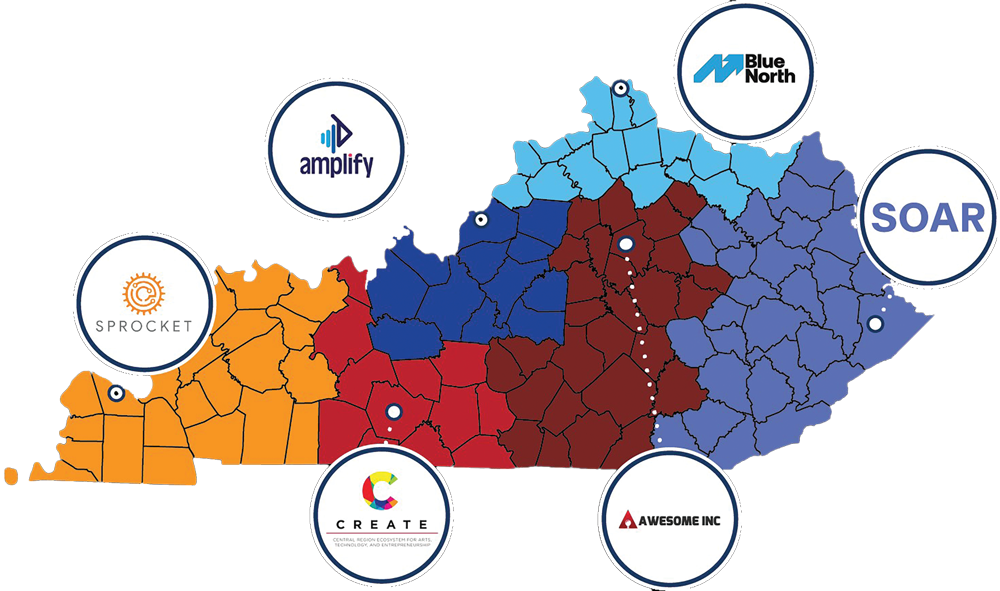
There are six KY Innovation Hubs in the state, and they are organized by region.
Map courtesy of CED
The success stories that have emanated from these efforts are growing on a regular basis. They include successful startups like pharmaceutical unicorn Apellis, which grew out of technology developed in a lab at the University of Louisville.
“They did an IPO and now they are a big name in the pharma field. A lot of Kentuckians made money and learned valuable skills here because of that. It is definitely a positive,” says Samuel.
Kanbol Inc. in Western Kentucky is another bright spot.

“Our biggest role, from Paducah to Pikeville, is that we are conveners and collaborators. It is all about what we can do for Kentucky. That is the biggest part of what we do.”
— Terry Samuel, President, Kentucky Science and Technology Corp.
“They are replacing disposable food packaging by using agricultural fibers,” Samuel says. “University of Louisville and University of Kentucky are piloting their products and generating real-world feedback for the company.”
To date, the firm founded in Louisville in 2020 has raised $3.5 million in capital, has seven employees, and is securing 95% of its feedstock from Kentucky.
Another shining star is Paducah startup Santerre International, which recently secured a $100,000 AgTech Grant with help from KSTC.
“They are taking problematic Asian carp out of our waterways and then using the carp to produce high nutrient fertilizers. KSTC has made an investment in that company,” says Samuel.
ElectraMet, a Lexington startup that removes metals like copper from wastewater, is tied to Toyota and is also working with KSTC.
“Toyota is piloting ElectraMet technology in their automotive assembly plant inGeorgetown, Kentucky,” Samuel says. “This is yet another great Kentucky-born success story.”
Pretty soon, KSTC will expand its efforts to include a specialized program to back defense industry startups.
“Kentucky has done well in SBIR but not in Department of Defense SBIR,” Samuel says. “We have a new program that is working with a group in Ohio which received funding from the DOD. We are calling it FORGE. The goal is to grow more business startups out of the U.S. Air Force.”
Another program that receives assistance from KSTC and the Cabinet, is the KY APEX Accelerator, which promotes inclusive economic development by linking minority-led small enterprises with federal, state and local resources. In 2023-2024, APEX assisted 2,894 clients and helped them secure $737.6 million in federal contracts and $3.07 billion in non-federal contacts.
Brock of KY Innovation notes that the partnership with KSTC has been an important part of implementing the state’s Collaborative Blueprint, its strategic plan for economic development.
“Entrepreneurship was identified as a key enabler of success across all our key sectors. We have a chance to establish thriving, innovation-driven industry clusters across the state by building on Kentucky’s foundation as a pacesetter for early-stage startup support, and by helping more high-growth businesses stay, scale and become the next Kentucky companies with household. KSTC is vital to achieving that.”