
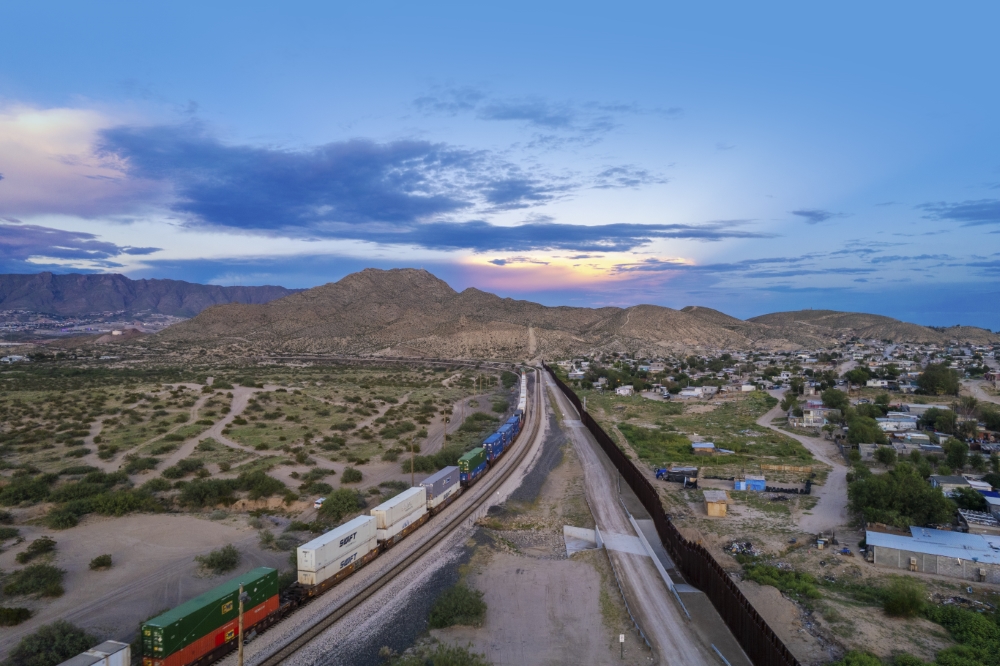
by Savannah Yawn
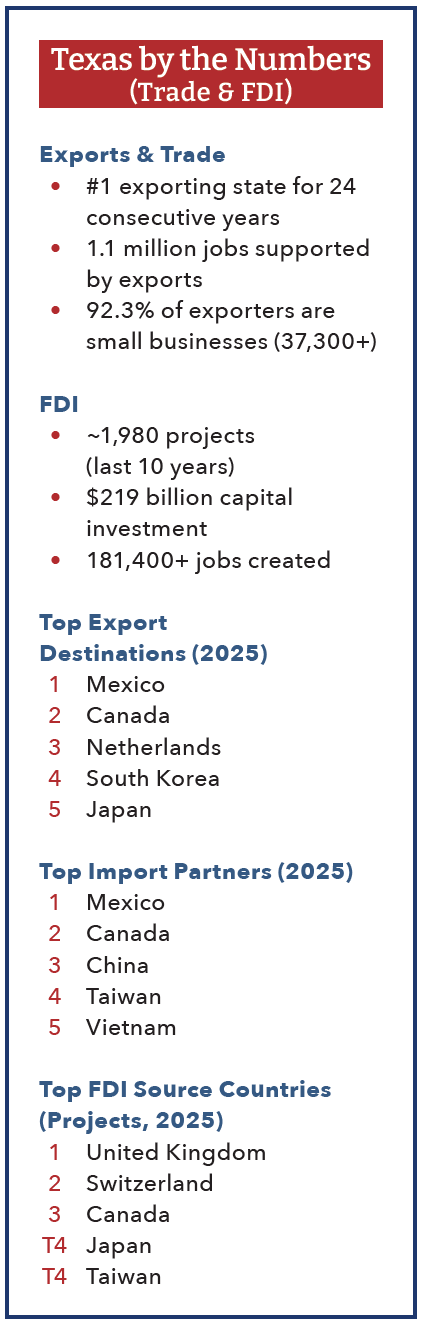
Texas has long held its position as the nation’s top exporting state and is on a mission to extend it. For the 24th consecutive year in 2025, Texas ranked No. 1 in exports, while continuing to draw foreign direct investment (FDI) at a pace unmatched by any other U.S. state over the past two decades.
That performance is not incidental. It reflects a coordinated strategy that pairs global outreach with physical infrastructure and a business climate designed to attract international firms. More than 2,200 foreign corporations now operate in Texas, underscoring the state’s role as a central hub for global commerce.
A key component of that strategy is the state’s growing international presence, led by the Texas Economic Development & Tourism Office within the Office of the Governor. Texas has maintained a formal economic presence in Mexico since 1971 through its State of Texas Mexico Office, with locations in Mexico City and Monterrey. The office promotes Texas exports while working to attract investment from the state’s largest trading partner, which is an increasingly critical relationship as nearshoring accelerates across North America.
In 2024, trade between Texas and Mexico totaled $281.2 billion, making Mexico the state’s No. 1 trading partner for at least the past 17 years. Mexico also ranked as Texas’ top export destination, receiving $123.7 billion in goods, while serving as its largest source of imports at $157.5 billion. The depth of that integration positions Texas as a primary gateway for cross-border manufacturing and distribution across North America.
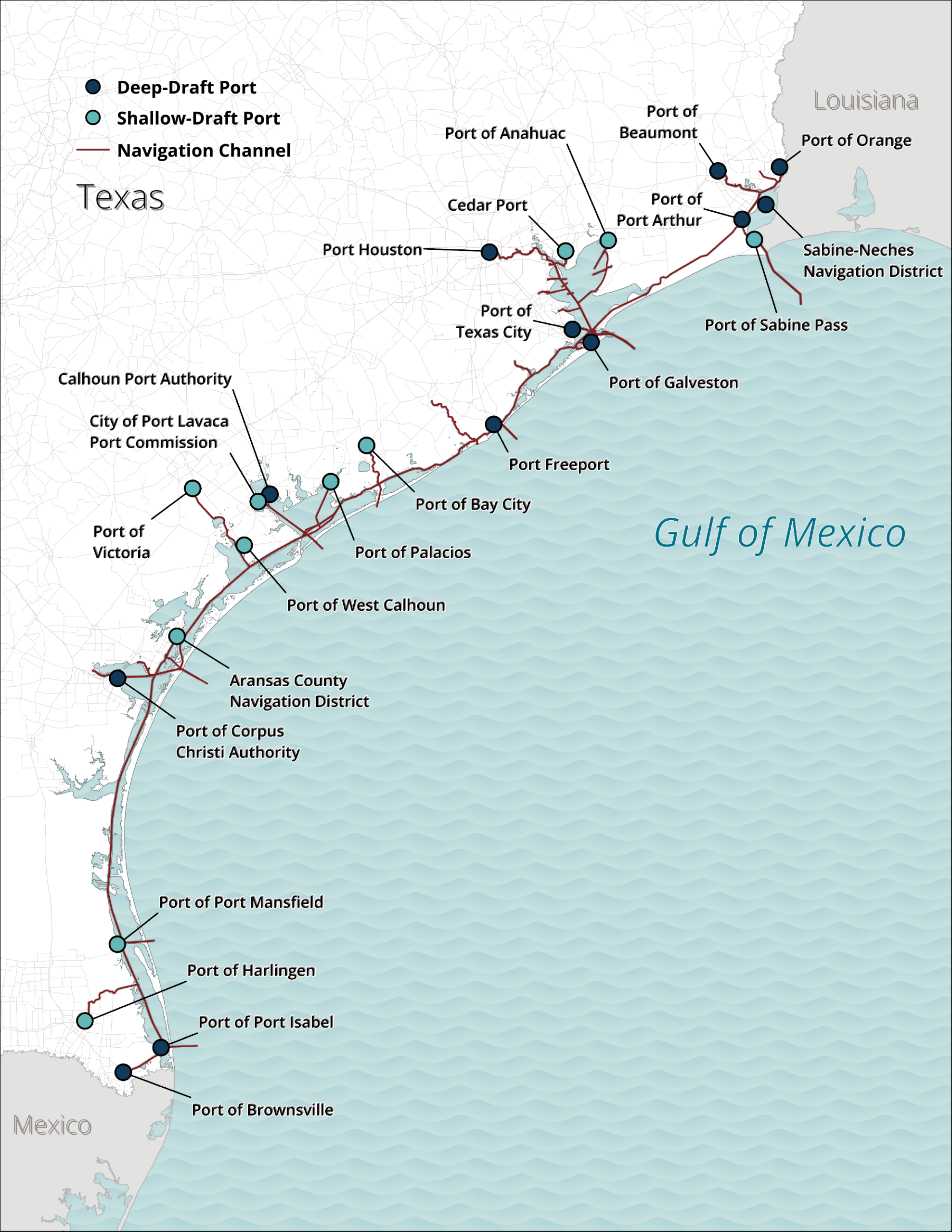
Map courtesy of the Texas Department of Transportation
More recently, Texas has expanded its global footprint into Asia with the establishment of the State of Texas Taiwan Office. The move reflects both the scale of the existing relationship and its future potential.
In 2024, trade between Texas and Taiwan totaled $25.6 billion, making Taiwan the state’s sixth-largest trading partner. Taiwanese companies have invested $13.9 billion in Texas and created more than 5,000 jobs, with activity concentrated in semiconductors, electronics, energy and petrochemicals. Texas’ leadership in semiconductor and electronic component exports, where it has ranked No. 1 for 15 consecutive years in 2025, further reinforces that alignment.
“Both Texas and Taiwan have experienced miraculous economic growth in the last few decades, becoming pivotal economies for our regions and driving the future of innovation by providing economic freedom and opportunity for our people,” said Governor Greg Abbott, while on an economic development mission to Taiwan in 2024.

Texas Governor Greg Abbott stands with a delegation outside the U.S. Embassy in London during an economic development mission to the United Kingdom.
Photo courtesy of the Office of the Texas Governor
The Taiwan office is one piece of a wider push to extend Texas’ global reach. Additional expansion is underway. Texas has formalized a statement of mutual cooperation with the United Kingdom, aimed at strengthening trade and investment ties between the two economies. The agreement outlines collaboration across sectors including energy, technology and advanced manufacturing, while also supporting increased business engagement and market access between Texas and the UK.
As one of the largest sources of foreign direct investment into Texas, the UK represents a key partner in the state’s broader international strategy. UK trade officials at the time of the agreement noted it would make it easier and less expensive for UK and Texan firms to thrive in each other’s markets, and would also encourage shared expertise in areas such as life sciences and professional business services.
Engagement with Israel is also advancing. Governor Greg Abbott has participated in shared leadership forums and led economic development missions to Israel, underscoring the state’s ongoing efforts to deepen economic and cultural ties. Building on that foundation, the State of Texas Israel Office was approved during the 89th Legislative Session in 2025, with plans to launch this year to support Israeli business expansion and increase Texas exports to the region.
Ports Powering Global Reach
If international offices represent the state’s outward-facing strategy, its ports form the operational backbone that enables it. According to the Texas Ports Association, Texas ports collectively generate $713.9 billion in economic activity — equivalent to 28% of the state’s GDP — and move more cargo than any other state. In total, the system handles more than 746.4 million tons of cargo annually and served nearly 1.5 million cruise passengers in 2023.
The scale of activity is concentrated across a network of globally significant gateways. Port Houston anchors containerized trade and ranks as the nation’s leading port for waterborne foreign tonnage, while Port of Corpus Christi has emerged as a critical hub for energy exports, particularly crude oil and liquefied natural gas.
Further along the Gulf Coast, Port of Beaumont plays a key role in both bulk cargo and military logistics, complemented by major facilities in Port Arthur, Texas City and Port Freeport.
Together, this system supports 153,000 direct jobs and 2.5 million jobs tied to port-dependent economic activity, generating $196.7 billion in personal income and contributing $17.1 billion annually in state and local tax revenues. Six Texas ports rank among the top 20 in the U.S. by total tonnage, reinforcing the state’s position as a primary gateway for both domestic distribution and international trade.
That scale is matched by connectivity. With 23 seaports, 26 commercial airports, the nation’s largest freight rail network and 35 foreign trade zones, Texas offers direct access to global markets across multiple modes of transport.
The result is a self-reinforcing system: International offices build relationships and attract capital, infrastructure enables efficient movement of goods, and sustained export performance validates the model.
As global supply chains continue to become more complex, Texas is positioning itself to lead.