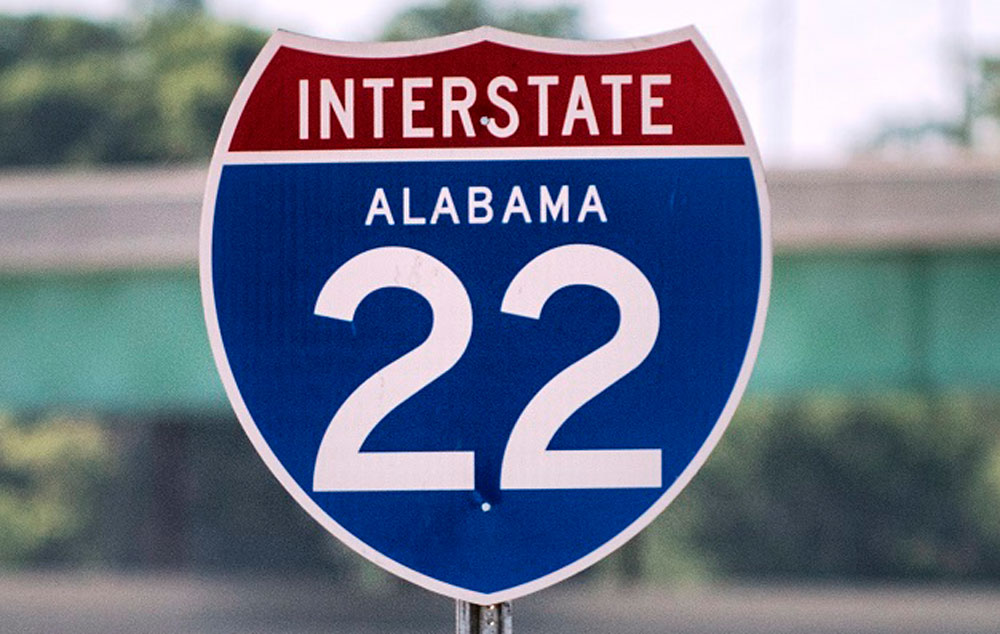
In June 2016, a ceremony was held to officially mark the completion of the connection between north-south I-65 and the new I-22 running for 202 miles from Birmingham, Alabama, to Memphis, Tennessee. It made Birmingham one of only three cities in the South (Atlanta and Nashville being the others) to have six Interstate highways emanating from their centers.
Thus ended a 40-year campaign to upgrade from the former U.S. Highway 78 spearheaded in the 1970s by the late Alabama Congressman Tom Bevill, whose work on the Tennessee-Tombigbee Waterway illustrated the importance of transportation infrastructure to the state economy. This time around it was the Appalachian Highway Corridor, later known as Corridor X.
Designation, however, does not mean development. Driving the new I-22 a few years ago on a holiday trip from Atlanta to St. Louis, I encountered rolling hills and beautiful countryside, but scant business presence. It reminded me of the sleepy 167-mile stretch of I-16 from Macon to Savannah, Georgia, where development didn’t really kick in until the Port of Savannah started booming and then the Hyundai metaplant showed up.
One man who’s seen the evolution of the I-22 corridor is David Thornell, the now semi-retired former leader at C3 of Northwest Alabama Economic Development Alliance and the author of “Small Town Solutions.” So far, the development at the region’s nine exits on I-22 has consisted of the typical (though welcome) truck stops like Love’s and Pilot, he writes. “Traffic continues to increase, as will opportunities,” he says. “Any Interstate boosts the desirability of a rural region, and for that we are grateful.”
Leveraging Strengths
What will it take to bring further growth to the I-22 corridor? Personal experience driving it is a start.
“I’ve spent much of my life in Birmingham and I-22 has been great because it’s so much easier to get to Memphis than it used to be,” says Anoop Mishra, vice president and regional executive at the Birmingham Branch of the Federal Reserve Bank of Atlanta, taking what he calls “a big chunk” out of the travel time.
He sees potential for places such as Franklin County and Red Bay (located at the Mississippi state line) to leverage the advanced manufacturing and logistics success of north and northwest Alabama communities such as Huntsville, Decatur, Sheffield, Tuscumbia and Florence-Muscle Shoals, a region known for its music and TVA heritage and the University of North Alabama, which has grown enrollment by 50% over the past decade to 10,600.
There is already a solid manufacturing base in Franklin County, featuring such companies as Tiffin Motorhomes and pet food maker Sunshine Mills in Red Bay and G&G Steel and Pilgrim’s Pride in Russellville.
“Franklin County has outkicked its coverage,” Mishra says, putting things in SEC football terms everyone understands. The area stands to further benefit from its relatively lower costs. “As Huntsville continues to expand out, one of the benefits of locating to a smaller area is lower land costs,” he says. “When talking about Red Bay or Russellville, we’re talking about 45 minutes from the Shoals or Huntsville. It’s still a reasonable proximity.”
Northwest Alabama has truly focused on “making sure we have infrastructure in place, not something that comes after the fact,” he says. Taking into account the connectivity that’s evolved with a trucking and logistics hub like Memphis, he says, “it makes a lot of sense to say if there were going to be some opportunities to explore, that would be a great corridor for it to happen.”
One avenue for such opportunities may be Opportunity Alabama, the organization focused around federal Opportunity Zones that is led by Alex Flachsbart, founder and CEO.
“With the renewal of Opportunity Zones and the expansion of benefits for those willing to invest in rural areas,” Flachsbart says in an email, “places like the I-22 corridor could offer the perfect growth conditions to maximize the tax benefits provided through an OZ investment.”