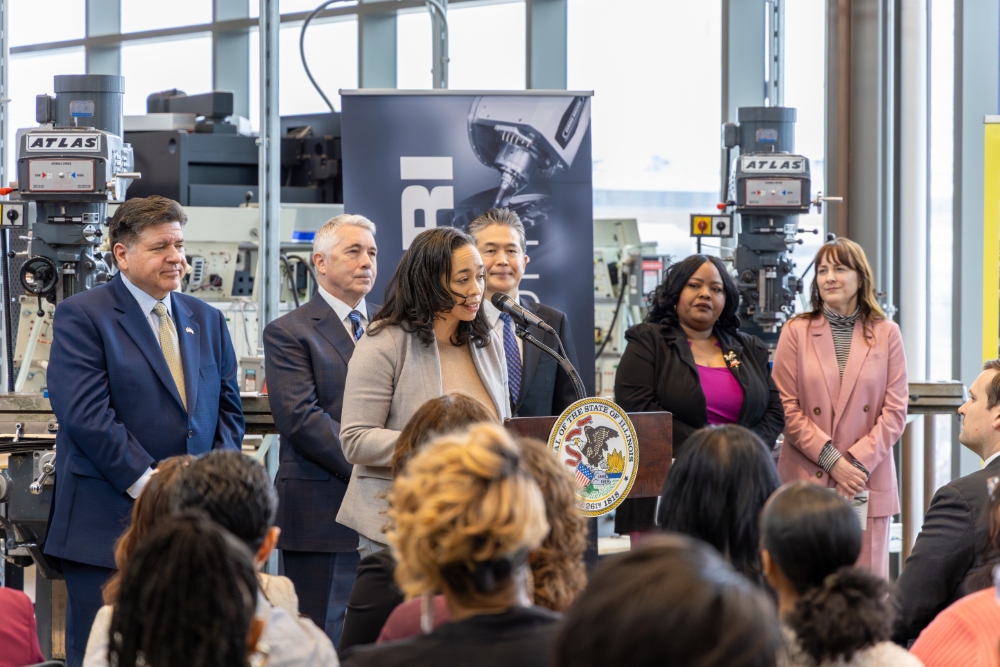
George: Strategic investments pay off for every corner of the state.
When you run one of the most successful economic development organizations in America, it can sometimes be a challenge to top last year’s performance.
For Christy George, president and CEO of the Illinois Economic Development Corporation (Illinois EDC), the challenge was met and surpassed when Illinois increased its total corporate facility project tally from 2024 to 2025. One year after finishing second in the nation with 664 projects, Illinois upped that total to 680 in 2025 and again captured the No. 2 ranking.
How significant is this performance? Consider this: Illinois easily bested third-place finisher Ohio, which had 467 projects last year, and every other state in the East North Central Region of the U.S. In fact, if you combine the tallies of the states that finished third, fourth and fifth in the region — Indiana, Michigan and Wisconsin — you would still be more than 200 projects shy of Illinois’ total.
Over the past five years, Illinois has finished either second or third in the nation each time. It is a testament to the hard work put in day in and day out by George and her relentless team at Illinois EDC. In the following interview, we sit down with George and take a closer look at this performance and how Illinois EDC achieves it.
What have been your state’s biggest economic development wins of 2026?
CHRISTY GEORGE: We’ve had an incredible year, with major wins across several of Illinois’ priority industries.
Hyundai Translead is opening its first U.S. manufacturing plants in Will County, investing more than $450 million and creating more than 2,500 new jobs.
Existing Illinois companies are also doubling down. IBM is establishing its FutureNow Chicago innovation and delivery center at the 128-acre Illinois Quantum and Microelectronics Park on Chicago’s South Side. The new hub will create 750 full-time jobs in AI, cybersecurity, data science, and other technology fields and will serve as an anchor tenant in the park’s new Quantum Works building. IBM is also developing an apprenticeship program with City Colleges of Chicago to help build its workforce. This is a fantastic showcase of how Illinois’ ecosystem is building.
We’re seeing similar momentum across the broader quantum ecosystem, with a growing number of companies establishing operations and hiring talent in Illinois.
Life sciences is another area of significant growth. CSL announced a $1.5 billion investment in Kankakee County that will add more than 300 highly skilled pharmaceutical jobs while retaining another 1,200. AbbVie is also making more than $575 million in investments in Illinois.
And the momentum extends well beyond those sectors. Pure Lithium is investing $46 million and creating 50 jobs in Chicago, while ADM is investing $103 million to modernize and expand its North American headquarters in Decatur.
What’s exciting is, this growth isn’t limited to a single sector or region. These investments show the breadth of Illinois’ momentum and the confidence companies have in growing here.
“The state’s economic development strategy is working. It is happening because we recognized that you have to first invest in yourself. We did that in 2019 with an investment of more than $50 billion in infrastructure.”
— Christy George, President and CEO, Illinois EDC
Which industries are growing at the fastest rate in Illinois now, and why?
GEORGE: Illinois is growing in all of our key industries: advanced manufacturing; next-generation agriculture, agtech, and food processing; clean energy production and manufacturing; quantum computing, AI, and microelectronics; life sciences; and transportation, distribution, and logistics.
Quantum is growing rapidly while the life sciences have seen the strongest percentage growth among Illinois’ priority sectors, with employment increasing 12% since 2021. But the broader story is that Illinois has been deliberate about investing in the assets companies need to grow. That starts with infrastructure. Since 2019, Illinois has committed more than $50 billion to infrastructure investment. We also have one of the nation’s largest community college systems and utility partners working to provide a reliable energy grid.
Illinois became much more intentional about economic development and energy policy beginning in 2021, and we are now seeing the results. From 2021 to 2025, Illinois added 368,000 jobs. That kind of growth comes from aligning infrastructure, workforce, energy, and economic development work around a common strategy.
How does Illinois support innovation and entrepreneurship?
GEORGE: At Illinois supports innovation by pairing significant public investment with world-class research, talent, and private-sector partnerships.
One fresh example: The Department of Commerce and Economic Opportunity will administer the new X-Labs Fast Fund, which will help attract and support teams working on breakthrough technologies.
Quantum is a great example of that broader strategy. Illinois is betting big on innovation with quantum — more than any other state in the nation. Recent announcements include Infleqtion’s Chicago Quantum Innovation Center, Zero Point Cryogenics launching a Chicago hub, and a longtime Illinois manufacturer, Ability Engineering Technology (AET), modernizing and expanding to develop and scale the development of quantum hardware.
Illinois has made major investments in the ecosystem since 2019, and we are seeing that commitment translate into companies establishing operations, collaborating with our universities and national laboratories, and building new technologies here.
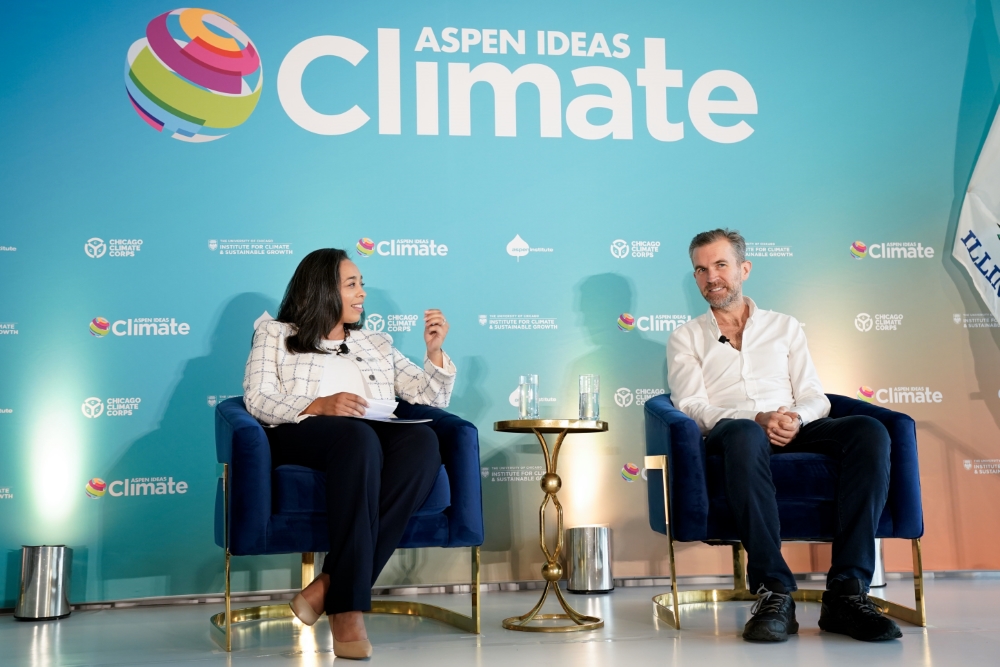
Christy George speaks at a recent Aspen Ideas Climate Conference.
Photo courtesy of Illinois EDC
Greater Chicago recently claimed yet another national No. 1 Top Metro Award from Site Selection Magazine for having more corporate facility projects than any other MSA in the country last year. What enables Greater Chicago to outpace all other American cities so consistently?
GEORGE: Chicago has a combination of assets that is difficult to replicate. Its corporate community is deeply civically engaged, and companies have access to a large and diverse workforce, world-class universities, national laboratories, and strong innovation and technology ecosystem. It’s exceptional connectivity.
Chicago also has an enormous professional-services talent base and a quality of life that helps companies attract and retain workers. The city’s diversity and central location also make it attractive. Taken together, those advantages give businesses confidence that they can scale and grow here for the long term.
Talent wants to live here, work here, and stay here.
Those opportunities don’t stop at Chicago — we have communities and economic centers with distinct strengths across the state.
What are three little-known facts about Illinois that you wish more people knew and understood?
GEORGE: One is that Illinois has an extraordinarily diverse economy. Manufacturing is a major strength, but so are agriculture and a range of other industries, and our manufacturing legacy supports supply chains and other sectors across the state. No one industry dominates the state’s economy, which allows for both stability and opportunity. Second, Illinois has tremendous depth in skilled and technical talent, including engineers, welders, and workers trained through our building trades and labor unions. That workforce is a real competitive advantage. Third, Illinois is one of the country’s strongest innovation economies. Our universities, national laboratories, research institutions, and private-sector partners create an environment where new ideas can move from research toward commercialization. Illinois universities are engines of innovation.
How do you engage in FDI promotion and attraction — and how is your state performing in that area?
GEORGE: Foreign direct investment is a major focus for Illinois, and partnerships are foundational to that work.
Our team travels internationally to build relationships with companies and investors, working alongside DCEO, Illinois’ international offices, consulates, and other partners. Trade missions also give us an opportunity to make the Illinois case directly in key global markets. Our team has recently traveled to London, Mexico City, Taiwan, and Tokyo.
Illinois has six regional trade offices across the globe, which work to encourage international companies to invest in Illinois. Many international companies see Illinois as a gateway to the North American market. Our central location, transportation network, workforce, and diverse economy give companies the ability to establish a U.S. presence and grow from here.
Illinois is a big state for agribusiness. What’s new in your state in this field?
GEORGE: Agriculture has faced real headwind over the past two years, but we continue to see significant investment across the sector.
ADM announced more than $100 million in new investment at its Decatur headquarters, and Incobrasa Industries opened a $250 million soybean-processing facility in Gilman that doubles the company’s production capacity to nearly 100 million bushels annually. Rural King, the farm supply store chain, is investing $75 million in a new headquarters project in Mattoon, in Central Illinois.
Life sciences saw the
highest percentage job growth at 12%
with nearly 75,000 new jobs added
since 2021.
Source: Illinois EDC
We’re also building strength in agricultural innovation. The Illinois Fermentation and Agriculture Biomanufacturing Tech Hub, or iFAB Tech Hub, is helping grow biomanufacturing and precision fermentation in the Decatur and Champaign-Urbana region. And in Southwest Illinois, the 15-mile Ag Coast is one of the assets helping Illinois producers reach domestic and global markets — this stretch along the Mississippi River is a supercenter for grain and fertilizer transportation and logistics.
So while the industry is navigating challenges, we’re seeing investment and innovation across the entire agriculture value chain — from production and processing to biomanufacturing and logistics.