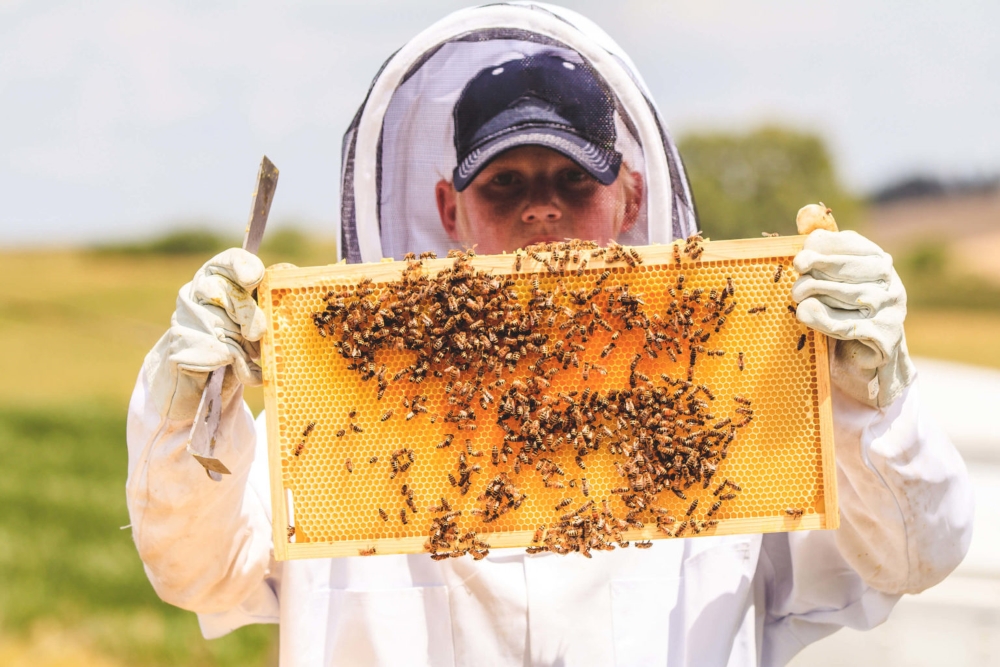
After 105 years in Sioux City, the Sioux Honey Co-op sticks with what works.
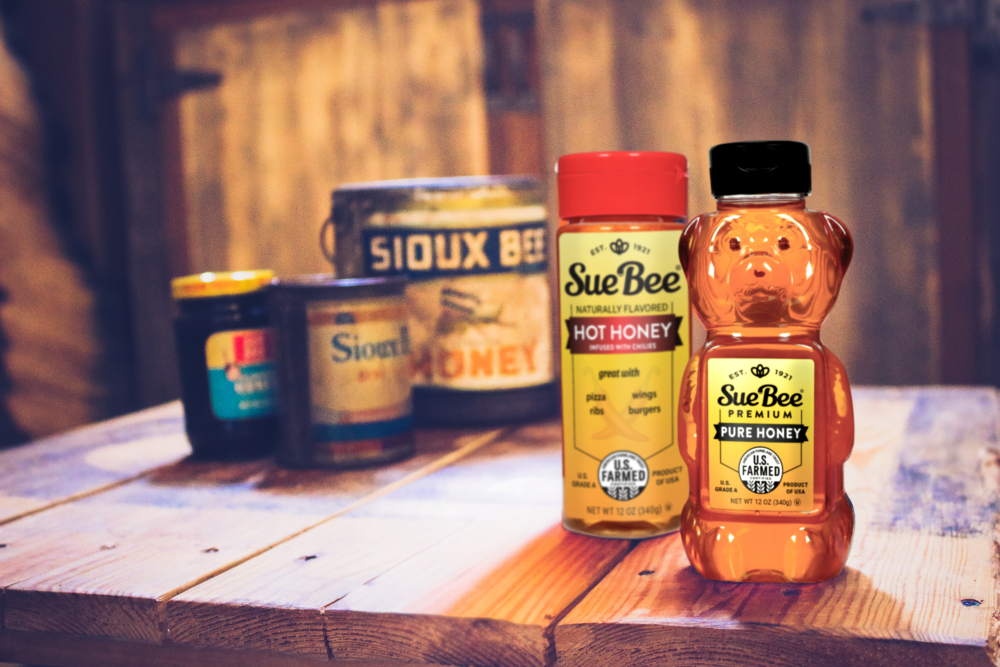
Visit the headquarters and processing operation of the Sioux Honey Co-op in Sioux City, Iowa, and the first thing you notice is the aroma of honey is just as sweet and enticing in large volumes as it is served on a warm biscuit straight from the jar or the famous plastic bears — bears you can watch flipped into position on the bottle orientator to be perfectly filled with golden honey warmed to 130 degrees.
Another thing that sticks out is tight quarters: Expert forklift operators and their teammates make tight turns and navigate all the right pathways to process more than 36 million pounds of honey a year, delivered in steel drums or custom-designed, molded plastic totes and representing between 25% and 30% of the entire U.S. honey market.
After it’s tested for color and moisture content, the honey is then transformed into an increasing number of SKUs, from commercial-scale honey for bakers to spun honey, hot honey and a growing number of localized and raw honey varieties for consumers who associate local pollen with good health. Clover and alfalfa honey tends to be light in color, while buckwheat honey and other honeys from the South have a darker tint. “Now the consumer is gravitating toward more localized honey,” says Sioux Honey Co-op President and CEO Kevin Heuser, “so they don’t mind that it’s very dark out of Mississippi or Louisiana as long as it contains the pollen from their region.”
Sioux Honey’s Sue Bee® and Aunt Sue’s® were the first honey brands to earn the U.S. Farmed™ certification, “underscoring the co-op’s commitment to domestic farming and sustainable practices,” says the co-op. Byproducts are part of the business too: In addition to barrels full of honey, stacked at one end of the Sioux City warehouse are pallets and pallets of beeswax in big, honey-colored bricks, destined to someday be in a tube of lip balm, a pharmaceutical or a candle on an altar — the Catholic Church is one of the biggest beeswax buyers.
Photos courtesy of Sioux Honey Co-op.
The next thing you notice? People who work there tend to stick around. Plant workers and their family members are known to be employed for 40 years or more. One of my escorts for the tour, Doug Mammen, started in October 1976, so this year marks his 50th anniversary. His brother Mark, a past company president who retired in December 2025, had 51. Their father put in 28 years himself.
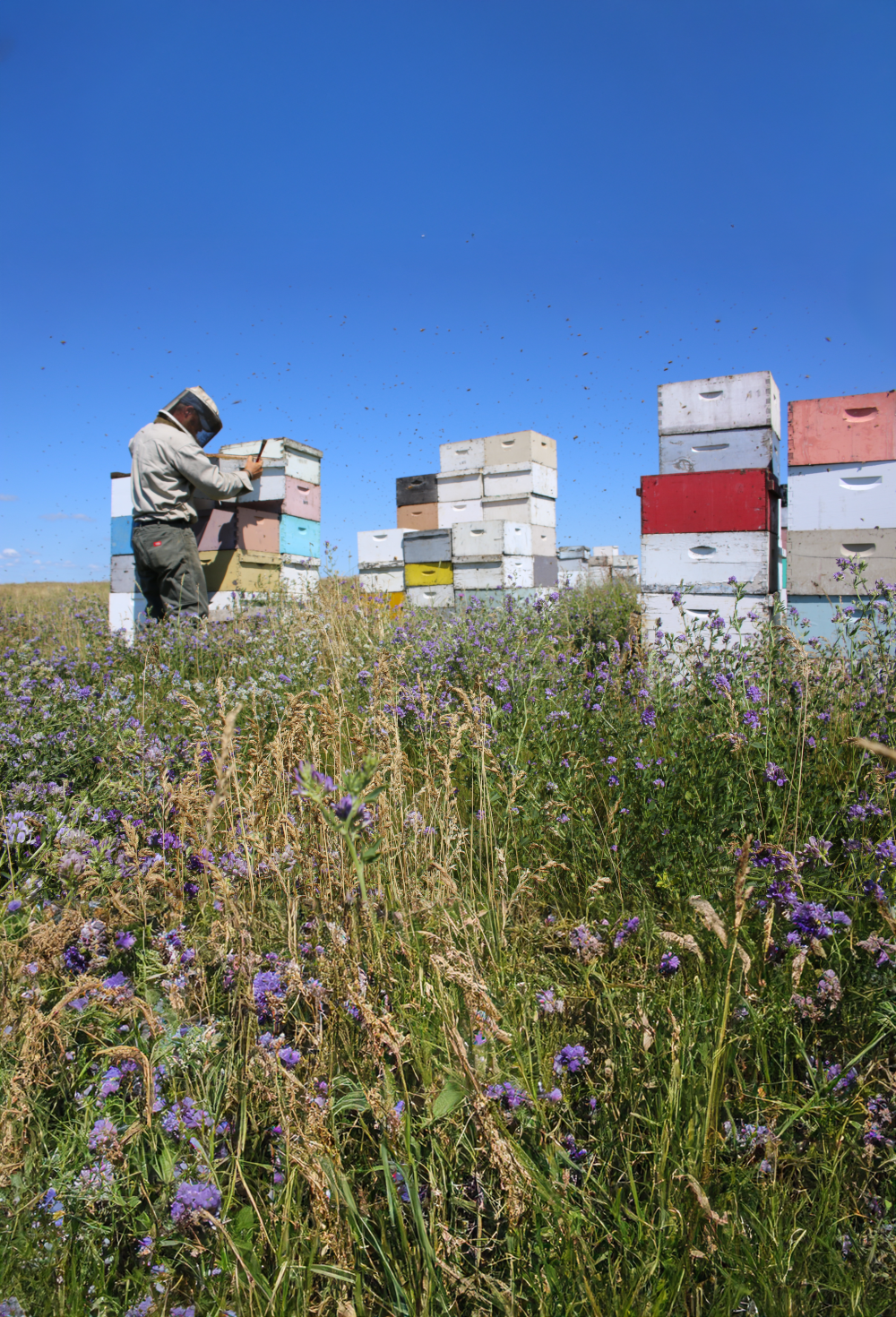
“We’ve been in existence for 105 years, and we’re on our fourth chairman of the board,” says Hueser. Longevity applies to the co-op’s network of beekeepers too, which has grown from five operations 105 years ago to more than 200 today. Twenty-five joined between mid-2025 and spring 2026, including the nation’s largest beekeeping operation. But there’s always room for more, especially from California. Meanwhile, longtime members are just as loyal as longtime plant employees: “We have beekeepers on their fifth generation of operating their apiary businesses,” Heuser says.
Growing Where You’re Planted
In February, Sioux Honey Co-op announced its search for a place to expand had concluded that staying home was the best option, with a move to a larger corporate office and warehouse. Beginning in January 2027, the three-phase move will begin with renovations to those pre-existing facilities on Expedition Court. A new processing facility and lab come next, to be followed by a new raw honey warehouse to support membership growth. The company even envisions a pollinator garden in order to localize the same message beekeepers have been spreading for the past decade: The world needs pollinators and the flowers that feed them.
As of March, the new complex’s design was nearly complete. “We’re on version 51, I think,” says Heuser. “We’ll probably be closer to 60 before we’re done. The best part is we picked a local contractor for the facility, so everything we’re going to spend is going to remain in the local economy.”
Overall the expansion is expected to create 39 new jobs, which include relocating some positions in Anaheim, California, to Sioux City. And rest assured, even in a region known for its food processing economy, the job applicants will be there. “We just posted one of our machine operator positions,” Heuser says, “and had 115 applicants for the one position.”
Among other things, says Sioux Honey Co-op Director of Growth & Community Impact Aimee Sandman, “Our product smells good.” The operation typically runs five 7 a.m.-3:30 p.m. shifts a week (six during busy times) and workers don’t have to do overnight shifts, “so if you have a family it works really, really well,” she says.
The organization recently implemented changes such as a 14% across-the-board raise for all plant employees, more holiday time and upgraded benefit options that will continue keeping team members working well.
The facility in Anaheim, originally purchased in 1962, will be sold. “The facility we had out there was only running one shift, one line. It just didn’t make sense for us to have it running as a processing facility. Our corporate offices are here, our largest plant already runs in Sioux City, so it was easier for us to just bring everything here. We’re a one-shift facility here in Sioux City, so we have a lot of opportunity to expand within where we’re at now.”
Finding prospective buyers in California should not be a problem: The facility on 6.5 acres is a half-mile from Disneyland. “Just the people who want to list the property is a tremendous amount of traffic,” Hueser says. “One of our team members stayed at a Disney resort hotel and walked to the plant every day. The whole area is being renewed with sports and multifamily development. We’re hoping it goes into one of those arenas. It could be sold as a warehouse space, but part of the reason in needing to reinvest is the capital gains we’ll experience on that property.”
As for the site selection arena, Sioux City was on the potential chopping block. The search region was the Upper Midwest — 85% of honey is produced in the Dakotas, Montana, Wyoming and Minnesota. The only Iowa member was in eastern Iowa and the board, who travel to Sioux City at least four times a year, were interested in potential locations that were easier to get in and out of. Sioux Falls, South Dakota, and Omaha, Nebraska, were options — some of the co-op’s largest beekeepers are near Sioux Falls. Le Mars, the ice cream capital located on the outskirts of Siouxland, was also a candidate.
But in the end, Heuser says, he was able to convince his board that Sioux Honey’s longtime home was the best place to keep growing.
“The desire of our team was to stay here, and that was mine as well. We have really strong longevity. So if we were to up and move, we would lose all of that kind of tenure that we had here. Our people are a great asset to us and a reason why we wanted to stay here.”
Photos courtesy of Sioux Honey Co-op.
Sioux Honey Co-op’s blend of business and serving members is an ethic that makes those people want to stay too. “We’re unique in the honey industry in that we’re a co-op,” Hueser says. “Our members market 100% of their crop. We have to receive 100% of their crop. While we have our industrial business, our bottling, our private label, our three-country blends, and all of those components, we are here first and foremost to market our members’ honey, to grow our brands. And if the other stuff adds incremental revenue so that we can pay our co-op members more for their crop, then by all means we want to participate in it.”
“When people are buying our brands, Sue Bee and Aunt Sue’s, they know that all of our funds go directly back to our beekeepers,” says Aimee Sandman. “Once our bills are paid, everything goes back to our beekeeping member family.
“I really like working for a co-op,” she adds. “It makes you feel you’re not just working for an equity firm to gain more money. You’re truly working for people’s life and their livelihood. Once a year we invite all of our members to Sioux City, Iowa. Getting to talk with all of them and see the impact and hear their stories, I learn more about beekeeping every single time the board and the members are here.”
Improving Iowa Competitiveness
The 2026 edition of the Iowa Competitive Dashboard from the Iowa Business Council (IBC) listed adequate and affordable housing stock as a priority for the Iowa Legislature to address this year. Judging by a report issued by WalletHub analyzing mortgage and home energy payments and median household income across all 50 states, Iowa is starting from a good foundation.
The study found that while homeowners spend upwards of 30% of their median monthly household income in states such as Massachusetts, Colorado and Nevada (and 43% in California), Iowa comes in at 17.26% — the lowest percentage in the country. Renters have it good as well, spending 20.95% of their median monthly household income on rent, second only to 20.29% in Oklahoma.
Among other findings and priorities from the IBC report:
- “Iowa’s gross state product (GSP) has increased again to $265.8 billion, a gain of 4.65% from the prior year. The report further shows median household income increasing to more than $75,000. Iowa remains a top tier hub for the country’s manufacturing industry, solidifying a top 3 ranking once again.”
- The CNBC Technology and Innovation Index ranked Iowa No. 29 in the nation in 2025, up from No. 30 in 2024.
- In the 2024-2025 academic year, 278 Iowa high school districts offered registered apprenticeships, pre-apprenticeships and internship programs, “resulting in 36,075 Iowa students engaging in at least one high-quality work-based learning experience. This is an increase of over 11,000 participants across the high school student population.”
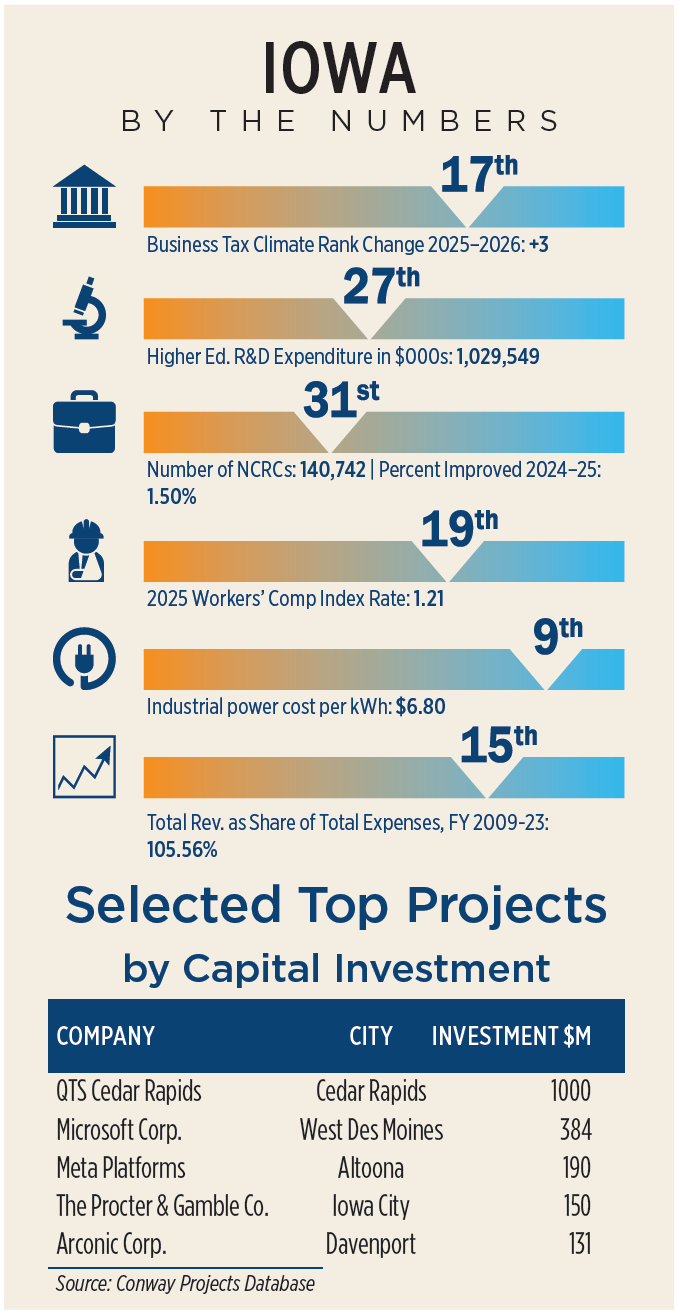
- Since income tax reform was signed into law in 2022, Iowa’s individual tax climate ranking according to Tax Foundation metrics has increased by a total of 28 spots to No. 11 in the nation, while the corporate tax climate ranking has increased by seven spots. “Achieving a top 15 rank in individual and corporate tax climate is the long-term goal of the IBC,” the organization stated, noting that “based on the 2022 income tax reform, as state corporate revenue receipts exceed $700 million annually, the corporate tax rate will be reduced and Iowa’s corporate tax competitiveness will increase.”
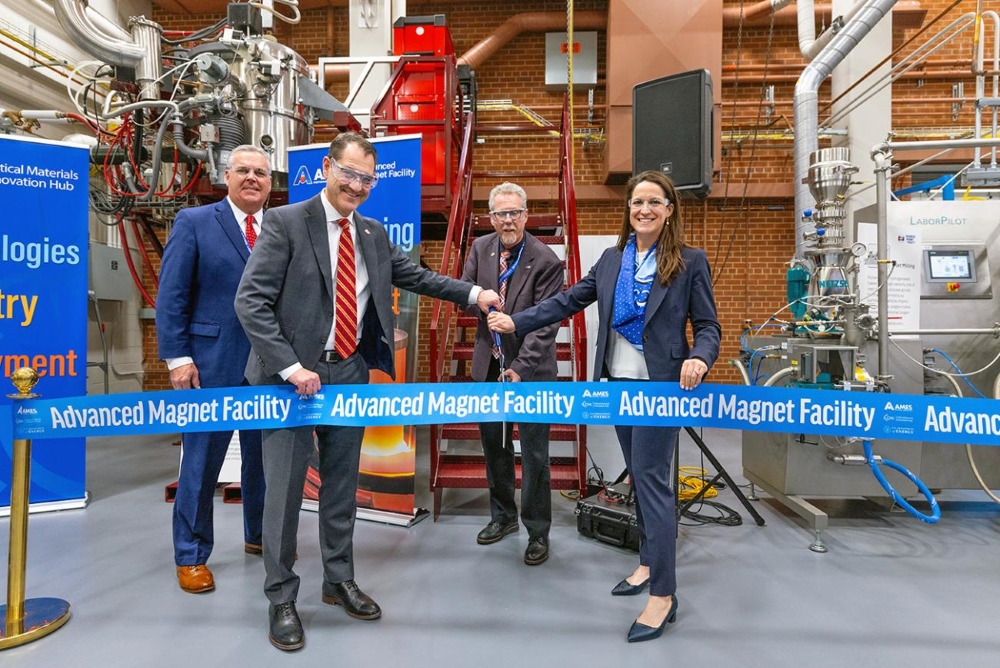
Photo courtesy of DOE
Increased Attraction in Ames
March 10 saw the official opening of the new Advanced Magnet Facility (AMF) at the U. S. Department of Energy’s (DOE) Ames National Laboratory on the campus of Iowa State University. celebrated a major milestone on March 10 with the official opening of its new (AMF), marking a significant investment in U. S. leadership in magnet science and critical materials research.
A DOE release explained that the AMF provides “modernized space and instrumentation that will expand the laboratory’s capabilities in magnetic materials, energy technologies and applications focused on national security.” Ames Lab Director Karl Mueller said, “The opening of the Advanced Magnet Facility represents a major step forward for our mission — strengthening the nation’s capabilities in magnet science and critical materials, and the technologies that rely on them.”
“The newly renovated Advanced Magnet Facility underscores the scientific and research excellence of our national laboratories,” said DOE Assistant Secretary of Energy Audrey Robertson. “It will enable cutting-edge work to establish new magnetic materials and components for use across transportation and industry, while supporting American manufacturing innovation.”