
JANUARY 2007


Emerging Ports (cover)
CBRE Expands Its National Reach
Logistical Nirvana
ESBAS: Foremost Manufacturing Zone in Turkey
Harrison County, Mississippi...
Harrison County Development Commission
North Carolina Department of Commerce
CenterPoint Intermodal Centers
Midwest Empire's Inland Ports
Georgia's Ports … Engine for Economic Development
Opportunities That Set the Pace
County of San Bernardino: Opportunity, CA
Discover Opportunity, California
A Perfict Fit in Victorville
Victorville… A World of Opportunity
Rutherford County, Tennessee
Rutherford County is a Clear Winner
Dallas Logistics Hub
Southwest Louisiana: Open for Business
The Development Corporation
Lincoln: 'A Great Place to Live and Work'
CBRE
Valdosta-On the Move
Request Information

SPECIAL ADVERTISING SECTION
EMERGING LOGISTICS HUBS
EMERGING LOGISTICS HUBS
Harrison County, Mississippi …
A Smart Shipping Solution for Latin America
A Smart Shipping Solution for Latin America
| L |
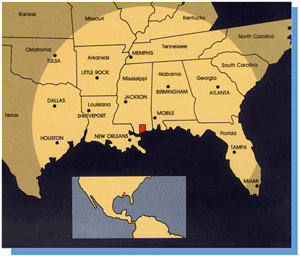
ocated on the Gulf of Mexico, only 24 hours from nearly 75 percent of U.S. markets, Harrison County, Mississippi is a great solution for the distribution of products to and from Latin America.
Latin America has recognized the ease of distribution offered by the Mississippi State Port and Gulfport- Biloxi International Airport, and a strong, growing trade relationship has been established.
For over 100 years, the Mississippi State Port at Gulfport has been responsible for the transport and delivery of millions of tons of cargo. This bulk, break- bulk and container seaport has a channel width of 250 ft., maintains a depth of 36 ft., encompasses 184 acres and is under expansion.
The three major carriers currently serving the port,
 |
The Gulfport- Biloxi International Airport plans to begin shipping cargo in 2007 and has recognized that synchronizing with the port in perishables is important for its success. Brokers and forwarders focusing on perishable goods are already in the area working with the port, so it is a natural avenue for the airport. Plus, the short travel time required for many perishable goods can be achieved by air travel.
Specifically, producers of products with an extremely short shelf life, like flowers, fresh seafood and produce, will find opportunity with the Gulfport- Biloxi International Airport. Gulf Coast International Cargo, in collaboration with several major producers and buyers, will utilize the Gulfport- Biloxi International Airport because it offers an efficient, low- cost, un- congested alternative to some of the busier distribution areas. The airport can handle, clear, consolidate and distribute products with a turn around time which is a fraction of that of busier locations.
Reasons for the prosperity of the port and the expected success of the airport are related to the common factor of location, in relation to each other, in relation to Latin America and in relation to the rest of the U.S. The port is just one and a half hours from major shipping lanes, the airport is located near U.S. Interstate 10 and the two facilities are only three miles apart.
As important, the two operations are connected by an established intermodal transportation system, allowing a constant flow of products. Three class- one rail services carry cargo north, south, east and west across the U.S., and numerous trucking services are available to the area.
The Mississippi State Port experienced significant damage as a result of Hurricane Katrina. However, the Port Authority, Coast Guard, major carriers and other partners quickly aligned to make repairs and return the port to operable condition. The hard work and cooperation paid off and only 23 days after the storm, a cargo ship sailed into the port.
Today, the port receives four to five ships per week and has maintained its position as the third busiest container port on the Gulf of Mexico. Efforts are underway to quickly return it to full operating capacity. Executive Director Don Allee says that rather than abandon the master plan the port had prior to Katrina, they have advanced and revised it to include projects that will repair the damage done by the storm.
Allee says, "If a product comes through our port, something good is happening; a job is being created or a need is being met. We remain committed to growing this port and finding more efficient ways to operate it."
Port facilities will include a state of the art chiller and freezer. Expanded container operations will continue on West Pier. The East Pier will provide dry cargo storage and will accommodate the port's break bulk business. A feasibility study is also being conducted to increase the channel's depth to 42 ft.
The airport's distance from the Gulf shielded it from the extent of damage received by the port, yet it did receive its share. Executive Director Bruce Frallic says that like the port, the airport had expansion and improvement plans that were advanced due to the storm. By fourth quarter 2007, the airport plans to complete a new 40,000 sq. ft. cargo facility that will include 20,000 sq. ft. of chiller, 20,000 sq. ft. of cargo sorting and distribution space and 6,000 sq. ft. of office space. A new airside access ramp is also being constructed to service more and larger cargo aircraft, plus 120 acres has been reserved for further expansion.
Both Allee and Frallic are extremely optimistic about the future of their facilities and their trade relationship with Latin America. Frallic says, "The improvements and updates to our facilities will enable us to bring more products in and send more products out in a much more efficient manner. Building a balanced flow of products by ocean and air will strengthen our trade relationship with Latin America and will create many new employment and investment opportunities."
The Mississippi State Port and Gulfport- Biloxi International Airport are ready to assist you with your shipping needs, and the Harrison County Development Commission can help you with available industrial sites or financing incentives.
|
For more information, visit their websites or contact the following:
Gulfport- Biloxi International Airport • www.flygpt.com Bruce Frallic, Executive Director 228-863-5951 Mississippi State Port • www.shipmspa.com Enrique Hurtado, Deputy Director of Trade Development 228-865-4300 Harrison County Development Commission • www.mscoast.org Larry Barnett, Executive Director 228-896-5020 |