
JANUARY 2007


Emerging Ports (cover)
CBRE Expands Its National Reach
Logistical Nirvana
ESBAS: Foremost Manufacturing Zone in Turkey
Harrison County, Mississippi...
Harrison County Development Commission
North Carolina Department of Commerce
CenterPoint Intermodal Centers
Midwest Empire's Inland Ports
Georgia's Ports … Engine for Economic Development
Opportunities That Set the Pace
County of San Bernardino: Opportunity, CA
Discover Opportunity, California
A Perfict Fit in Victorville
Victorville… A World of Opportunity
Rutherford County, Tennessee
Rutherford County is a Clear Winner
Dallas Logistics Hub
Southwest Louisiana: Open for Business
The Development Corporation
Lincoln: 'A Great Place to Live and Work'
CBRE
Valdosta-On the Move
Request Information

SPECIAL ADVERTISING SECTION
EMERGING LOGISTICS HUBS
EMERGING LOGISTICS HUBS
Georgia's Ports … Engine for Economic Development
| F |
or decades, economic developers in Georgia have touted the state's sophisticated ports to entice manufacturers and distribution centers. In recent years, The Georgia Ports Authority has taken a more active role in developing partnerships to enhance the industrial recruitment process. In 1999, the Authority established an Economic and Industrial Development Division specifically to assist in the solicitation process.
"We're becoming site consultants," observes Stacy Watson, GPA's Manager, Economic and Industrial Development.
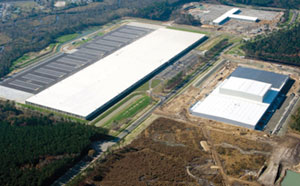 |
| Under construction, Target and IKEA DCs are located only 5 miles from the Port of Savannah's Garden City Terminal. Eighteen additional import DCs are located in Savannah, and over 70 more are within 5 hours driving distance.
Photo by David Smalls |
Watson observes that retail operations drive many location decisions. These fall into two categories. The high volume, so called "big box" stores favor port proximity for their major distribution operations. In turn, they often ship to a chain of smaller, inland DC's closer to stores and customers. Small and medium-sized importers often forego the port-based facility in favor of dispersed distribution centers near their target markets.
It's a classic chicken and egg equation. Climate, quality of life and cost of living have fueled a continuing population influx into the Southeast. Subsequently, jobs have followed the workers, with retail centers close behind. As importers look to stock shelves in the country's hottest markets, the Port of Savannah has emerged as the optimum gateway for cost, transit and carrier choice. Identical opportunities exist for area exporters, specifically among steamship lines eager for backhaul freight to balance their inbound moves.
The story does not begin and end with retail. Manufacturing and assembly operations demand a predictable flow of raw materials, and the infrastructure to facilitate export shipments. Watson explains, "We have a major influence on these projects, as well. Often, we work with an entirely different set of site specifications when the project demands proximity not only to customers, but to domestic sources of raw materials or components."
Macon, Georgia is proof positive that the inland formula works. Pat Topping, Senior VP of the Macon Economic Development Committee, reports that both Kohl's and Bass Pro Shops have recently opened inland distribution centers there. With imports comprising over 50% of total inbound freight, proximity to the Port of Savannah was a requirement for both projects. However, other factors made a Macon location viable.
"Total transportation costs were a prime determinant," says Topping. "These firms looked not only at freight costs from the port, but DC-to-store delivery costs.
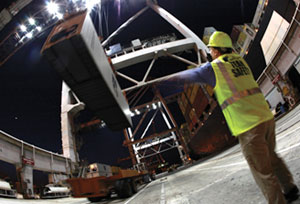 |
| With room to build and grow, the Port of Savannah has experienced a phenomenal 78% growth in container throughput between fiscal year 2002 to fiscal year 2006. The GPA ranks as the 4th largest container port in the nation.
Photo by Russ Bryant |
Watson works closely with prospects in analyzing their logistics networks. He reports that many shippers have learned hard lessons from putting all their ocean shipping eggs in one basket. In particular, issues of transit, congestion and equipment shortages have dramatically compromised landbridge shipments moving cross-country from the West Coast.
"Importers are well aware of these issues, and are beginning to address them. We see increasing interest in the all-water option from Asia as the means of supplying the eastern half of the U.S." Manufacturing shifts to areas such as Malaysia, India and East Africa are predicted to generate traffic increases via the Suez, as well.
As more international shippers turn to outsourced logistics, Third Party Logistics providers, 3PL's, have garnered the attentions of Watson and the Georgia development community. "Many smaller retailers cannot justify the expense of an in-house logistics operation," Watson explains. "The multinational 3PL's take over this job for them. The combined volume of their shipping customers means they undertake the same site selection process as a large, single importer."
GPA's strategic, long-term development plan, 2015 Plan, incorporates improvements in technology, infrastructure and process that will perpetuate the role of the state's ports as strategic tools for industrial solicitation. By dedicating resources exclusively to economic development, GPA assures that site prospects and developers alike are well armed with compelling logistics arguments for doing business in Georgia.
– John Powers