
by Carol Brzozowski
You may not think of Illinois as a lifesaver, but perhaps you should. Illinois has become the first choice for several life sciences operations.
In early March, global biotechnology company CSL broke ground for the expansion of its plasma therapy manufacturing facility in Kankakee.
The $1.5 billion investment builds on more than $3 billion already spent on the company’s U.S. operations since 2018.
The expansion creates at least 300 new, highly skilled positions and enhances production of plasma-derived therapies and albumin through advanced manufacturing capabilities to help people with rare and serious diseases and other acute medical issues.
The expansion, expected to be operational by 2031, will incorporate CSL’s Horizon 2 manufacturing process: a patented, yield-enhancing technology enabling significantly greater production of immunoglobulin from the same base amount of plasma.
“Behind every plasma-derived therapy is a person trying to live a more stable life, and donors who made that therapy possible,” said Gordon Naylor, CSL chief executive officer and managing director. “As the need for plasma-derived therapies continues to grow in the U.S. and globally, expanding our Kankakee site further strengthens this key hub in our supply network. We thank our partners in government and our local community for supporting our mission to serve those who require these essential medicines.”
Illinois Governor JB Pritzker noted, “Illinois is leading the way in life sciences manufacturing, and CSL’s $1.5 billion investment is a powerful vote of confidence in our state,” adding the expansion will strengthen domestic supply chains for critical therapies.
Illinois will soon grow in the life sciences thanks to the Chan Zuckerberg Biohub Chicago, a newly-established biomedical research center joining leading Chicagoland scientific and technology institutions with the goal of solving large-scale scientific challenges on a 10- to 15-year time frame. Centrally located near its partner universities — the University of Chicago, Northwestern University, and the University of Illinois Urbana-Champaign — in Chicago’s Fulton Market, the state-of-the-art lab and administrative facility features specialized rooms, engineering equipment, and a space to host scientific presentations.
The goal: Understand the mysteries of the cell and how cells interact within systems.
Its focus is on engineering technologies to make precise, molecular-level measurements of biological processes within human tissues, with the ultimate goal of understanding and treating the inflammatory states underlying many diseases leading to half of all deaths.
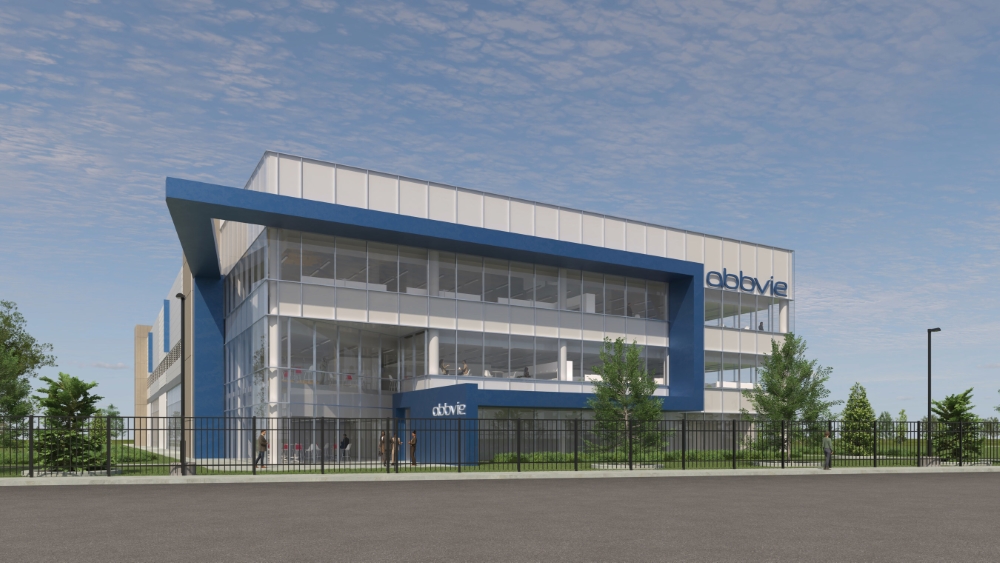
Rendering courtesy of AbbVie
AbbVie Chooses Chicago
AbbVie initiated a new $380 million investment to build two new active pharmaceutical ingredient manufacturing facilities at its current North Chicago campus.
These state-of-the-art facilities will integrate advanced manufacturing technologies with artificial intelligence (AI) to support the production of AbbVie’s next-generation neuroscience and obesity medications and are expected to be fully operational in 2029.
AbbVie plans to hire 300 people in North Chicago, including engineers, scientists, manufacturing operators and lab technicians.
“This milestone demonstrates further progress against our $100 billion commitment to U.S. R&D and capital investments over the next decade,” said Robert A. Michael, AbbVie chairman and CEO.
CZ Biohub Going National
Understanding inflammation requires the ability to measure a myriad of interactions at the molecular and cellular level in 3D living tissue, a capability that does not currently exist, according to CZ Biohub.
The CZ Biohub Chicago is the first institution to expand the CZ Biohub Network, building on a successful collaborative model of the first CZ Biohub in San Francisco and comprising a group of nonprofit research institutes bringing together physicians, scientists and engineers.
Aleks Baranczak, Biohub vice president, partnerships and strategy, says the collaborative effort builds the foundation for “understanding human biology with compute capacity, cutting-edge imaging and measurement technologies, and AI models and data shared openly with the global scientific community.”
Baranczak notes the selection of Chicago came through a 2023 open Request for Applications process drawing 59 proposals from 170 institutions nationwide.
“What set the Chicago proposal apart was the strength of the scientific vision — a genuinely novel approach to measuring inflammation in human tissue — alongside the caliber of the partnering universities and Chicago’s burgeoning biotech ecosystem,” she says.
Addressing how the Illinois workforce measures up, Baranczak notes “Illinois has talent across the full range that our work demands such as basic scientists, bioengineers and computational researchers.”
Baranczak also says the three partner universities alone represent an excellent concentration of expertise from which the CZ Biohub will actively benefit.