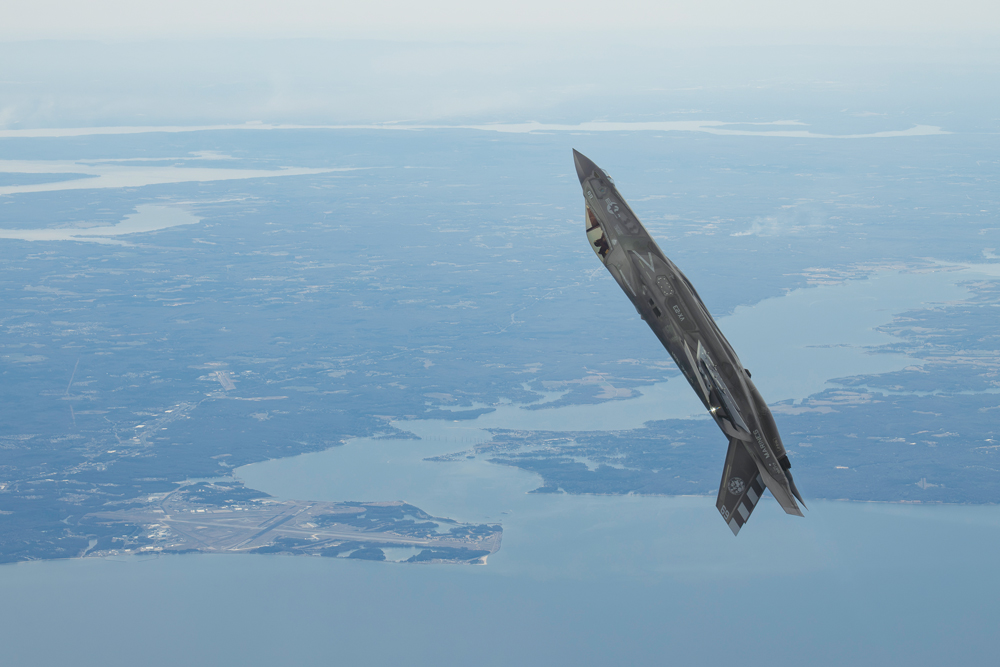
Dale Moore, former Department of the Navy Strategist and current Chair of the Maryland Aerospace and Technology Commission (MATC), is leading an effort to synergize all of the capabilities in Maryland’s ecosystem.
“Maryland’s secret sauce is our ability to educate, train, research, develop and integrate leading edge technologies into highly complex systems and applications that are changing the game for the national and global space and aerospace sectors,” Moore says.
Take it from the more than 9,000 aviation and aerospace companies doing business in Maryland, like mission control and space systems engineering firm Qwaltec. Qwaltec Vice President of Strategy and Growth Georgie Brophy co-founded the Maryland Aerospace Alliance and represents the Maryland Space Business Roundtable as vice chair of the recently formed Maryland Aerospace & Technology Commission housed in the Maryland Department of Commerce.
“The state has an extraordinary number of assets from an aerospace perspective,” she says, citing 90 years of aircraft building. The heritage of assets and infrastructure isn’t only about legacy. It’s about tomorrow. Brophy cites Rocket Lab’s decision to move into a former Lockheed Martin facility in Middle River, where there is “incredible infrastructure with resources to help them build,” she says.
The assets include a robust electrical grid, access to more than 30 airports, more than 20 military installations and institutions such as NASA Goddard Space Flight Center in Greenbelt, Johns Hopkins University Applied Physics Lab in Laurel, Aberdeen Proving Grounds and Naval Air Station Patuxent River, which is the busiest flight test center in the world with 50,000 square miles of test range. Next door to that installation sits California-Lexington Park, home to some 115,000 citizens and the nation’s highest known area concentration of aerospace engineers.
“I’m in an industry where college degrees, master’s degrees and scientists are absolutely critical, and we have them in spades,” Brophy says. “We also have one of the top engineering universities in the country at the University of Maryland, and we have a skilled technical workforce available for manufacturing.”
More engineers are on the way thanks to the No. 6 undergraduate engineering program in the country at the U.S. Naval Academy in Annapolis and that University of Maryland engineering school where the 672 aerospace engineering undergrads enrolled in fall 2025 trailed only the 1,389 enrolled in mechanical engineering. One of those undergrads is Brophy’s daughter. Brophy already knew the program was exceptional.
“Now that my daughter is there, I’m blown away,” she says. “First semester freshman year, they’re working on a program to design space suits with women in mind.”
Brophy says even after 30 years of cris-crossing the country in the business, she’s amazed that “so many people don’t realize Maryland has everything. Space has been this quiet, revenue-generating thing most people weren’t aware of. Engineers don’t make a lot of noise. “
New Zones, Good Bones
“Everything” also means room to grow: “There’s actually room and you can build,” Brophy says, backed by local incentives and supported by aerospace and technology zones Moore and the MATC team are organizing across the state, including the Central Maryland Aerospace Corridor, the Western Maryland Manufacturing Region, the Eastern Maryland Space Systems Integration and Support Zone and the Southern Maryland Defense Hub anchored by St. Mary’s County, a zone that is home to Maryland’s naval aviation core but is also diversifying into advanced materials, prototyping, autonomy and emerging dual-use technologies.
Kellie Hinkle, deputy director of the St. Mary’s County Department of Economic Development, says the county is in year six of implementing a master plan for the Aeropark Innovation District around St. Mary’s County Regional Airport, an unusually advanced concept for a general aviation airport with no commuter flights. But that’s because the county itself is unusually advanced and unusually airborne. “You can’t swing a stick without hitting a pilot,” Hinkle says.
Hinkle praises the effectiveness of the Apprenticeship Maryland Program’s Tech Jobs Rule partnership with the Patuxent Partnership, the James A. Forrest Technology Center and the Strategic Education Office of the Naval Air Warfare Center Aircraft Division (NAWCAD).
Among employers taking advantage of the program is Platform Aerospace, maker of the Vanilla unmanned aircraft that can be launched from a truck and holds the world record for longest flight time without refueling (more than eight days). “Walk into their facility,” Hinkle says, “and they’ll say, ‘Yep, he came to us through Tech Jobs Rule and has been here for 15 years.’ ”
The University System of Maryland at Southern Maryland just completed the 84,000-sq.-ft. Maryland Autonomous Technologies Research Innovation and eXploration (MATRIX) Lab for all things autonomous and unmanned, be they by air, land or sea, a perfect complement to the University of Maryland’s Uncrewed Research and Operations Center (UROC). A runway extension to 5,350 ft. was due to be celebrated in March. County-owned land big enough to accommodate four hangars will now have direct runway access. The queue has already formed.
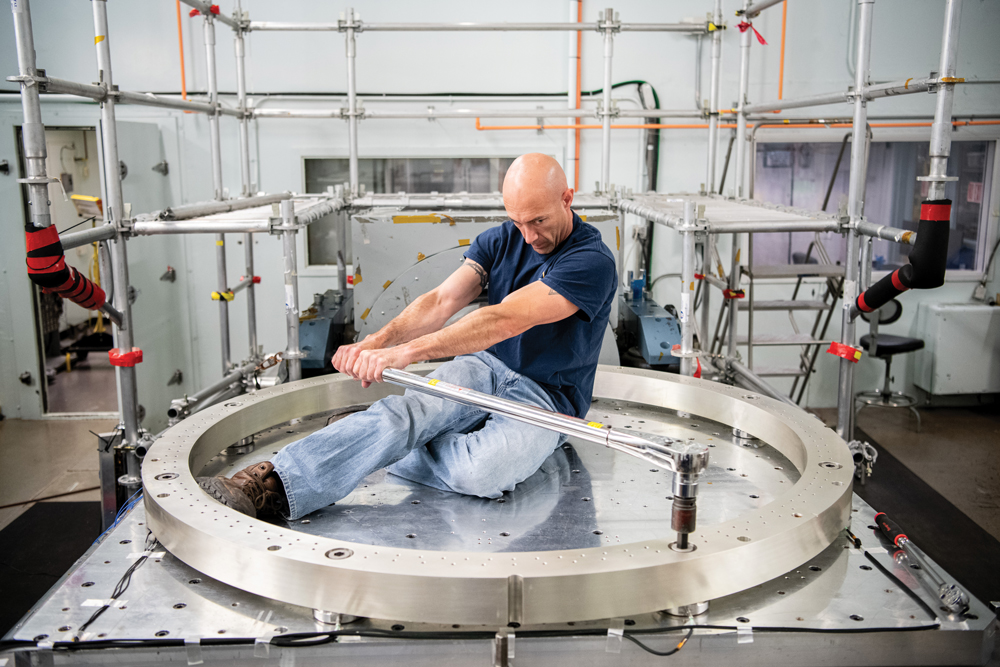
Engineering Technician Ryan Fischer torques the Force Gauge Ring on to the vibe table in preparation for vibration testing of the Plankton, Aerosol, Cloud, ocean Ecosystem (PACE) spacecraft bus at NASA Goddard Space Flight Center in Greenbelt, Maryland, in June 2021.
Photo by Denny Henry courtesy of NASA
“Our sweet spot is aircraft modification associated with the Navy,” Hinkle says. “We have at least four drone manufacturers or drone assembly facilities that are looking for space that would love runway access.”
The runway-adjacent land is one part of some 145 acres near the airport planned to host future development. On the southern peninsula of the county sits another opportunity at the former Piney Point Terminal petroleum storage site, where Offshore Aviation Group, which develops drones that can take off from and land on vessels, has gained clearance for testing in the airspace above some 320 acres. Hinkle says this activity will reactivate the runway as a private, commercial runway. “The plan is for them to have their base of operations there and also open it up as a campus for other private and public sector organizations for all things unmanned,” she says.
As a long-time Naval engineer and president of the Southern Maryland Navy Alliance, Moore sees Maryland’s aerospace activity as a model and test bed for a new way of approaching Department of Defense innovation ecosystems.
“The beauty of it is there are just so many opportunities,” he says. “We have to accelerate our ability to become aware and to learn so we can take action on the new things … To take the cutting-edge research and put it into practice — that’s what we’re trying to do in Maryland. We understand where we are, and we’re moving.” Then he cites author William Gibson’s famous line: “The future is already here, it’s just not very evenly distributed.”
Look for the next chapter in the Maryland aerospace story to distribute new opportunities for all companies and talent focused on flying through the air to come in for a prosperous landing.
This Investment Profile was created under the auspices of the Maryland Department of Commerce. Visit commerce.maryland.gov.