When up to 1,500 executives, scientists, entrepreneurs and officials from around the globe convene on the campus of the University of Maryland (UMD) in College Park in September for the Quantum World Congress, they will quickly comprehend why it’s the right place to be. And not only because of the scheduled launch of a deep tech facility backed by $20 million in state funds.
“Maryland has been a global leader in quantum science for decades, built on an extraordinary concentration of world-class research institutions, federal assets, talent and pioneering companies,” says Maryland Commerce Secretary Harry Coker, Jr. “Now, through our Lighthouse Sector strategy, we are turning that scientific leadership into economic leadership — accelerating the commercialization, growth and deployment of quantum technologies and building the ecosystem that will support the industry at scale.”
Scale is what it’s all about: Pitchbook data show that Q3 2025’s record $1.5 billion invested in quantum exceeded the entire annual VC total raised in the sector in every full year prior to 2021. “Quantum computing venture funding hit a record $3.9 billion across 127 deals in 2025, the highest annual total on record,” Pitchbook analyst Dimitri Zabelin wrote in June.
Timing is the name of the game too. This summer saw the issuing of an executive order by the White House calling for securing American leadership in quantum information science and technology. A release from the National Science Foundation, which backed the country’s first I-Corps Quantum for National Security Cohort at UMD, said, “From the lab bench to the factory floor, from the classroom to the clean room, NSF’s role in this executive order runs deep — advancing the basic research, national infrastructure and workforce development pipelines that turn quantum promise into quantum capability.”
While the scientists explore entangled qubits, cryogenics, error correction and decoherence, they’re also helping to accelerate the journey from theory to engineering to commercialization. One of those scientists is UMD Associate Vice President for Quantum Research and Education Dr. Gretchen Campbell, a pioneering experimental physicist who previously served as director of the National Quantum Coordination Office in the White House Office of Science and Technology Policy and held multiple leadership roles at the National Institute of Standards and Technology (NIST).
Campbell sees quantum as an ecosystem that needs to be cultivated holistically, ensuring that all pieces of the puzzle are in place, from federal funding to institutional and venture capital and fundamental research. Campbell says patient capital is important right now. She praises UMD’s strong history of helping faculty and students take technologies out of the lab and nurture companies, led by IonQ, the standard-bearer for the sector that emerged from UMD and recently saw a 287% surge in revenue to reach $80 million during Q2 2026. UMD’s Quantum Startup Foundry and its pre-seed-focused Discovery Fund have helped a growing roster of founders commercialize their research, while Quantum Catalyzer, a separate Maryland-based venture studio, has built its own portfolio — including EuQlid and ArQSensors — from its base in Discovery District.
Among the biggest challenges ahead: facility infrastructure. “One of the reasons why quantum is allowing us to create new devices and technology is these quantum systems are incredibly sensitive,” Campbell explains. They can be startled by the least vibration, temperature and humidity changes, magnetic fields and noise — which, ironically, is one of the byproducts of typical supercomputers. “This is why people are thinking about improving things like quantum networking,” she says.
Such a notion dovetails with the more traditional sort of networking that will be on display at the Quantum World Congress and which is necessary in what Campbell calls “still a very small global ecosystem. Nobody can do it alone.” Many international firms are looking to establish a U.S. foothold in a place near the corridors of power in the nation’s capital. Being near sheer talent helps too.
“Companies really do want to go where the talent is being produced,” she says. “The University of Maryland has the largest concentration of quantum scientists of any university in the country, if not the world, with an incredibly deep bench and expertise.”
Some of the area’s quantum talent comes from places like NIST. But there’s really no place like NIST, where the stunning breadth of research stretches from post-9/11 work on fire-resistant materials to setting standards for peanut butter to setting the absolutely correct time of day. “Almost all of the quantum technologies today, particularly based on neutral atoms or trapped ions, are based on early research done at NIST,” Campbell says.
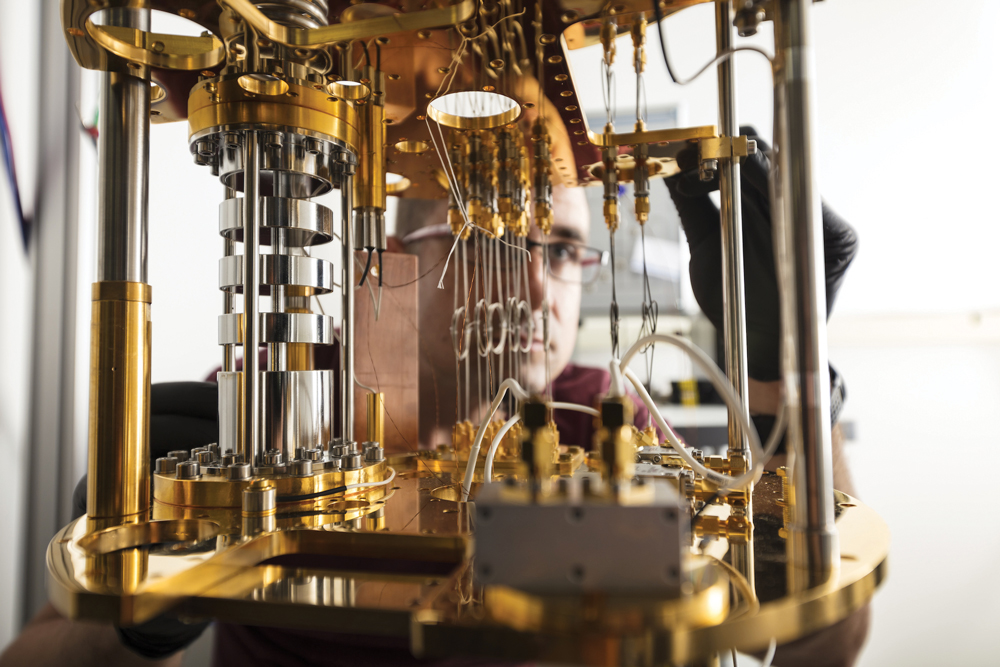
Quantum research in Maryland also includes work at Johns Hopkins University’s Applied Physics Laboratory.
Dr. Corey Stambaugh is the director of the $1 billion Capital of Quantum public-private initiative launched by Maryland Gov. Wes Moore in 2025. Prior to this role, Stambaugh too was stationed at NIST as chief of staff of the Physical Measurement Laboratory, which splits its labs and facilities between Boulder, Colorado, and Gaithersburg, Maryland. He calls NIST “the crown jewel of the federal quantum ecosystem.”
“What’s amazing about NIST, particularly in the frame of quantum, is that this is a metrology institute — the science of measurement — and quantum sets the fundamental limits of measurement,” whether it’s mass, pressure, voltage or how humans respond to LED lights. “So it’s the perfect marriage. It’s rare to get a combination of people who care so much about getting the right answer and getting it in a way that they can demonstrate it repeatedly and reproducibly … But that’s how you drive industry changes over time,” because of someone “continuously pushing the bounds of how you make a measurement. In the end, for many industries, it comes down to how you measure something. The better you quantify it, the better you can commercialize your activities.”
Stambaugh points to the signing of the first National Quantum Initiative Act in 2018 as an inflection point for quantum innovation and investment. “In the last year, I feel like we’re hitting another increase in terms of engagement,” he says. “Capital of Quantum is about making sense of and helping coordinate, promote, connect and really invest in that ecosystem. I had a VC firm here earlier this week. When I show them what’s here, you can see the spark and the ‘Aha!’ moment — ‘You guys are already doing this.’ This is not an idea; it’s a thing that’s happening there and being manifested through the investments the Capital of Quantum is making.”
That pitch has already landed with international players: Finland’s IQM and UK-based Quantum Motion both chose the Discovery District for their U.S. footholds this year, joining Microsoft and IonQ in the hub.
“With historic commitments from companies including Microsoft and IonQ, alongside federal and national security partners such as DARPA, Maryland is bringing together the research, talent, capital, infrastructure and customers necessary to lead this emerging industry,” says Commerce Secretary Harry Coker, Jr. “We are not simply preparing for the quantum economy — we are building it, and positioning Maryland to be the quantum capital of the world.”
This Investment Profile was prepared under the auspices of the Maryland Department of Commerce. For more information, visit business.maryland.gov/quantum.