
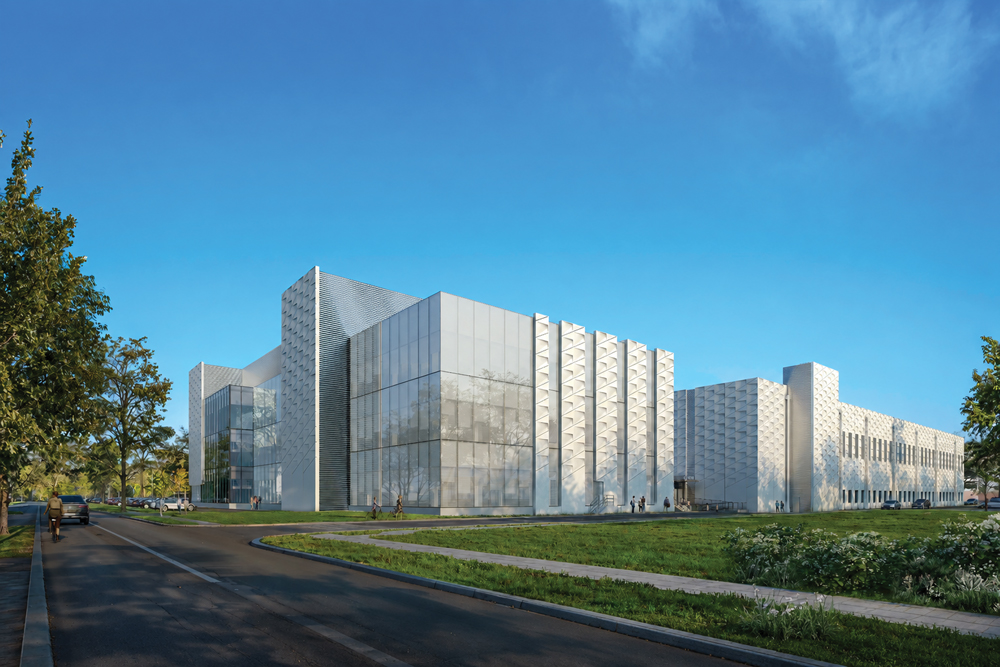
Multibillion-dollar investments across Virginia, Maryland and Delaware are expanding the Mid-Atlantic’s role in advanced pharmaceutical manufacturing.
by Savannah Yawn
More than $15.5 billion in announced investments from AstraZeneca, Eli Lilly and Company and Merck is expanding pharmaceutical manufacturing capacity across Virginia, Maryland and Delaware. The five projects represent one of the clearest signs yet that the Mid-Atlantic is establishing itself not only as a center of life sciences research, but as a destination for advanced biopharmaceutical manufacturing.
The scale of that investment signals an evolution in the Mid-Atlantic’s value proposition. Historically recognized for its federal research institutions, universities and scientific talent base, the region is increasingly demonstrating that it can also provide the sites, workers, infrastructure and public-private coordination required to move complex therapies from discovery into commercial production.
That progression is taking different forms across the three states. Maryland is connecting its research and regulatory assets with expanding clinical and commercial manufacturing capacity. Virginia has prepared large industrial sites and specialized workforce systems capable of supporting multibillion-dollar projects. Delaware is building on its chemical expertise, established pharmaceutical base and position within the broader Northeast life sciences corridor.
The investments also arrive as pharmaceutical companies seek to expand U.S. production capacity, strengthen supply-chain resilience and place critical operations closer to domestic patients and markets.
Virginia Builds for Pharmaceutical Scale
Virginia provides the clearest demonstration of the size and technical complexity of the projects now landing in the Mid-Atlantic.
AstraZeneca plans to invest $4.5 billion to establish two manufacturing facilities in Albemarle County, the Piedmont region jurisdiction whose county seat is Charlottesville, home to the University of Virginia. One plant will manufacture drug substances for chronic-disease treatments, while the other will support AstraZeneca’s antibody-drug conjugate oncology portfolio. Together, the facilities are expected to create 600 highly skilled jobs and generate an estimated 3,000 indirect jobs. The company in July 2025 committed to invest $50 billion in the United States by 2030.
“With our $4.5 billion investment in Virginia, the largest in AstraZeneca’s history, we are not only building a state-of-the-art manufacturing facility, but also driving life sciences innovation and economic growth,” said AstraZeneca CEO Pascal Soriot. The project will be located at the Rivanna Futures Site in northern Albemarle County. Before AstraZeneca selected the property, the site had received a $9.7 million grant through the Virginia Business Ready Sites Program to support infrastructure improvements. The matching-grant program coordinates localities, utilities and state agencies to prepare sites.
That advance preparation is becoming an increasingly important part of Virginia’s pitch. Highly regulated pharmaceutical facilities require substantial utility capacity, specialized infrastructure, predictable permitting and confidence that construction can proceed without unnecessary delays.
Virginia’s ability to support projects of this scale reflects years of investment in workforce development, research capacity, site readiness and industry partnerships, according to Jason El Koubi, president and CEO of the Virginia Economic Development Partnership.
“Companies are increasingly prioritizing workforce availability, speed to market and risk mitigation when making location decisions,” says El Koubi. “Virginia’s strengths in workforce development, site readiness, business climate and state-local collaboration align closely with those priorities.”
Those strengths will only grow stronger after the July news that the Alliance for Building Better Medicine, a coalition of 55 partners spanning industry, academia, workforce development, government, nonprofit organizations and economic development leading Virginia’s Advanced Pharmaceutical Manufacturing (APM) Tech Hub, had successfully attracted a $15.97 million investment from the U.S. Economic Development Administration (EDA) to launch the End-to-End (E2E) Commercialization Project. The initiative will help establish a domestic commercialization pathway connecting innovation, manufacturing and patients.
Eli Lilly and Company is adding another $5 billion to Virginia’s pharmaceutical manufacturing pipeline with plans for a new facility in Goochland County, west of Richmond. The site will be Eli Lilly’s first fully integrated facility dedicated to both active pharmaceutical ingredient (API) and drug-product manufacturing. Expected to be completed within five years, the project will create more than 650 jobs for engineers, scientists, operations personnel and laboratory technicians.
Merck’s expansion in Rockingham County further reinforces Virginia’s manufacturing case. The company is investing $3 billion in a 400,000-sq.-ft. Center of Excellence for Pharmaceutical Ingredients and Small Molecule Manufacturing at its existing Elkton operation. The project, which grew from an original scope of $2 billion and 300 jobs, is expected to create 500 positions.
The center will include API and drug-product operations as well as small-molecule manufacturing and testing. It builds on Merck’s nearly 85-year presence in the Shenandoah Valley. The state approved a performance-based $5 million Virginia Investment Performance grant and a $4 million Commonwealth’s Opportunity Fund grant to support the Merck project.
Virginia reports that more than 85,000 residents work in life sciences-related occupations and that its colleges and universities produce more than 20,000 life sciences degrees and certificates annually. The Commonwealth is also home to six Tier 1 research universities and a network of colleges and workforce organizations preparing workers for engineering, quality assurance, laboratory and advanced-manufacturing roles. “The ecosystem itself has become a competitive advantage,” El Koubi says.
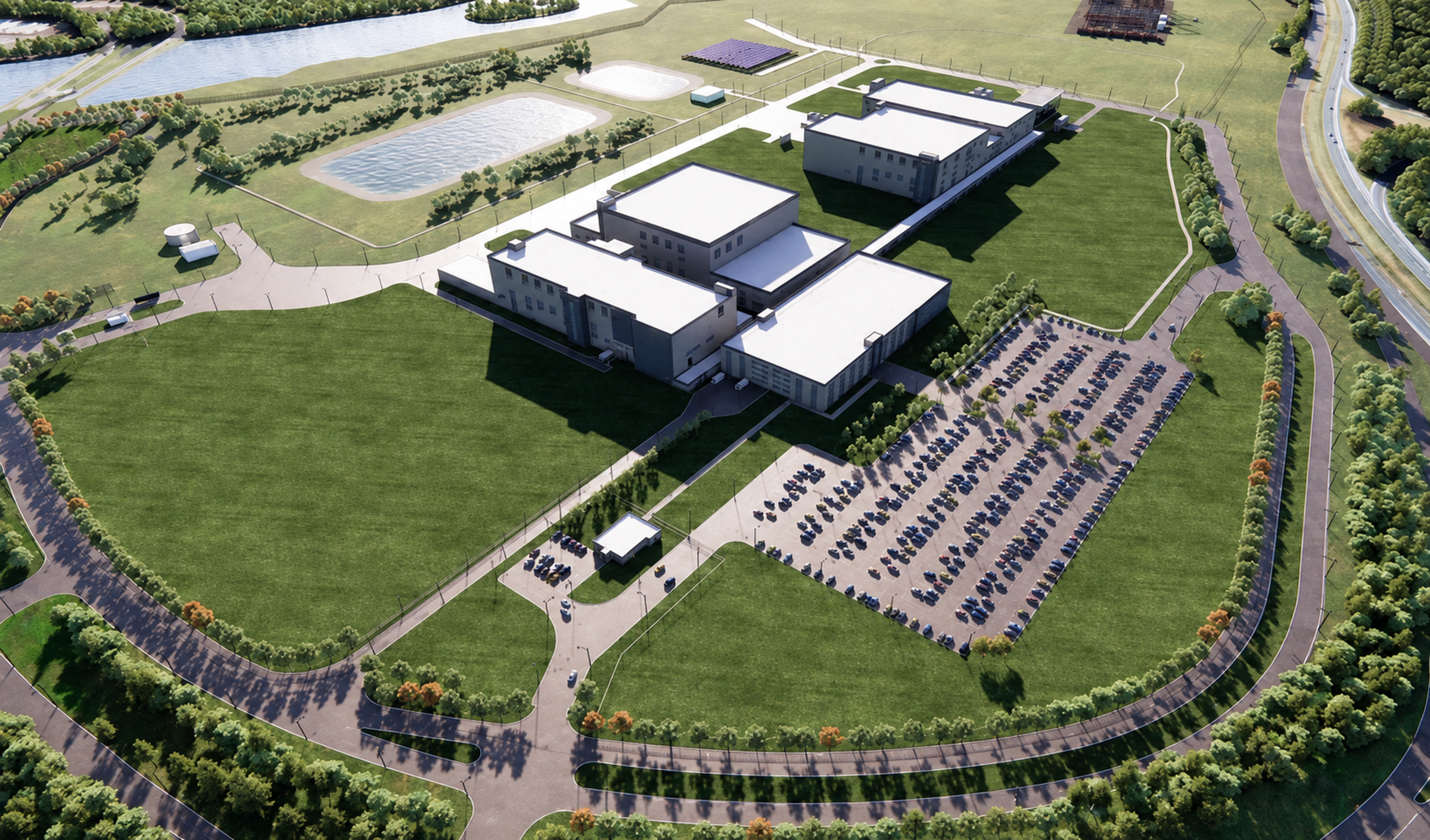
Eli Lilly and Company is building a $5 billion manufacturing facility just west of Richmond, Virginia, in Goochland County.
Rendering courtesy of Eli Lilly and Company
Maryland Closes the Distance Between Lab and Market
In Maryland, the manufacturing story begins with one of the country’s densest concentrations of biomedical research, regulatory and scientific institutions. AstraZeneca plans to invest $2 billion to expand its flagship biologics manufacturing operation in Frederick and build a clinical manufacturing facility in Gaithersburg. Maryland described the announcement as the state’s largest private capital investment in a decade.
The Frederick expansion will nearly double AstraZeneca’s commercial manufacturing capacity and return production of the company’s extensive rare-disease portfolio to the United States. The facility is expected to create 200 highly skilled jobs and 900 construction positions.
The Gaithersburg facility will manufacture products advancing through clinical trials. It is expected to create another 100 jobs, retain 400 existing positions and support approximately 1,000 construction jobs. Both projects are scheduled to become fully operational in 2029.
The two facilities illustrate Maryland’s effort to connect multiple stages of the development process. One site will help move therapies through clinical manufacturing, while the other will expand commercial-scale biologics production.
“Maryland has long been recognized as an R&D leader, and now we are well positioned to advance drug pipelines into the clinic, commercialization and scaling,” says Stefanie Trop, Ph.D., director of life sciences at the Maryland Department of Commerce. The state is pursuing that goal by expanding specialized talent, integrating AI, bioinformatics and advanced manufacturing, and attracting global contract and pharmaceutical manufacturers.
Maryland’s research environment remains central to that strategy. Proximity to the National Institutes of Health, the FDA, the National Cancer Institute, major Defense Health Agency facilities, Johns Hopkins University and the University System of Maryland gives companies access to regulators, scientists, funders and potential research partners.
According to Trop, that concentration can help accelerate clinical translation and reduce investment risk.
Maryland also presents the investment case as a cost and logistics proposition. Commercial laboratory and biomanufacturing space in the region can average as much as 60% less than space in competing major hubs, according to the Maryland Department of Commerce. The state is connected to global markets through several international airports, the Port of Baltimore and integrated interstate and rail systems, assets that support cold-chain integrity and pharmaceutical distribution.
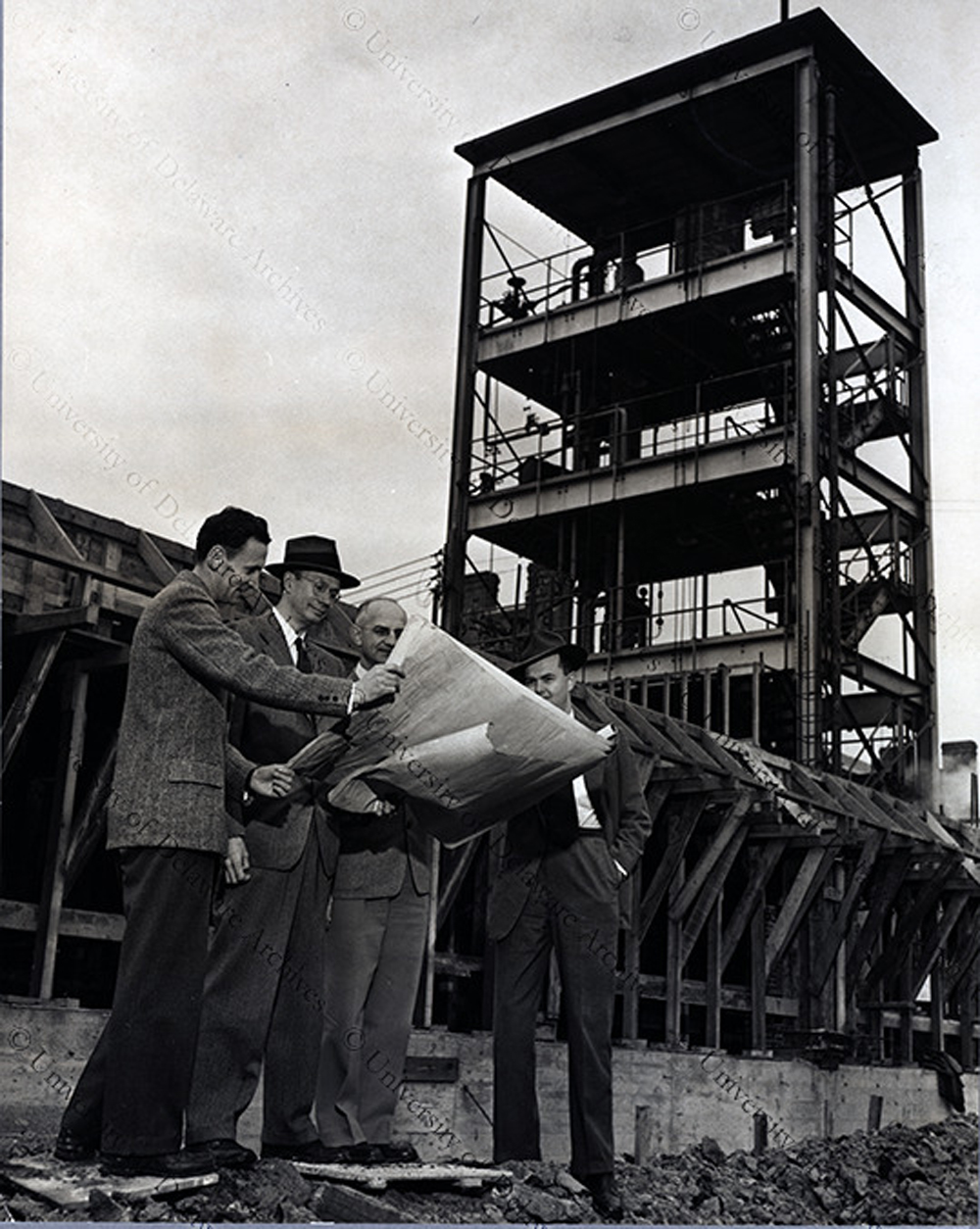
The University of Delaware’s expertise in chemistry and chemical engineering goes back many decades, including the construction of a distillation tower in the 1950s.
Photo courtesy of University of Delaware Archives
Public investment is being used to reduce the risk associated with expensive biomanufacturing projects. Maryland supports companies through programs including the Build Our Future Grant, job-creation tax credits and matching workforce-training grants.
For the project, Maryland committed $116.5 million over eight years as part of a broader state and local support package equal to approximately 10% of total costs. The investment also builds on a wider manufacturing push by AstraZeneca in Maryland. In May 2025, the company opened a $300 million cell-therapy manufacturing facility in Rockville.
Similarly, Samsung Biologics established its first U.S. manufacturing operation in Rockville after acquiring an existing GSK facility in late 2025. The company plans to expand the operation’s drug-substance capacity and upgrade its technology to support demand for biologic medicines.
Delaware Competes Through Concentration
Delaware offers a different model. Rather than competing primarily on geographic scale, the state draws on its concentration of chemical and pharmaceutical expertise, accessible business network and location within the Northeast Corridor.
Merck broke ground in April 2025 on a $1 billion, 470,000-sq.-ft. Biologics Center of Excellence at the Chestnut Run Innovation & Science Park (CRISP) in Wilmington. Merck Wilmington Biotech will combine laboratory, manufacturing and warehouse capabilities to support the launch and commercial production of next-generation biologics and antibody-drug conjugates.
The facility will also have the capability to manufacture the company’s leading oncology medicines, and Merck intends to establish Wilmington as the medicines’ future U.S. production home for American patients. The laboratory component is expected to become operational in 2028, with production of investigational compounds anticipated to begin in 2030.
The project is expected to create more than 500 permanent jobs and approximately 4,000 construction positions. A potential future expansion could generate an additional 1,500 full-time jobs and 26,000 construction roles.
“As a hub for life science, research and development, and pharmaceutical manufacturing, CRISP offers unparalleled opportunities for future expansion,” said Sanat Chattopadhyay, executive vice president and president, Merck Manufacturing Division.
WuXi STA provides another example of Delaware’s ability to attract large-scale pharmaceutical manufacturing. The company selected Middletown for a $510 million clinical and commercial manufacturing campus expected to bring nearly 500 jobs to the state.
Delaware Prosperity Partnership points to the state’s concentration of chemical engineers and chemists, its experienced pharmaceutical workforce and a regional labor shed of more than 1.3 million workers within a 45-minute drive. More than 100 colleges and universities are located within two hours, including 13 Tier 1 research institutions and two Ivy League universities.
The University of Delaware’s chemical engineering programs rank among the nation’s leading programs, while nearby institutions including the University of Pennsylvania and Johns Hopkins University add nationally recognized strengths in biomedical engineering, biocomputing and related fields. Delaware State University, one of the country’s leading public HBCUs, further broadens the region’s higher education and talent base.
Established employers including AstraZeneca, Incyte, Adesis, Noramco, Prelude Therapeutics and Sepax Technologies provide an existing base of industry experience. Delaware also sits within the Greater Philadelphia pharmaceutical cluster and near the life sciences markets of Maryland and New York. The state’s position along Interstate 95 puts more than 53 million consumers within 250 miles and provides access to Philadelphia International Airport and Port Wilmington.
Delaware Prosperity Partnership also highlights the state’s absence of sales, personal-property, inventory, equipment and value-added taxes as an advantage for manufacturers. Its compact size can also make government and business relationships easier to navigate. According to Megan Kopistecki, director of business development for Delaware Prosperity Partnership, corporate leaders, public officials and regulators are often separated by “ ‘two degrees of separation’ or less.”
One of Delaware’s most important life sciences assets is the National Institute for Innovation in Manufacturing Biopharmaceuticals (NIIMBL), headquartered at the University of Delaware’s Science, Technology and Advanced Research Campus.
NIIMBL is part of the federal Manufacturing USA network and connects industry, academic and government organizations working to improve biopharmaceutical manufacturing. Its mission includes accelerating manufacturing innovation, developing standards that enable faster and more efficient production, and training the biopharmaceutical workforce.
Kopistecki says that the number of pharmaceutical companies in Delaware has grown by 60% over the past decade, further evidence that “company growth begets company growth.”