

Research by Savills identifies the cities that are most successful at attracting and developing wealth from both individuals and businesses.
by Kelcie Sellers, Associate Director, Savills World Research
Global corporate and individual wealth is increasingly mobile, seeking destinations that offer the most favorable environments for living, working and investing. Three forces are particularly influential in shaping location decisions for high-net-worth individuals (HNWIs) and internationally mobile companies: an evolving geopolitical and economic landscape, shifting government policies including taxes and incentives, and the rising importance of quality-of-life considerations.
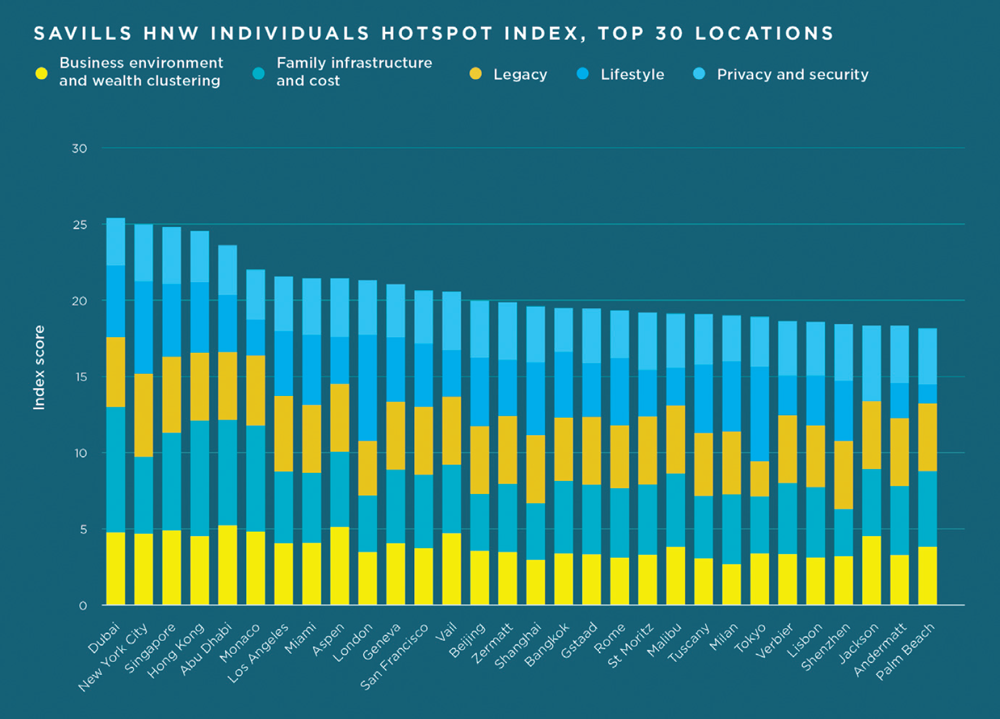
The Savills Dynamic Wealth Indices identify the cities that are most successful at attracting and developing wealth from both individuals and businesses, while also highlighting the factors driving these choices. Personal tax advantages, large existing concentrations of HNWIs, and strong quality-of-life indicators place Dubai and Abu Dhabi at the top of the rankings.
Abu Dhabi’s sovereign wealth ecosystem has attracted a growing number of affiliated family offices and multinational companies. This trend has stimulated demand for office space, particularly among new market entrants, and has also strengthened activity in the emirate’s luxury residential market.
The UAE is a particularly attractive option for HNWIs who bring their companies with them. The national economy is diversifying rapidly beyond hydrocarbons and is supported by rising flows of corporate and sovereign capital.
In Savills Spotlight on Wealth Trends, further research on the HNWI population was conducted, where Dubai came in first place globally as a HNWI hotspot. Abu Dhabi came in No. 5 in the same index. Both markets ranked highly as a result of strong performance across all our categories, namely business environment, family infrastructure, legacy planning, lifestyle, security and privacy.
Family infrastructure is a particularly important consideration. The number of international schools, a priority for wealthy households, positions Dubai at the forefront with 168 schools. Many of these operate with significant waiting lists as new families continue to arrive.
Connectivity is equally critical for global wealth hubs. Both Abu Dhabi and Dubai offer world-class aviation networks and strong digital infrastructure, further enhancing their competitiveness.
A Sense of Place
These dynamics have translated into strong real estate activity. According to the upcoming Savills World Cities Prime Residential Index for 2025, Dubai’s prime residential capital values increased by 11.2% during the year, while prime office rents rose by 7.4%. In the residential sector, off plan sales above AED 10 million accounted for 73% of transactions in 2025, up from 70% in 2024. Limited prime supply continues to support values, even as growth moderates from the exceptionally rapid expansion seen in the early 2020s.
Against an increasingly changeable geopolitical and economic backdrop, global wealth flows are evolving, as HNWIs and businesses adapt their decisions on where to locate. Traditional predictors of global wealth flows, such as government policies, taxes and incentives, and the presence of either innovative talent pools or existing communities of similar individuals, have always been key drivers of dynamic, footloose companies and individuals, and will continue to play a major role. But a sense of place and a high quality of living are progressively the deciding factor when making location decisions.

“The UAE is a particularly attractive option for HNWIs who bring their companies with them. The national economy is diversifying rapidly beyond hydrocarbons and is supported by rising flows of corporate and sovereign capital.”
— Kelcie Sellers, Associate Director, Savills World Research
Data from both reports suggest that successful locations for HNWIs and their businesses appeal to both the corporate and individual desires — highlighting how business and personal priorities can often overlap as businesses want to locate in destinations that can provide the necessary talent to sustain them, following skilled workers who tend to prioritize a better quality of life. While lifestyle factors appeal chiefly to the individual, the knock-on effects of creating talent clusters — or HNWIs bringing their businesses with them when they relocate — make them a magnet for corporate wealth, too.
Looking ahead, the distribution of global wealth will increasingly be shaped by generational change and expanding mobility. Millennials and Generation Z are expected to inherit more than $18 trillion in wealth globally, representing the largest intergenerational transfer of wealth in history. Cities such as New York, Dubai and Singapore are well positioned to benefit from this shift, supported by pro-business environments, favorable tax regimes and stable geopolitical conditions.
Government strategy will also play a decisive role in shaping future wealth centers. For example, Saudi Arabia’s Vision 2030 aims to diversify the national economy, enhance the country’s position as a global business destination, and attract both affluent individuals and international investors. Ambitious policy programs, investment migration initiatives and large-scale infrastructure spending are transforming cities like Riyadh and Delhi into emerging global wealth hubs.