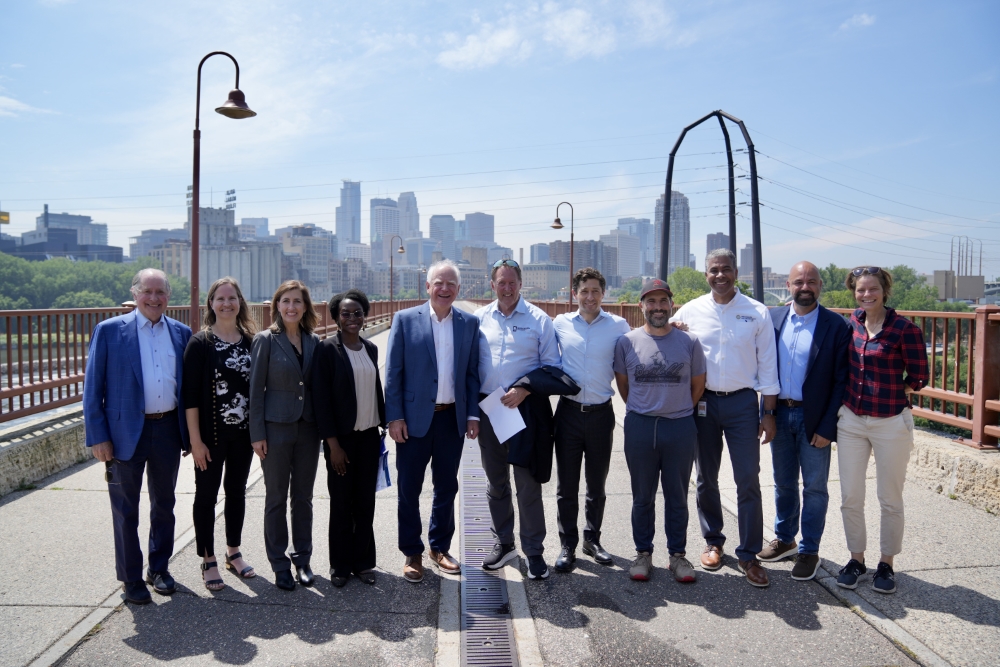
Minnesota Governor Tim Walz turns to recovery, reassurance and the promise of more good things to come.
Federal forces have signaled their withdrawal. Minnesota employers have not.
In mid-February, after many weeks of disruptive conflict with the federal government, Minnesota Governor Tim Walz thanked Minnesotans for their decency. He announced a proposal for $10 million one-time emergency relief aimed at Minnesota businesses. And he responded by email to questions from Site Selection. This exchange has been edited for clarity and brevity.
Site Selection: Last year saw the Twin Cities lead all metros on the Mississippi River in corporate facility project investments. Describe what company leaders tell you about their confidence in growing in the state. What have they have told you in recent weeks with their words and actions in support of the region and citizens they’ve chosen to invest in?
Governor Tim Walz: When global leaders are looking to invest and grow, they are choosing Minnesota. That is the result of intentional policies and partnerships that make our state the best place in America to turn great ideas into great businesses.
Business leaders note our strong foundation of workforce talent, innovation and technology, infrastructure and quality of life that fuels their success and growth. In fact, Minneapolis-St. Paul ranks as the 17th most diverse economy among all 384 metropolitan areas in the nation. And data from the U.S. Bureau of Labor Statistics show that Minnesota has one of the highest five-year business survival rates among U.S. states — making us a top state for new businesses.
Right now, as we hope to see an end to the surge in federal agents that has caused losses impacting the economy, community livelihoods and food and shelter security totaling hundreds of millions of dollars, we’re focusing on providing relief for small businesses, specifically those that have seen sharp declines in foot traffic, lost revenue and operational disruptions. We know that for businesses operating on narrow margins, even short-term instability can threaten long-term survival, so we’re working to deliver immediate stabilization. And it’s important that our corporate partners step up during challenging times. Companies have helped build Minnesota’s civic culture, evident in the role of corporate philanthropy. As we work to build back from Operation Metro Surge, the contributions of major companies to support small businesses is vital.
Tell me the story of one company attraction or expansion project in recent months that you were personally involved in.
Walz: In March 2024, I toured Niron Magnetics’ Minneapolis facility, getting a firsthand look at the incredible work they are doing. The company, born out of the University of Minnesota in 2013, develops powerful permanent magnets that are free of rare earth minerals, using domestically sourced iron and nitrogen — solving one of America’s biggest supply chain vulnerabilities with some of the most abundant resources.
When I first learned about Niron Magnetics, it was clear to me that this is the kind of innovation that Minnesota needed to lead on — they’re reducing environmental impacts and strengthening the U.S. supply chain. Their expansion in Minnesota, a $400 million investment, included a new facility that would significantly increase production and create jobs. Over the summer, we awarded the City of Sartell, Minnesota, a $2 million grant through the Department of Employment and Economic Development [DEED] to help build the infrastructure for a new facility. And, in September, I had the opportunity to attend the groundbreaking.
How are company leaders and the people they employ responding to the implementation of the Drive for 5 workforce development initiative and to Paid Leave?
Walz: Response to the implementation of Drive for 5 and Paid Leave has been overwhelmingly positive for business leaders and employees alike. Investments in training and job placement help us ensure that businesses have skilled workers and that workers have fulfilling, family-sustaining employment. That’s what Drive for 5 is about — allocating competitive grants to provide workforce training and job placement in five high-growth industries: caring professions, education, manufacturing, technology and the trades. Businesses that partner with the state in the Drive for 5 initiative benefit from expanded production that supports thriving local economies.
Similarly, the Paid Leave program allows us to provide payments and job-protected leave for those welcoming a new child, caring for a loved one or managing personal medical needs, without risking income. Minnesota is one of only 13 states in the nation to offer paid family and medical leave and we’ve seen the results: We are home to one of the country’s most talented workforces and we consistently rank as one of the happiest, healthiest and most prosperous states in the nation.
What would you like to see your successor accomplish in the economic development sphere?
Walz: In Minnesota, we have built a solid foundation to foster economic development. It’s vital that we continue building on that foundation, leveraging our strengths to encourage business expansion. We’ve made major strides in strengthening our talent pipeline with programs like Drive for 5. The next step is scaling those models to allow talent development to keep pace with industry growth. Similarly, a focus on strengthening business development processes and improving site readiness will ensure communities are equipped with the tools and financial support to prepare sites and respond quickly to opportunities, ensuring Minnesota remains a competitor nationally and globally.
It’s also vital that we focus on continued investment in industry partnerships and the sectors that define Minnesota’s economy. Minnesota is widely recognized as a global leader in medical technology and health innovation, anchored by world-class institutions like Mayo Clinic and a strong network of medtech manufacturers. Minnesota also plays a critical role in the domestic semiconductor supply chain. A continued focus on advanced manufacturing, digital technology, food and agriculture, and clean energy innovation will ensure Minnesota businesses remain competitive nationally and internationally.
And, vitally, continuing the work to make Minnesota the best state in the nation for children to grow up in — prioritizing safe and thriving communities, improving health outcomes, ensuring access to child care and housing — to build a state where businesses, and the workforce, thrive.