
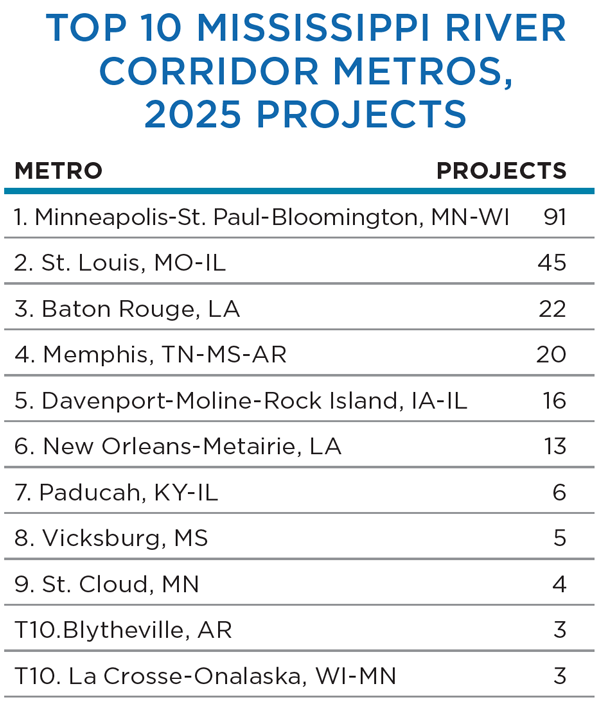
If the Twin Cities were so overrun with mayhem that the federal government felt compelled to step in, someone ought to tell the dozens of companies who invested hundreds of millions of dollars and created hundreds of jobs in the region in 2025. They’re why the Greater Minneapolis-St. Paul-Bloomington metro area is No. 1 by total projects among all metro and micropolitan regions along the entire length of the Mississippi River.
The region’s total of 91 projects is more than twice the tally in second-place St. Louis, with 45. That number in turn is more than twice the total in third-place Baton Rouge (22) and fourth-place Memphis (20).
“2025 was a record year for jobs and capital investment in the Minneapolis Saint Paul region, with the highest capital investment on record for GREATER MSP and the most new jobs committed since 2015,” says Amanda Taylor, vice president, business investment at GREATER MSP Partnership, the regional economic development organization for the 15-county region. Among the factors to which she attributes the success (after 109 projects the year before) are new tools like the $400 million Minnesota Forward Fund, created by the Minnesota Legislature in 2023.
“The fund was designed to ensure Minnesota’s competitiveness to support industry expansion and attraction for companies securing federal funding,” Taylor says. “It also created a more flexible deal-closing fund for high-impact projects in the state,” projects like Polar Semiconductor’s fab expansion in 2024, as well as Department of Defense-related investments in 2025 from BioMADE and North Wind. BioMADE is a Manufacturing Innovation Institute sponsored by the U.S. Department of Defense and is headquartered in Minneapolis.
“The $132 million investment in Maple Grove is BioMADE’s flagship demonstration-scale biomanufacturing facility, which will provide access to companies looking to reach commercial scale manufacturing of bio-based materials using precision fermentation technology,” Taylor says. North Wind is partnered with the University of Minnesota, the State of Minnesota (Forward Fund) and the U.S. Department of Defense to build out the most advanced aerospace R&D and test facility in the country, a new hub for hypersonics testing that brings a $1.1 billion investment to 60 acres at UMore Park in Rosemount.
The Minnesota Forward program also has provided funding for semiconductor workforce development with awards made to Hennepin Technical College, the University of Minnesota and the University of St. Thomas.
Data Center Supply Chain
Taylor says the region’s industrial diversity includes national and global leadership at the leading edge of such sectors as med and health tech, next-gen food and ag, clean tech, and compute tech (including semiconductors/microelectronics and hypersonics).
“The MSP region’s legacy sectors — industries like supercomputing (born here!), semiconductor and medical devices — have led to us having a significant concentration of capabilities in electromechanicals,” she says. “This means that many existing companies have pivoted successfully to lead in the data center supply chain. You see this in some 2025 wins, including Daikin (R&D test lab for data center cooling systems), Rolls-Royce in Mankato (backup generators) and nVent (advanced liquid cooling and enclosure solutions).”
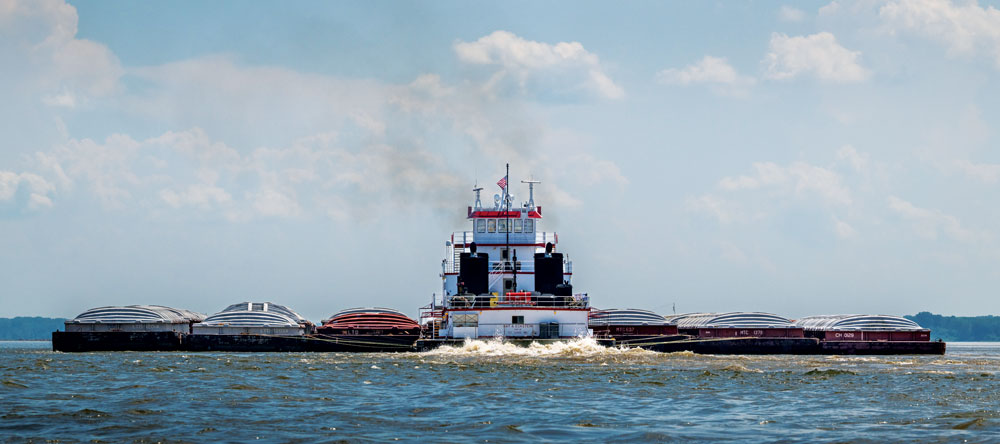
The Marquette Transportation Company vessel M/V Kay A. Eckstein pushes a large tow southbound on the Mississippi River.
Photo by David Rider courtesy of Marquette Transportation Company
Leadership in water technology also feeds into data center supply chain growth. “Companies like Ecolab (HQ in St. Paul and R&D in Eagan; data center water cooling tech) and Uponor/GF (HQ, R&D and manufacturing in Apple Valley; data center cooling flow solutions) are seeing growth,” Taylor writes.
I asked GREATER MSP leaders about the level of support for the community and its immigrant population they are experiencing from prominent employers in the face of the federal law enforcement surge that led to the deaths of citizens and many weeks of unrest.
“The recent federal enforcement situation has been disruptive and deeply concerning for many in our communities, particularly immigrant families and small business owners,” says GREATER MSP CEO Peter Frosch. “Employers across the region have responded with visible support — contributing to relief efforts, backing stabilization funds and working with community partners. Much of that work has happened quietly, but it has been steady and meaningful.”
Is such a frightening environment frightening off prospects?
“While the instability of the last 40 days has been disruptive to our region, the flow of new business expansion and attraction projects has remained steady and active,” Frosch says. “We have not seen a slowdown in interest in investment, nor a slide back in focus for active projects considering the market for growth.”
At the same time, messaging and bridge-building have taken on even more significance.
“We have been meaningfully focused on building global partnerships, representing that the MSP region and Minnesota are a strong partner for investment for international companies looking to invest in the U.S.” Frosch continues. “We have received messages of support from companies around the world, many further solidifying their interest in future investment in the region and state. What this moment has ultimately revealed is resilience. Leaders across sectors stepped up, neighbors showed care for one another, and the fundamentals of our economy remain strong. That combination — economic capability and civic resolve — continues to define Minnesota’s competitiveness.”
The View from the River
For further insights from points along the Mississippi, I turned to Damon Judd, president and CEO of Paducah, Kentucky–based Marquette Transportation Company, the leading independent provider of barge towing services on 6,000 miles of America’s inland waterways. The company’s assets include 130 tow-and-tugboats and some 300 open-top barges. Its work last year totaled 29 million barge miles and 2 million vessel miles. That means a unique perspective on industrial activity from, as he puts it, “the other side of the floodwall.”
“If you look at the inland waterway system and its impact on the U.S., the U.S. I believe has more navigable waterways than the rest of the world combined,” he says. “So it’s not just the largest system, but the largest system by a significant scale. And that creates a true artery for trade and a true competitive advantage,” especially as companies reshore. “There’s been a real focus on developing properties that have proximity to the river.”
The advantages of river proximity include bringing in raw materials, whether rock or steel, using the bulk shipping advantage to float freight in the form of finished products. “On one of our large horsepower boats from Cairo [Illinois] to New Orleans, we’ll take 42 barges at a time,” Judd says. “That’s the cargo equivalent of roughly 4,000 truckloads in front of one boat. And so again, that scale, that shipping cost advantage has been, I think, really important as people think about development.”
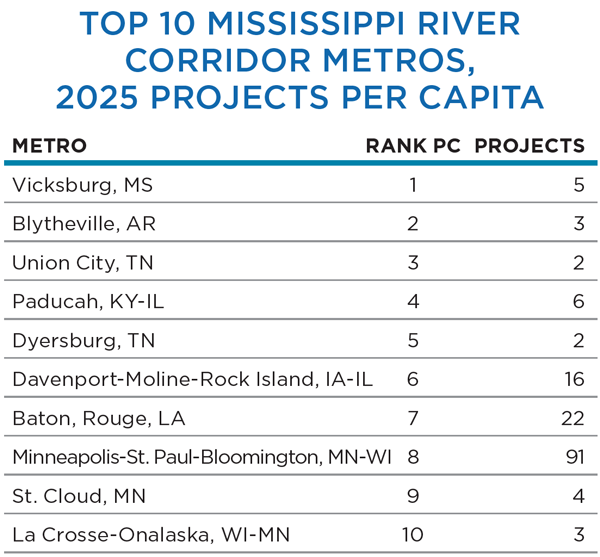
That includes new and expanding steel mills in top-ranking areas such as Blytheville, Arkansas (Osceola), home to what Judd calls some of the most sophisticated steel milling capacity in the U.S. “And now there’s a big rebar facility going in there as well. There’s a tremendous amount of raw materials, pig iron, HBI [hot briquetted iron], etc. going into there and coils coming out, and that’s all happening via barge,” Judd observes. “I know they use other modes as well, but that’s a big deal for those facilities.
And yes, the river’s advantages extend to huge data center complexes, too, like the massive Amazon project now going into Tallulah in the No. 1 per-capita metro area of Vicksburg, Mississippi.
“That is a meta project,” Judd says of the $10 billion investment. “It’s sourcing an incredible amount of aggregates right now from the river for the construction phase.”