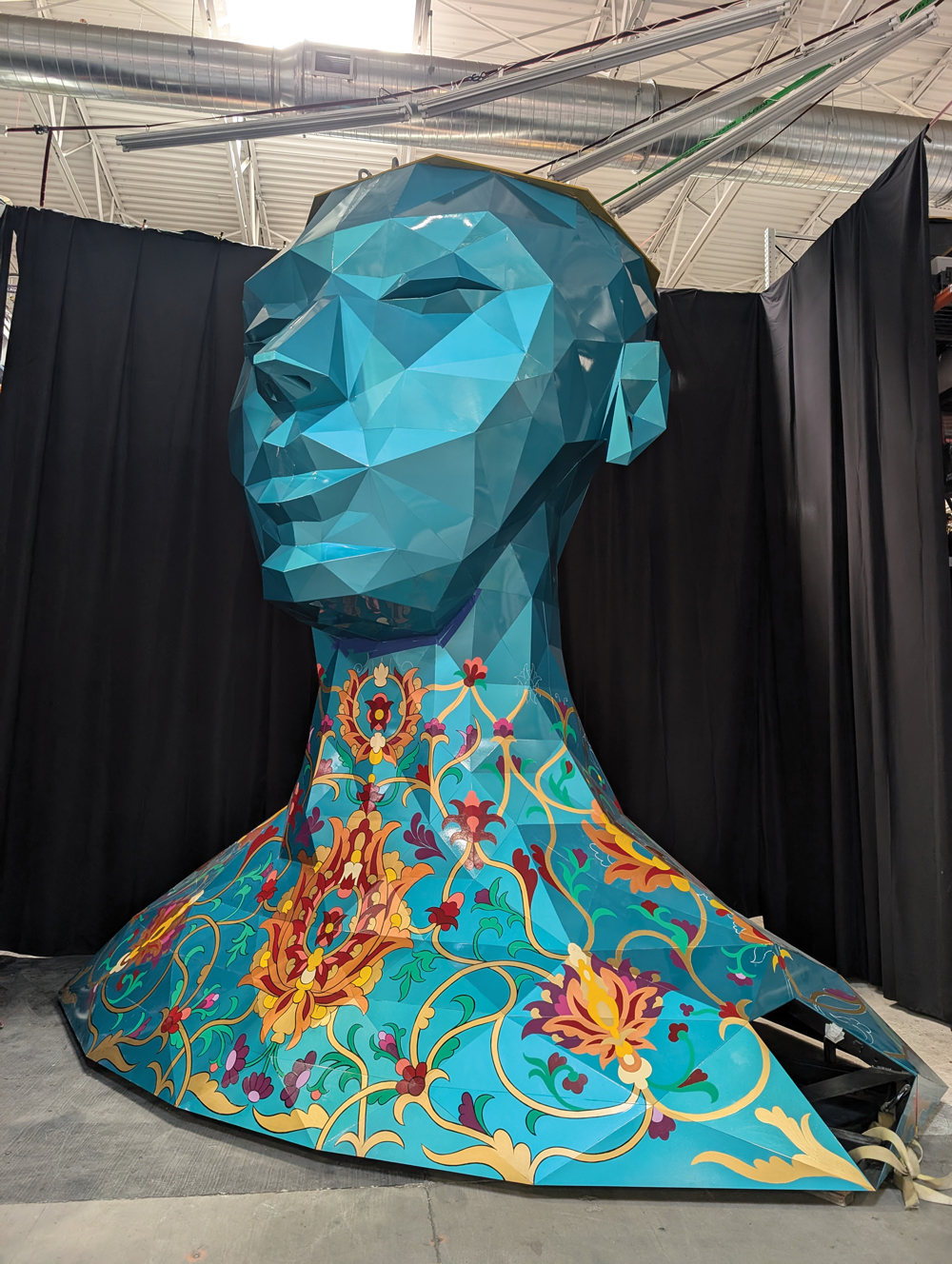
Asite in the Reno-Sparks metro area that once supplied a community’s home improvement needs has had a few alterations of its own, as doors open to the world’s largest makerspace, innovation campus and art park under a single roof.
Behind the redevelopment of a former 210,000-sq.-ft. Lowe’s building into the new 230,000-sq.-ft. The Oddie District is Foothill Partners. The space was brought to life by Foothill’s President and CEO Douglas Wiele and Community & Economic Development Partner Nick Smoot, who were intent on co-founding a collaborative working campus that fits the needs of engineers, entrepreneurs, makers and artists. One of the first phases of the development anchored a 63,000-sq.-ft. non-profit community makerspace, The Reno Generator, at the site in 2022, providing artists with access to heavy fabrication tools and equipment for their projects, such as art installations for the annual Burning Man event taking place in early September approximately two hours to the north.
The impetus for the district’s initial tenant came in 2019, as Foothill Partners COO and Director of Arts & Culture Nettie Oliverio gave Wiele a tour of local arts & culture venues while the team was working on another large regional project, the Reno Public Market. One of those tours included The Generator’s former site. Wiele then attended Burning Man that summer, noticing a number of pieces on The Playa had been fabricated within The Generator.
“Shortly after returning from Burning Man the news broke that The Generator had lost its lease, could not find a replacement space at a rent that it could afford and had decided to shut down,” says Wiele. “Nettie and I saw a business opportunity in creating a project curated around the energy and creativity of The Generator. [We] formed an alliance with its board of directors president, agreed to lease space to them at a rate that was affordable, then went out and bought the biggest vacant big-box retail building we could find — the vacant former Lowe’s on Oddie Boulevard in Sparks — and The Oddie District idea came to life.”
Soon after the property’s purchase, consequences of the global pandemic broke down supply chains and drove up commodity pricing and inflation dramatically. Increased rates of inflation caused the real estate credit markets to shut down, ultimately unveiling what Wiele states was an “expensive slog” to secure construction financing for the project.
“Ouch,” continued Wiele. “We learned that we got lucky, which is a blessing. We sensed a cultural interest in a maker economy was growing. We had no idea how strong that would turn out to be, that the trades would find themselves in a period of great resurgence and that the emergence of AI would drive that interest all the stronger.
“We learned to trust our instincts,” he says. “Yes, light industrial real estate can be curated as to tenant mix with great success. If we lift ourselves out of a commodity project orthodoxy, we create our own market and set our own rents.”
By the end of 2026, the team plans to have completed construction of 150,000 sq. ft. of light industrial and fabrication-ready spaces, flexible office space, training labs and R&D environments; a 20,000 sq. ft. outdoor art and event space; and a 300-seat food and entertainment venue, The Oddie Commons.
The project wraps around on three sides of The Oddie Commons, which features nine storefronts with open-air common seating and a gathering area. Those nine spots are intended for a variety of food and beverage offerings — as Wiele puts it, you can’t have all these advanced engineering uses and producers in one place without a little coffee, beer and something to eat. A local coffeehouse chain, Coffeebar, has already come in to occupy 3,000 sq. ft. of the space to relocate and expand its craft coffee roasting facility.
“At night we close it down for security, in the morning we open it up again unless the weather is really inclement,” says Wiele. “The center of the space is a gathering area — soft seating, casual seating, big firepit, video monitors, video projectors — and the gathering area is convertible to makers fairs, farmer’s markets, lecture series, casual and programmed music events, a stage that plays to the indoors and to the outdoors.”
Direct access to skilled talent led NevadaWorks and the Nevada Department of Employment, Training and Rehabilitation to invest in a new EmployNV hub at the campus. The Oddie District’s model provides an ideal environment to support EmployNV’s vision of cultivating a single accessible place to deliver workforce services, education pathways, employer engagement and service infrastructure.
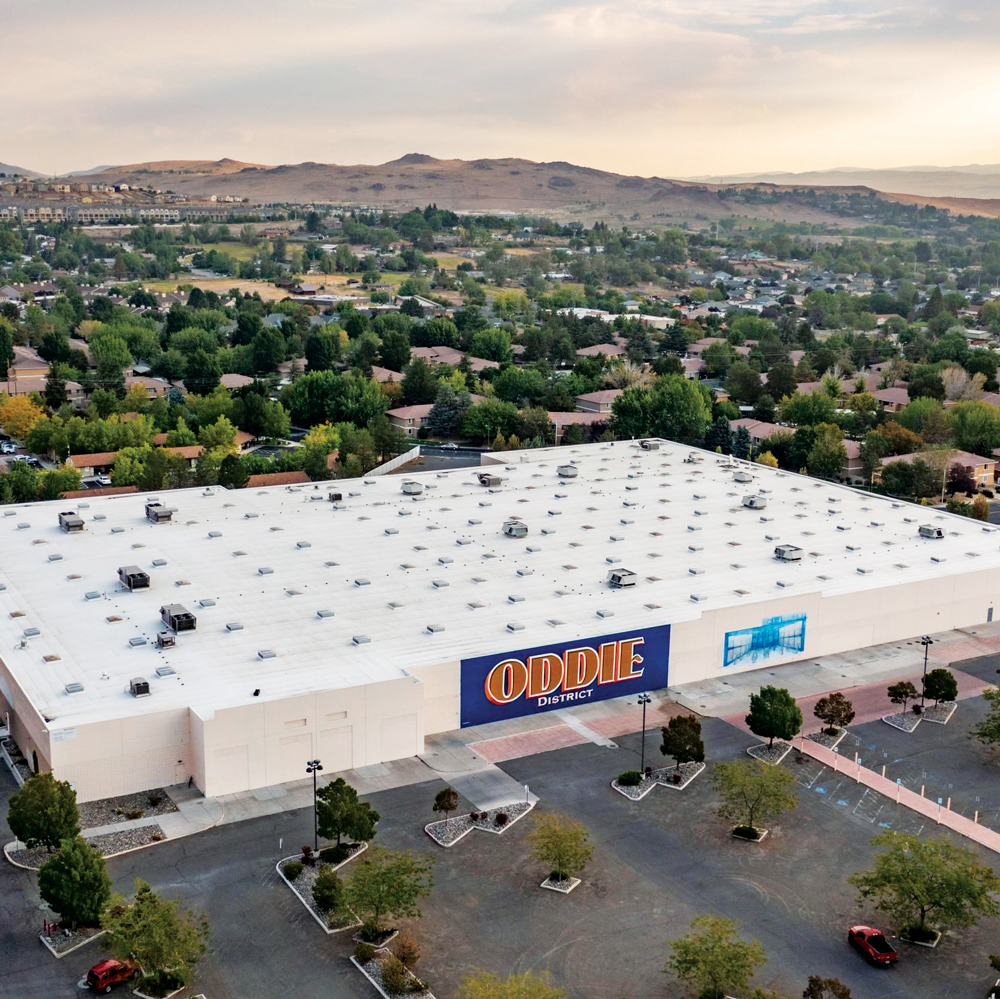
Revitalization of a former Lowe’s home improvement facility in Nevada is setting the stage for new levels of innovation and entrepreneurship within the Reno-Sparks metro region.
Photo courtesy of The Oddie District
Another career-focused occupant to date is the National Technical Institute, which will provide workforce training tailored to industry needs.
“Combined with entrepreneurs, educators, investors, restaurants and community partners, the campus creates an environment where companies can recruit talent, develop their workforce, collaborate and scale all under one roof,” says Nevada GOED Director of Strategic Programs and Innovation Karsten Heise. “That integrated approach is what companies are responding to. Rather than navigating disconnected organizations, they see a coordinated ecosystem where capital, workforce, education, real estate, entrepreneurship and community work together to help businesses succeed.”
Integrating Build Nevada
In May 2026, the Nevada Battle Born Growth Escalator (NBBGEI) launched a new AI-powered platform, Build Nevada, designed to connect both in-state and out-of-state founders, operators and growth-stage companies to capital infrastructure and expansion opportunities available in Nevada.
The Oddie District equips the state with a physical hub to pair with the digital platform. Here, Build Nevada will route founders toward vital funding while also connecting them to a literal building with community, mentorship programming and other companies building alongside them.
Within the platform, companies can submit structured project profiles outlining their product, traction, team and growth plans to get matched with capital, financing tools and strategic partners in Nevada’s innovation ecosystem. Build Nevada focuses on sectors the state has identified for growth — Energy & Electrification; Advanced Manufacturing; Robotics, Automation and Drone Systems; Industrial AI and Infrastructure Intelligence; Defense and Industrial Resilience; Supply Chain and Logistics Technologies; and Rural Industrial Growth — offering approved companies between $250,000 and over $3 million in venture equity, equipment financing, growth lending and expansion capital for Nevada-based operations.
“Our internal team then reviews submissions and follows up directly on strong fits, turning a relationship-dependent process into a structured intake funnel,” says Heise.
Ahead of the platform’s rollout, Heise and Smoot, who is also the co-founder of build_cities, spent several years discussing economic development challenges faced by the country and Nevada itself. These discussions explored potential opportunities, ultimately helping to shape aspects of build_cities’ Build Nevada platform.
Upon building out its AI-powered search engine and Innovation Challenge Marketplace, Smoot connected with NBBGEI Chief Program Officer for Venture Capital Kyle Ferguson, who leads the Battle Born Growth Venture program under GOED’s SSBCI program, Battle Born Growth.
The obstacles surrounding large SSBCI programs like Battle Born Growth, overseen by NBBGEI, often center on broad visibility and awareness of Nevada’s resources in both urban and rural areas. This challenge also applies to companies relocating to the state. By combining public resources with private innovation, the state is creating a connected, responsive ecosystem while providing a better experience and new opportunities for companies.
“It lowers the ‘Do I even qualify?’ barrier that keeps founders from ever applying in the first place,” says Heise, “surfacing Nevada’s target-sector priorities so founders can self-select and position their companies accordingly and connecting digital engagement through the platform to physical infrastructure at The Oddie District. So there’s a real on-ramp rather than just a database. Build Nevada widens the aperture of who knows they qualify, not just who’s already plugged into the ecosystem.”
With activity rolling out at the campus, in addition to Build Nevada, over 20 companies have already begun engaging with the platform, registering their projects for review to address specific innovation challenges in targeted growth areas.