|
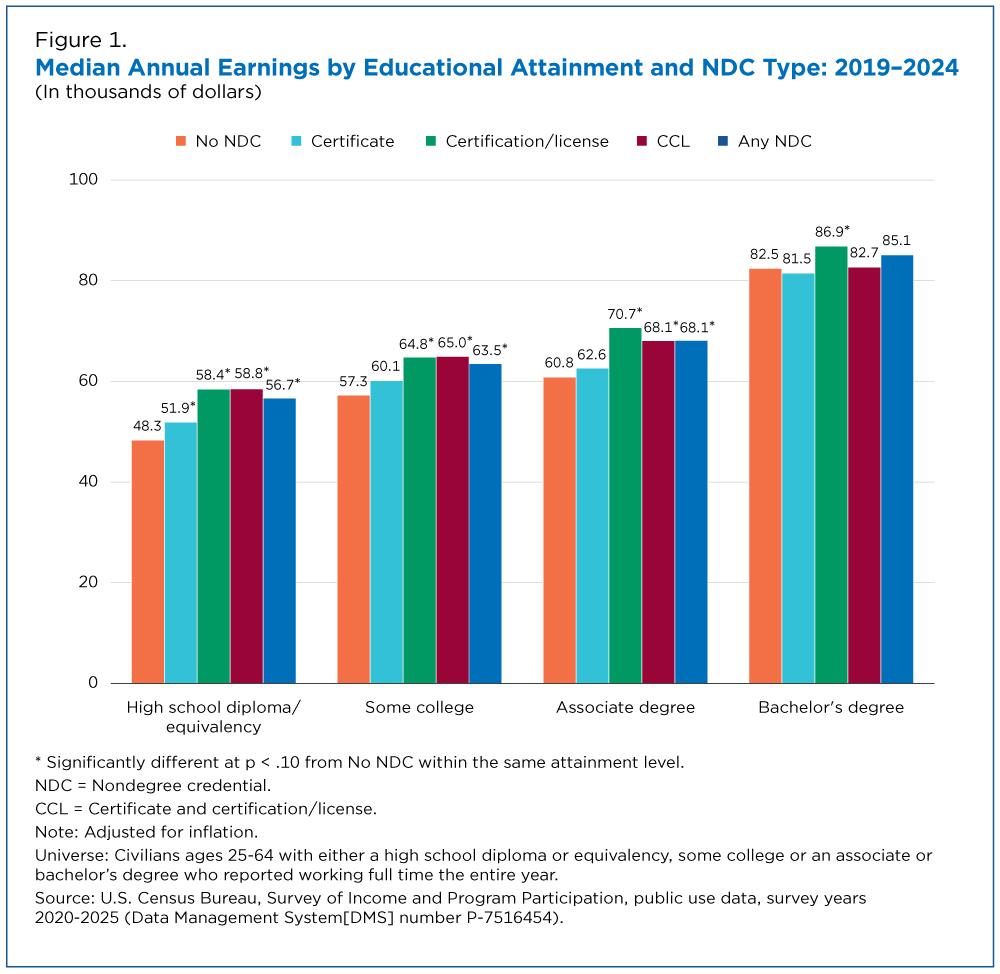
Three news items from the U.S. Census Bureau over the past month merit further attention from Site Selection readers. First, according to 2019–2024 combined data from the Survey of Income and Program Participation, full-time workers ages 25 to 64 with a non-degree credential reported 16.4% higher annual median earnings than those without one. About 37% of adults in that age cohort with at least a high school diploma went on to earn nondegree credentials (NDC) — professional certifications, licenses or certificates — which typically target specific skills and occupations. The finding applies to those with only a high school diploma and those with college degrees.
In August, the Bureau announced new partnerships with institutions in Colorado, Maryland, New Mexico, New Jersey, Pennsylvania, Utah, Tennessee and Vermont for its Post-Secondary Employment Outcomes (PSEO) experimental data product. “People considering attending college can use the PSEO to find earnings and employment outcome data by major, degree level, post-secondary institution and state,” a release explains. “Partnerships with eight new educational systems, plus new institutions from four existing partners, add data from 165 post-secondary institutions to the PSEO. This brings the total to 1,117 institutions, covering about 40% of all U.S. college graduates.”
As for the employers those credentialed individuals hope to work for, the Bureau early this month released the full dataset from the 2024 Annual Integrated Economic Survey (AIES), offering a single, comprehensive annual snapshot of U.S. employer businesses. “The AIES provides economic data, including business revenue, expenses, payroll and employment at detailed geographies,” the Bureau announced, including data at the national, regional and divisional levels, with state-level estimates available for selected sectors.
|