


U.S. Holdings
hile Asian and Middle Eastern sovereign wealth funds garner their share of attention, good old corporate FDI is still flowing to the U.S., even from good old Europe.
A 2008 Bureau of Economic Analysis report on FDI outlays to establish or acquire U.S. businesses in 2007 showed a substantial year-over-year increase (37 percent) from Europe, which accounted for more than half of the year’s total.
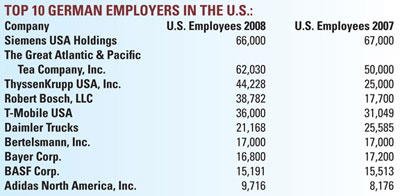
German investors increased their U.S. FDI by 26 percent between 2003 and 2007. Further evidence of the country’s staunch position was offered early this year by the German American Chambers of Commerce, which released its latest Top 50 ranking of German firms in the U.S., based on 2007/2008 annual sales. Total sales among them came to $276 billion –coincidentally equal to all foreign FDI in the U.S. in 2007 –with U.S. sales representing nearly 10 percent of that total. German firms employed 327,000 in the U.S. in 2007-2008.
Conway Data New Plant Database analysis of the facility investment track records of these Top 50 companies shows no fewer than 67 projects were implemented by them in 2007-2008, led by Siemens with eight projects, Daimler with seven, BMW and ThyssenKrupp with six each, and DHL with five.
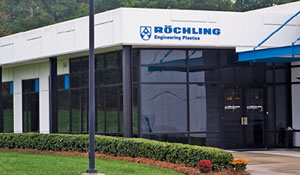
More German companies are seeking to join the ranks. Among them would be Röchling Group, which in October 2008 opened its sixth North American plant near Gastonia, N.C., for the production of thermoplastic pressed sheets. Partly by acquisitions over the past two years, the company also operates plants in Cleveland, Ohio; Orangeville, Ont.; Mount Pleasant, Pa.; and Kimberly, Wis. And in December, it acquired a smart card manufacturer in Tlaxcala, Mexico. The company employs 6,000 worldwide at 54 locations in 18 countries.
The 165,000-sq.-ft. (15,330-sq.-m.) new administrative and manufacturing facility in Dallas, N.C., received a $5.2-million investment from Röchling, which, like top firm Siemens, sees the infrastructure opportunity as a time to shine.
“Despite the current economic and financial crisis, we view North America, in particular the United States, as a future market,” said Ludger Bartels, CEO of the company’s high-performing plastics division.
ne year after announcing a US$73.4-million expansion of its Toronto Hub in Vaughan, Ont., UPS Canada in November 2008 announced a $26-million consolidation investment in a new 150,000-sq.-ft. (13,935-sq.-m.) distribution center at Calgary International Airport, which will eventually allow the shipper to double the facility’s package processing capacity.
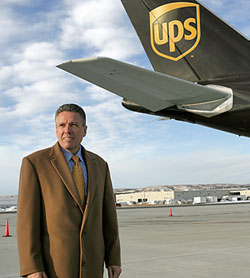
“Calgary is clearly Alberta’s premier international gateway for cargo today and in the future, and this new facility will ensure current and new customers continue to receive expedient, reliable and convenient service,” said Mike Tierney, president of UPS Canada.
UPS currently operates three separate distribution centers in the city, which will be shut down when the new facility becomes operational in October 2009.
Calgary has seen its transportation and logistics industry grow by 77 percent and double its work force to more than 40,000 in the past decade.
Of the air transport sector’s 6,500 employees in the Calgary metro area, 415 will now work at the new UPS facility. The company has seen a 60-percent increase in order volume in greater Calgary since 2003.
The new facility will reside in one of the Calgary Airport Authority’s YYC Global Logistics Parks, developed by Trammell Crow. In June 2008, one of the six parks welcomed a long-term lease from Textron‘s Bell Helicopter unit for its primary Canadian distribution operation.
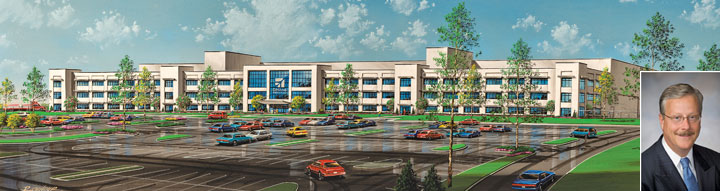
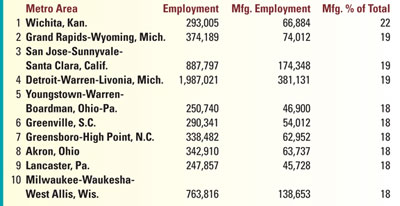
ooking for a pool of manufacturing labor? A quick series of drop-down menus offered by a new online tool of the Brookings Institution’s Metropolitan Policy Program produces the list below of top metro areas for manufacturing employment among the nation’s 100 largest cities, courtesy of the 2007 American Community Survey.
Wichita, Kan., tops the list, but the crown is not lightly worn. In February, the U.S. Department of Labor’s Bureau of Labor Statistics reported that two of the 12 private-sector work stoppages of 1,000 workers or more that began in 2008 intersected with Wichita: the multi-location machinists strike of Boeing Co., and a three-week dispute between machinists and Hawker-Beechcraft.
At the same time, it’s a title that brings opportunity. In October 2008, the city saw the groundbreaking for Cessna Aircraft’s new Citation Columbus design and assembly facility, announced the previous April after approval by the Kansas Legislature of $35 million in bonds for the project, part of a $115-million package of local and state loans, bonds and training resources.
“Cessna fully appreciates the partnership and support we have had at the state level and locally,” said Cessna Chairman, President and CEO Jack J. Pelton. Textron‘s Cessna unit will create 1,000 jobs with a total payroll of $74 million in Wichita, and invest $780 million in the development of the aircraft. It will be tested by another company, Spirit AeroSystems, investing $260 million in its own Wichita complex.
No. 5 on the Brookings list –Greater Youngstown-Warren, Ohio –may see a healthy number of its manufacturing workers employed in a new venture soon. The State of Ohio recently approved a 10-year, 75-percent job creation tax credit for Vallourec & Mannesmann Holdings Inc., a maker of seamless steel tubes for the energy industry, to construct a $750-million rolling mill and melt shop that would create 300 new jobs. At press time, the company had not yet decided whether to go forward with the project.

Site Selection Online – The magazine of Corporate Real Estate Strategy and Area Economic Development.
©2009 Conway Data, Inc. All rights reserved. SiteNet data is from many sources and not warranted to be accurate or current.