
The co-author of a new history of Research Triangle Park places a new chapter in context.
By Mack Paul
This summer we received a galley copy of the forthcoming book “Miracle Road: The Story of Research Triangle Park” by the late journalist and author Allen Paul (who died in May after the manuscript was completed) and his son Mack Paul, co-founder of Morningstar Law Group, where he is a partner, and an instructor in land use law at North Carolina State University and North Carolina Central University. By special arrangement with Duke University Press, we present here a contribution by Mack Paul, followed by a conversation between Paul and Senior Editor Alexis Elmore. —Ed.
In early 1965, IBM’s real estate team gathered at the company’s new headquarters in Armonk, New York. They had already recommended Boulder, Colorado, for a new facility to produce the revolutionary System 360 computer. The company wanted an additional facility — one located in the southern United States. The decision came down to Manassas, Virginia, and Research Triangle Park, North Carolina.
Manassas had many advantages including better infrastructure, an international airport and proximity to the nation’s capital. RTP showed promise but remained nearly vacant after its creation in 1959. When the real estate team delivered its recommendation of Manassas, Tom Watson, Jr. reportedly looked up from his desk and said, “No, we’re going to RTP.”
The real estate team missed one important factor. They failed to weigh the momentous social conditions rocking the country after the Brown v. Board of Education decision in 1954. Watson, however, followed events closely. He understood that Virginia’s governor had promised “massive resistance” to desegregation while leaders in North Carolina took a more measured approach. In particular, the local school system offered a stabler environment for IBM’s workers skeptical about relocating to the South.
In July 2026, the Research Triangle Foundation completed a multi-year process, establishing a new template for real estate development called RTP 3.0. What has been a suburban-style office park will now slowly transform by allowing residential, retail and hospitality uses in the Park. Leaders intend for 3.0 to produce “innovation hubs” where entrepreneurs can exchange ideas, start businesses and test new products. RTP has always depended on meeting the needs of tech workers. For many decades it provided an idyllic environment for R&D labs situated on large campuses surrounded by pine forests. RTP 3.0 acknowledges that preferences of tech workers and companies have changed. It marks a new era for the Park.
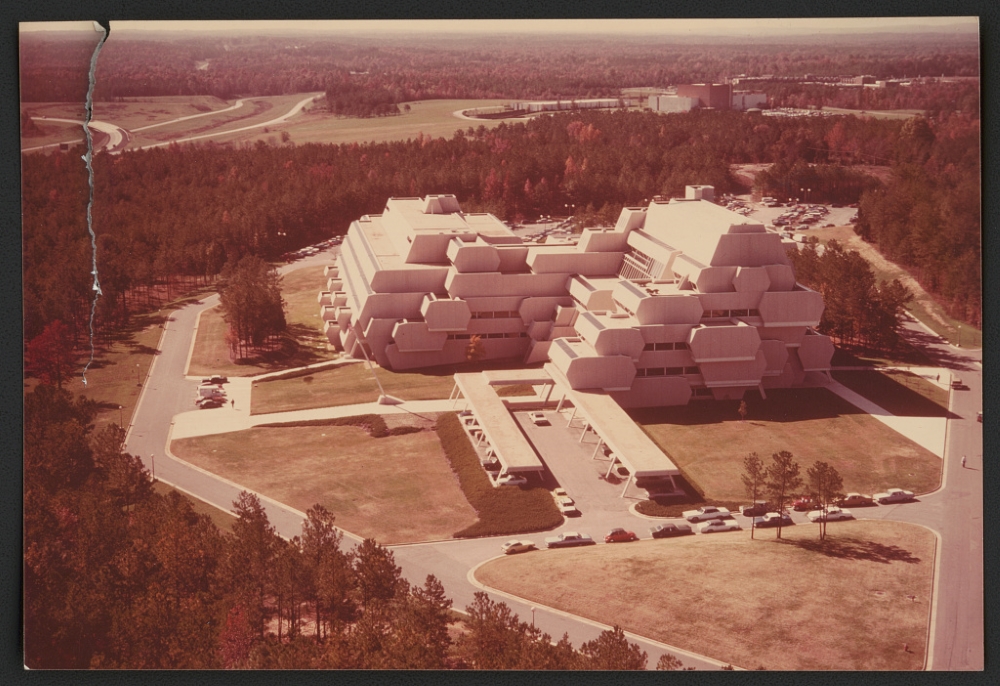
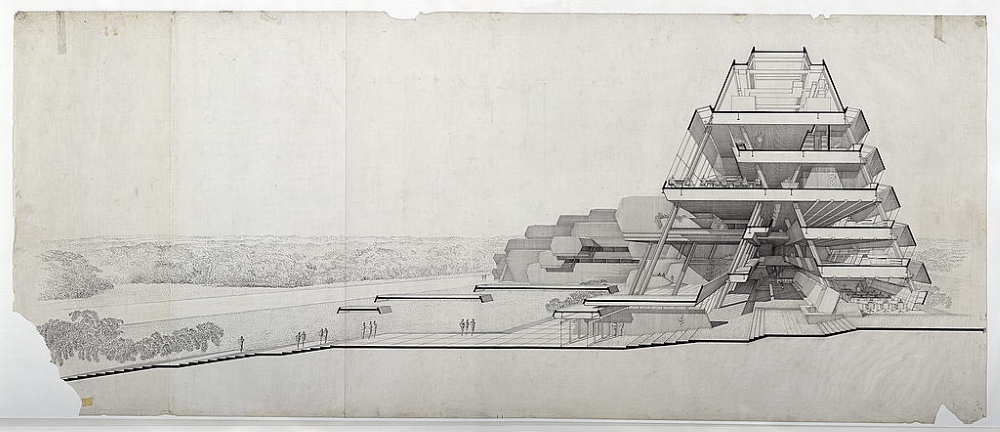
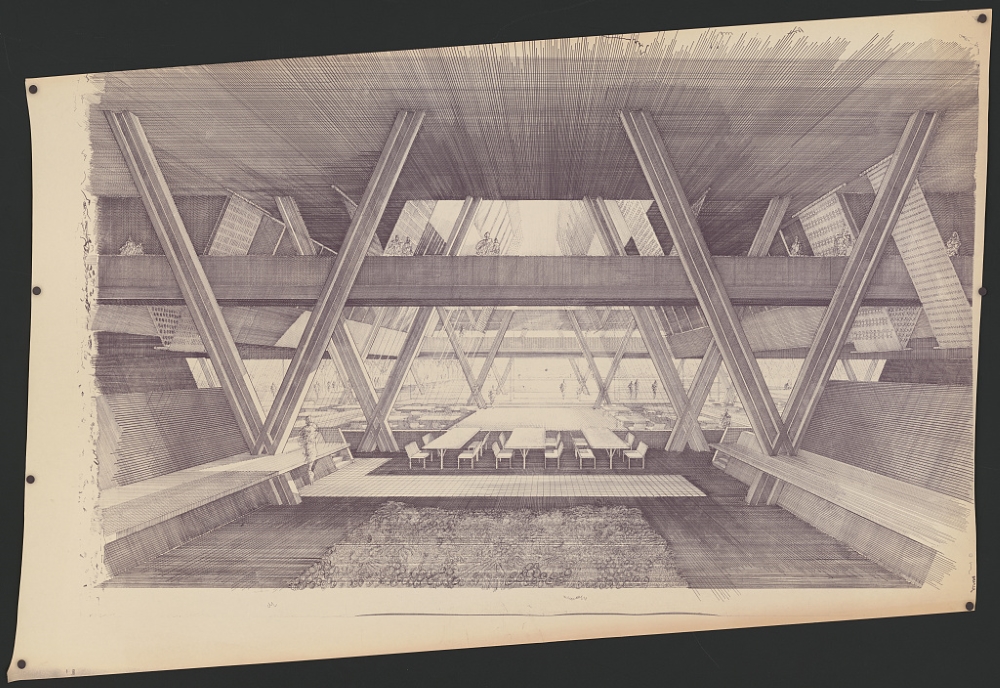
Image courtesy of Paul Rudolph Archive, Library of Congress Prints and Photographs Division
IBM’s decision in 1965, however, proves the point that successful corporate recruitment requires far more than an attractive site. RTP has succeeded while so many other science parks have failed because it has persistently executed an economic development strategy based on two key prongs: First, attract R&D laboratories to areas near the local universities and second, leverage those facilities to spur new industries throughout the state, thereby raising the standard of living of all residents. Importantly, RTP was only one facet of this strategy. The most important aspect of it rested on strong collaborations among three key groups: the business community, government and the area universities. A long-term focus on these collaborations serves as the secret sauce behind RTP’s track record.
Business
The business community conceived of and originally backed RTP. As president of a struggling construction firm, Romeo Guest first promoted RTP to replace declining industries in textiles, furniture and tobacco. Business leaders in Charlotte, Winston-Salem and Greensboro embraced the idea for the good of the state. They raised funds privately to acquire the land for RTP, and most of those funds came from outside the Raleigh-Durham area.
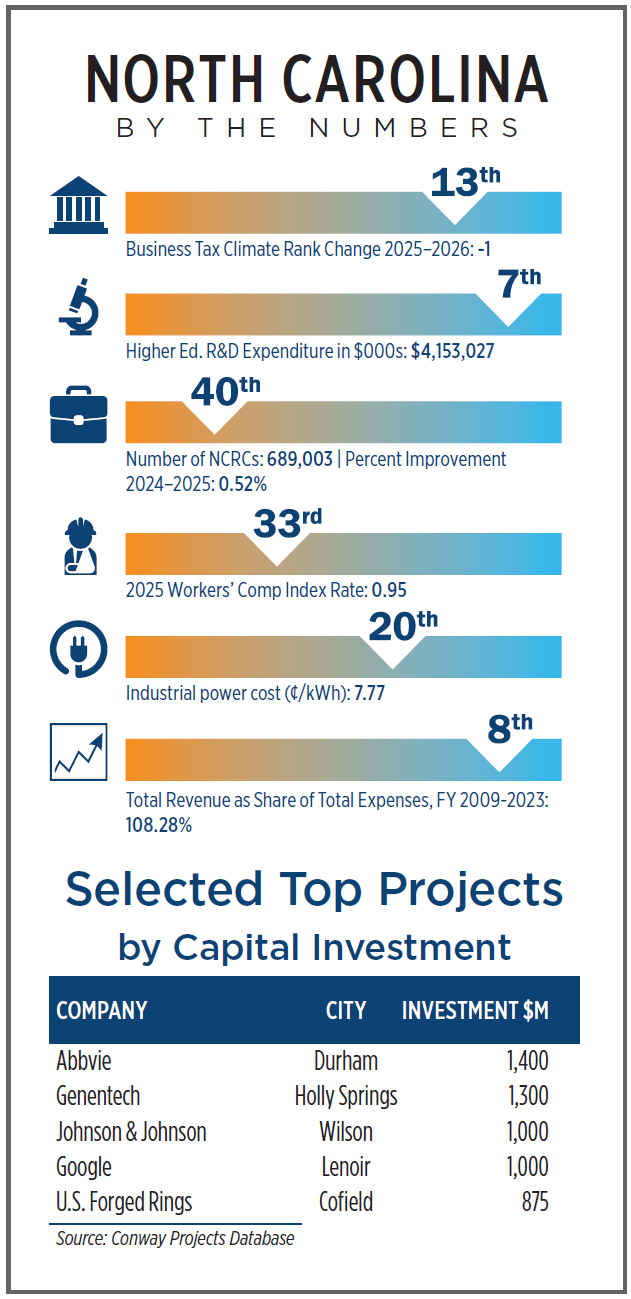
Companies arriving in RTP and the area have participated in numerous initiatives to promote the tech industry. In the 1990s, business leaders pushed for greater regional collaboration such as a single marketing arm instead of fragmented local efforts. Around the same time, local business leaders saw the need for more start-ups. They created the Council for Entrepreneurial Development as a place to network and learn from one another. One member sought out Eugene Kleiner, founder of Silicon Valley’s preeminent venture capital firm, to mentor the first venture capital firm in the Triangle, Intersouth Partners. Finally, business leaders support education at every level — from public schools to workforce training to special initiatives at the university level such as the Biomanufacturing Training and Education Center (BTEC) at North Carolina State University.
Government
From the outset, government played a critical role in RTP’s success. After the untimely death of Governor William Umstead, Luther Hodges took his place in 1954. Hodges was an outsider to North Carolina politics. He grew up poor but rose through the ranks to oversee all of the textile mills for Marshall Field’s Department Store and then served in Europe during the Marshall Plan. He saw himself as an “industry hunter” for the state. When approached by the CEO of Wachovia Bank and Romeo Guest, he embraced the concept of RTP, seeing the advantage of attracting new industries to boost one of the poorest economies in the nation at the time.
State government did not underwrite RTP. Gov. Hodges used his position to convene leaders in business and academia to flesh out the concept. His leadership gave RTP the credibility it would have otherwise lacked. Just as importantly, Hodges campaigned on the idea of industrial training centers — the precursor of the community college system. Workforce training would become an ace in the hole for North Carolina’s business recruitment. Essentially, the state offers to train the workers of any tech company choosing to establish a new facility in the state. Time and time again, companies cite “knowledge incentives” as the decisive factor leading them to choose North Carolina over other states.
A pivotal moment for RTP came in 1980 when a local state senator, Gerry Hancock, received a letter from a constituent asking him to look into biotech. Ultimately, the legislature invested in the first state organization focused specifically on this industry with the NC Biotech Center. The Center recruited a number of superstar scientists and their labs to the area universities. Studies have shown those places that attracted top innovators in the early years of biotech gained an edge in industry recruitment that continues to this day.
Beyond state government, RTP has benefited from the collaboration of local governments. Since tech workers coming to RTP had to live outside the Park, it was critical for local governments to provide the services, housing and amenities attractive to these new types of workers. Through the 1990s, local governments worked collaboratively to improve the entire region. Starting in the 2000s, energy began flowing back into the urban cores of Raleigh and Durham. Now, many communities in the area focus on their own identity and community amenities. They also compete for tech companies, which has encouraged RTP to change its model to offer similar urban, walkable features.
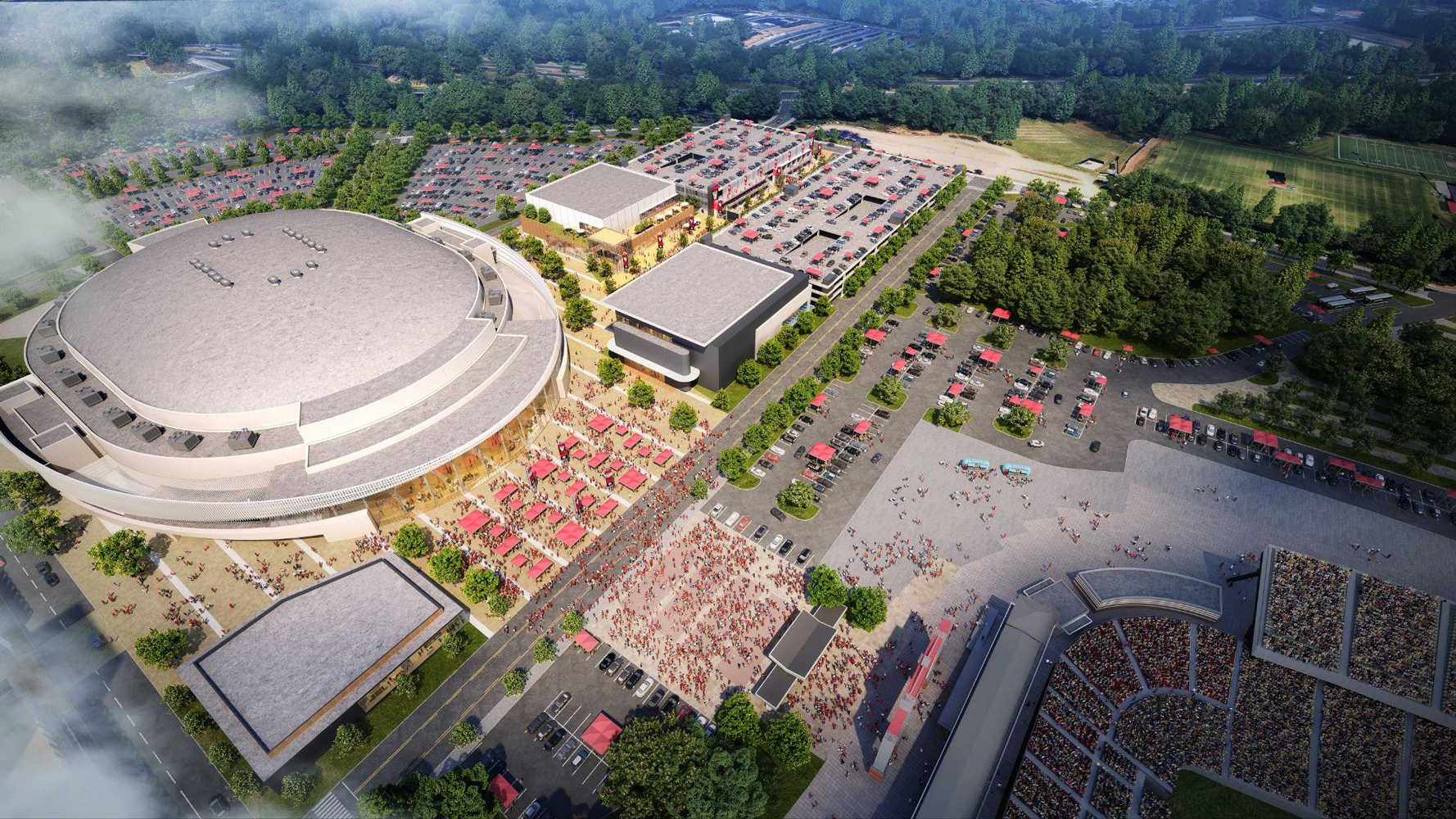
District development in the Research Triangle goes beyond innovation districts: The Lenovo Center, home to the 2026 Stanley Cup Champion Carolina Hurricanes, is undergoing $300 million in publicly-funded upgrades, anchoring the future $1 billion, 80-acre Raleigh Sports & Entertainment District.
Rendering courtesy of Pacific Elm Properties
Universities
Last, but certainly not least, area universities have actively collaborated in the strategy. Initially, they resisted. Prior to signing onto the RTP strategy, academics insisted on the formation of a research institute under university control to serve as a buffer between industry and academia. Now one of the largest independent research organizations in the United States, Research Triangle Institute (RTI) provided the glue for RTP as a place for academics to test ideas for the marketplace. By the 1970s, academics founded some of the largest tech companies in the state: SAS, Quintiles (now Iqvia) and Cree.
When the IBM real estate team in 1965 delivered its recommendation of Manassas, Tom Watson, Jr. reportedly looked up from his desk and said,
“No, we’re going to RTP.”
The universities work closely with institutions such as the NC Biotech Center and the Microelectronics Center of North Carolina to further their academic mission through new programs, new talent and interconnectivity among the universities. The tech transfer offices have grown more sophisticated each year. For example, Duke University boasts its own angel fund and recruits faculty with the promise of research space in converted cigarette factories in downtown Durham. The reticence of the 1950s has long vanished.
We think of RTP as a place. As the largest research and science park in the U.S., RTP commands attention. Its large presence in North Carolina helps keep the original strategy alive. But it is the strategy that has given life to RTP. As RTP enters a new era, it will be critical that business, government and university leaders find new ways to collaborate in the era of AI, quantum computing and other transformations shaping the tech industry.
A Conversation with ‘Miracle Road’ Co-Author Mack Paul
Mack Paul, co-author, with his late father Allen, of “Miracle Road: The Story of Research Triangle Park,” co-founded Morningstar Law Group, where he is a partner. He teaches land use law at North Carolina State University and North Carolina Central University. In July, he sat down for a conversation with Site Selection Senior Editor Alexis Elmore about the book and the RTP region’s history. —Ed.
Site Selection: Did anything surprise you when learning about the modern foresight early players such as Romeo Guest, Pearson Stewart, George Simpson, George Watts Hill and former Governor Luther Hodges had for the Triangle region?
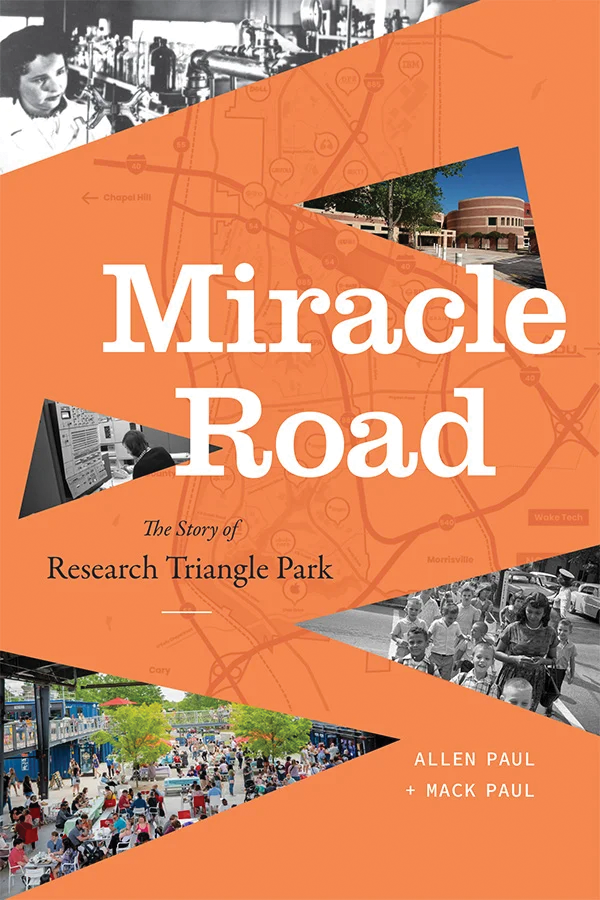
Mack Paul: I had thought a lot about that aspect — their foresight, their vision. Thinking about all of them together, most of them had some really interesting insight about what the world was going to be like where an RTP would exist.
They really believed in investing in the state. We have a great university system. One of the first to have a state art museum and symphony. All these things, they just had a civic aspect to them and belief in the state. RTP sort of came out of that line of thinking of an investment. Even people in the [Piedmont] Triad giving a lot of money to create something not in their backyard, but in another part of the state, to benefit the state. It just happened that these figures who got involved in the project brought different things to the table and had some really interesting insights.
Romeo Guest doesn’t really get the recognition he deserves. He kind of gets picked on because he was trying to make money. His construction company was struggling because there was very little happening. The textile companies were struggling and the type of work they typically did was not thriving, so he came up with this idea to build a center in North Carolina that would attract research and development labs. He happened to go to MIT in the late ’20s, and MIT just happened to be one university in the United States that was at the forefront of research labs and commercialization at that time. You didn’t really see that anywhere else. He saw the Polaroid camera being developed, a lot of the research along the Charles River, and he continued to correspond with a lot of his friends from MIT in the ’30s. He finished right at the Great Depression, so he’s really struggling through the ’30s. But he kept seeing this idea that companies might want to be near a university, and you really never had that before. Then in World War II, massive research dollars from the federal government to go to the universities with the decision being made not to provide money to private companies, but to go through the universities to do the research that was needed. He understood that and he’s looking on the map and saw we’ve got Duke, NC State and UNC kind of nearby. Wouldn’t it be great to build a center where we could attract and leverage those universities for this R&D? So, had he not gone to MIT, had he not had those relationships, had he not continued to look and struggle for a way to bring companies to North Carolina, that idea of RTP never would have happened.
Luther Hodges is kind of a more traditional figure, having run a major division for Marshall Field’s, overseeing all these textile companies and kind of bringing himself up by the bootstraps. He was the guy who had the idea of the modern community college system. One of his main issues was what he called Industrial Training Centers and getting funding for that in the legislature. He helped create it and then it went on in the next administration, Governor Terry Sanford, to turn it into the community college system. It’s become one of North Carolina’s strongest economic development tools.
Pearson Stewart was another fascinating guy who grew up around Boston and went to Amherst. He went to MIT for grad school in urban planning, came down to Chapel Hill to work as a planner and got hired by the next person I’m going to talk about to be the first planner for RTP. Nobody had ever planned a research and development park or science park at that time. What is it? How do you lay it out? He just had this really keen insight. He talked about trees. He loved the environment, and he thought deeply about the topography and the geography and the ridges and the valleys and how to lay it out in a way that would be attractive to workers. They had a plan that the firm up in New York had drawn up for RTP and he just took a look at it and threw it in the trash can. He said, “This doesn’t fit with North Carolina,” and he came up with it on his own. Then he became a huge conservationist and helped create the Triangle Land Conservancy later on in his career.
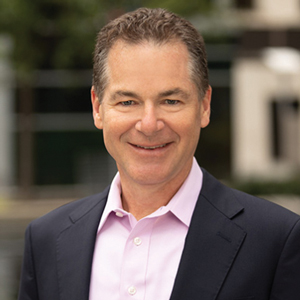
Mack Paul
“North Carolina’s always been of a mind it’s not going to try to compete on just financial incentives like other states have done. It’s going to build this infrastructure around knowledge and education and talent.”
The last I’ll talk about is George Simpson because he was my favorite among all of them, in terms of his insights into what the future might be. He was really young, at this time he studied under a guy named Howard Odom, who was a sociologist at UNC, apparently very well known nationally, writing about the South and culture and development. Simpson felt really strongly that the South could do better economically, but it needed to figure out a new industrial approach instead of just poaching companies coming from the Northeast. They had a committee that was supposed to hire the first director of the Triangle Committee, which became the foundation later. He was the first hire. Hodges couldn’t control himself and went to Bill Friday, who was a really young new president of the UNC system, and he immediately said, “You need to hire George Simpson.” George could deal with faculty and he also understood the economic imperative of North Carolina and the South. At that time, they were having a hard time getting universities to buy into RTP. There was just wasn’t this sense that academics and industry mixed together. George could be like that glue between the two, or at least the middleman to help bridge that gap.
Simpson understood this new world of technology coming out of World War II research and development. It was really a different type of worker who could operate very independently, go and study and research, come up with ideas, think deeply about problems and be innovative. That was a really different type of worker. He came up with how to describe an environment that is attractive to this worker and he put together a really great brochure called “The Dream and the Dilemma.” It laid out the whole picture of what tech centers might look like as a high quality of life for these workers, where you could have a really interesting, demanding job and also have the respite of coming back to a home and having your little oasis. It was kind of the post-World War II suburban environment with recreation, but you get access to really great jobs. RTP would be that job center in the center of the region, and people would live in other environments around it.
Besides sheer persistence toward RTP’s vision, another common theme in “Miracle Road” is the impact of unforeseen events, including Gertrude Cox’s arrival, Chemstrand’s decision to locate in RTP and entrepreneurial impacts of the Glaxo effect. What should state leaders seeking their own dedicated research or innovation parks take from the consequences of such events?
Paul: There’s always going to be unforeseen events. Sometimes those unforeseen events can be helpful. Sometimes they can be like the pandemic, something that comes out of nowhere and is a real problem that has to be dealt with. The lesson I took away from it is the leaders who created the vision of RTP. It was very collaborative, strategic economic development, a plan that had multiple facets to it.
RTP was just one of those elements. At the beginning, they didn’t even really think they were going to have an RTP. They just were going to bring companies here. They eventually realized they needed to have a physical place to show a company, “Hey, this is ready to go, this site is prepared,” etc. But a great example of why that persistence is so important is the early years.
George Simpson put together an army of faculty — hundreds of faculty members — to go out around the country to meet with all of these companies and try to talk to them about locating their research and development facilities or labs in North Carolina. After a year of doing that, they came back with zero interest. Or there was interest, but not one success of a company being serious about coming to North Carolina. Then, just by happenstance, one of the members of the faculty, really the ringleader of it, was a guy named William Little. He was a chemistry professor at UNC. He happened to be at the RDU airport after one of his trips and he ran into some of the executives from a company called Chemstrand, which is down in Decatur, Alabama. They were there to interview some of the chemistry students at UNC. They did a lot of kind of textile research, new types of materials with textiles. He just struck up a conversation with one of them, and it came out that they were looking at another site to build a facility. He’s like, “Hey, have you looked at RTP?” And they’re like, “No, never thought about it.”
He seized that opportunity. He had all this material with him. He talked them into taking the time to do a site visit to RTP. They already were way down the path of going to Princeton, New Jersey, and I think they were trying to hedge their bets. This is after Brown v. Board of Education. There was a lot of turmoil in the South and they needed a place their workers can go and don’t have to deal with some of the strife around desegregation. But they decided to look at RTP. Then ultimately, that was the first major coup of a company in the 1960s right after they created the Research Triangle Park. I think it’s a great example of happenstance. But this guy was persisting, meeting after meeting, all of that effort, not giving up and having a plan so when those unforeseen things happen, you were there, ready to take advantage of it. So that’s why I really feel it’s the persistence that’s the most important thing.
RTP got a generational head start on addressing challenges — cross-institutional collaboration, legislative and community buy-in, and targeted ecosystem building— many states now grapple with. Since the guidance of “industry hunter” Governor Hodges, how vital has North Carolina’s state leadership been in maintaining RTP growth?
Paul: It’s really critical. I first want to say something because I think it’s kind of a lesson of hope for any community, whether it’s in the United States or outside the United States, that’s thinking about this kind of model. While timing is important and it helps to be on the ground floor in certain industries, you can do it even though you may not be the first to do it. You talked about the generational head start. We forget —
and I didn’t really focus on it until I worked on this book — that MIT and Silicon Valley are gold standard for tech centers. Both of those areas are very closely tied to one another. They had essentially very similar leadership during World War II. There’s an engineering professor at MIT, Vannevar Bush, who ended up heading up the Office of Science and Scientific Research and Development (OSRD). They oversaw the Manhattan Project in World War II, and he was the one who really convinced the federal government that the universities ought to be the channel for this funding for research if we want to come up with new technologies.
At the time, it was mostly defense. A lot of it ended up having commercial application, and he was doing that to really build up MIT. He believed in the institution and he saw research and development as a way to build upon MIT’s preeminence. One of his students was a guy named Fred Terman who grew up a faculty brat at Stanford and went to MIT for engineering. He was, I think, Bush’s first PhD engineering student and worked with him at OSRD. He went back to Stanford after World War II and he essentially followed the same model Bush did at MIT. A the time, no one really knew Stanford. It was like a backwater. He started getting these federal contracts and he created the Stanford Research Institute. Both Stanford and MIT in the 1940s began getting these federal contracts and they built into the ’50s and the ’60s. So, 20 years before RTP got started, both of those regions had a huge head start.
You may remember Eisenhower’s farewell address talking about the military-industrial complex and being concerned about that concentration and dependence on the defense industry. MIT and Stanford were really at the center of that. The funding that they got was enormous, billions of dollars. RTP, it was just a field of nothing, and it was coming in after those two areas had such a head start and still, look what it was able to do through that persistence and strategic vision.
I think it’s a lesson. Don’t think just because you’re falling behind these other places that have existed or exist and are thriving that you can’t create something. Leadership is essential to it. State leadership, I believe, has been critical to RTP and not just throwing dollars at it. The state didn’t pay to create RTP. That was done through private money. What the state did, though, was create the community college system. It helped seed certain institutions like the NC Biotech Center and the Microelectronics Center. It’s created one of the best systems of higher education in the country. I didn’t fully appreciate what an incredible benefit it is to workers who move to North Carolina for their kids to be able to go to NC State or UNC, and the value of those educations is just amazing.
Also, there is the fact that our state has viewed RTP through a nonpartisan lens. We have a Democratic governor in North Carolina and we have a Republican House and Senate. When they’re talking about economic development projects coming to North Carolina, our commerce secretary says there’s zero daylight between Republicans and Democrats. That’s the only time you ever see them standing together smiling is when there’s an announcement of a company coming to North Carolina. The only way you could succeed is that approach.
SS: The Research Triangle Institute was paramount to proving early viability of RTP. Do you believe innovation and research parks require that same anchor today?
Paul: No, I don’t. I think we kind of touched on a little bit, but RTI was absolutely critical to RTP’s initial success. There was a professor at Duke, Paul Gross, another nationally recognized chemistry professor, who came to the table at the very beginning and he said, “Unless you create a research institute like RTI, Duke is not going to support RTP.”
It was really the vehicle to engage the faculties at UNC, NC State, and Duke in the project of RTP. To be able to have adjunct professors who came to the region to be at RTI doing that applied research but could be also teaching at the universities. Universities control RTI through its governance structure. It was interesting, RTP almost went down in flames. The options were about to expire on the land and they had this meeting at the beach with Archie Davis and the governor. They came back to the mansion. They brought Paul Gross and George Simpson, all the founders together saying, “Hey, we’ve got to get on the same page.” They had a big argument about RTI in that meeting and whether the foundation would control RTI. Paul Gross said, no, we’ve got to have it independent. The universities are going to control it. Once they got to an agreement on that, they raised money for RTI to buy the land, and RTI was the first institution to exist in RTP.
It was the only thing they had to sell RTP. We got RTI here, universities are involved, so it was really important. RTI became one of the largest independent research organizations in the country. It’s been a huge success. Many technologies have come out of it. We had a lot of changes in laws to make it easier for faculty to do research in the university and not have to have this buffer institution outside the university. And in fact, professors started seeing the actual benefits of commercialization and the universities creating offices around commercialization.
I think the role of RTI in that type of institution is just not nearly as important today as it was in 1959 or 1960. But the important point is RTP wouldn’t exist without RTI. It’s just that the world’s different now.
Of all of the organizations or initiatives formed in the development of RTP which do you consider to be its greatest gamechangers?
Paul: I talk a lot about RTI and the community college system. Those are definitely at the top. But another really interesting one, and I think unique and critical, is the NC Biotech Center. I think it’s really reflective of the leadership of the state, the governors and how important that is.
Governor Hunt coming in in 1976, young guy, he was looking for ways to innovate and energize the North Carolina economy. He put together a committee of scientists and one of the ideas was creating this biotech center. Genentech had just gone public and there was a Nobel Prize awarded to some of the first gene sequencing that was accomplished in the United States. So it was a very new idea and no one knew what was going to happen with biotech. They had the foresight to create an institution to try to promote that industry in North Carolina and they just happened to hire an amazing choice to lead it, a guy named Charles Hamner, who came from Southern Virginia and ran the UVA Medical Center. He had served as president of UVA. He did one of the first in vitro fertilizations in the world, so he was a renowned scientist. I think he had met with Governor Chuck Robb about this idea of the biotech center and Virginia just didn’t get it. They didn’t support it, and North Carolina came calling.
To him, it was a chance to build a whole new industry from the ground up. So he took the job, left Virginia, and came to RTP in this new institution. He had the insight and knew all of these scientists from his work. He started with hiring the superstars, successful or promising scientists in the world in biotech and gene research. One of his first hires was a guy named Oliver Smithies who came to UNC. He got the Nobel Prize, and he went to Governor Hunt and Governor Hunt asked him what he needed, and he told him, “I need $70 million and I’m going to go out and bring the best scientists here.”
He brought these labs from other universities. Later studies have shown, the places that brought the best scientists by measure of patents, academic papers, work product during the ’80s and ’90s, they became the leading centers for biotech. Once they became those leading centers — just like L.A. with film or Detroit with automobiles — you tend to keep that lead as long as you’re doing the right things. And so, the biotech center in North Carolina having the foresight to create that institution, bringing the right leadership together and bringing these scientists here, ended up being one of the biggest game changers. Life sciences is a major strength for RTP. Certainly IT is important, but the industry was much more mature when we tried to enter IT.
Novo Nordisk President and CEO Mads Øvlisen said that every state visited by the company in the 1970s offered incentives, but North Carolina uniquely provided “knowledge incentives” more powerful than locating near manufacturing resources. Now, over 50 years later, do the region’s big three universities, community colleges and the state’s focus on public education still stand as its most critical site selection factor?
Paul: Yes, absolutely. North Carolina’s always been of a mind it’s not going to try to compete on incentives and just financial incentives like other states have done. It’s going to build this infrastructure around knowledge and education and talent. And fortunately, we got a really early start on the community college system, which we’ve continued to improve over decades.
It’s really hard to come in now and replicate what we’ve been able to put together over many, many years. One example of how we’ve done that, and Novo Nordisk I think is an interesting tie into it, is there was a meeting between Mads and Governor Hunt back in the 70s. [Hunt] went over to Denmark — we did a lot of these industry hunting trips to Europe and Asia — and so they met. He was really impressed by Hunt, then they were looking at a facility for an enzyme production. A lot of what goes into enzyme is agricultural products, corn. They were looking at a place in Nebraska. Ultimately, they decided to come to Franklinton outside of RTP and the Triangle, because of the talent here. The knowledge incentives.
Tobacco was a huge part of our economy and it was going down. Even in the 50s it was declining, and then by the ’90s there was a lot of litigation against the cigarette manufacturers over advertising and all of that. There was a settlement with the tobacco companies, and Mike Easley, who was the attorney general at the time and became governor later, did a settlement. I think it was like $4.6 billion and he took that money, and we created the Golden Leaf Foundation, which was to help build new industries, particularly in the tobacco regions of the state. NC State got a big chunk of that and created the Bio Manufacturing Training and Education Center (BTEC) with it. BTEC does a lot of really interesting things both undergrad and master’s programs. But it also welcomes regulators, people in industry and suppliers to learn about biomanufacturing. I’m not aware of any other state having anything like it.
It’s been hugely important to a lot of the biotech and biomanufacturing companies here, and Novo Nordisk has been really involved in its development. They’ve ended up contributing tens of millions dollars to the BTEC program and 100% of the students coming out of there get jobs within six months. There’s a lot of demand for the students coming out of that program. But it is an example of how creative and innovative we’ve been to build on what we already have. So it’s always looking at what the need is out in the industry and where those opportunities are, and creating these new programs and institutions.
How does the new mixed-use development approach introduced by RTP 3.0 complement initial goals of redefining the traditional suburban model, especially when considering connectivity aspects like Chuck Flink’s greenway plan?
Paul: It really is a needed template for changing that suburban model. It creates the ability for a range of different uses, which didn’t exist before. RTP was simply an office park, essentially. Each company had its own large site and office uses. So now, it creates the ability to have a type of environment a lot of people like, which is mixed-use. You have apartments above retail, you have a hotel and office all within a walkable area.
Zoning isn’t a restriction. It’s not a requirement. RTP has always been based on selling property to owners, who then decide what they want to do, how they want to develop it. Of course, it had to be office. Now it creates an ability to do this type of framework, which is great. I think it’s important to know it doesn’t ensure it happens; it just allows it to happen. And certainly, there’s a demand for it to happen now. The world has changed a lot. At RTP’s beginning, there was very little development in the region. We had some people living in Raleigh, Durham, Chapel Hill. Now the region has grown tremendously, and RTP is ringed by development.
You’ve got apartments and industrial uses and office uses, and it’s right near RDU Airport, so it’s at the center of tremendous development pressure. So we can expect when you take the constraints off, it’s going to respond because of where it’s located. The connectivity is a really important part of that. We started the greenway system at RTP in the 1980s. The plan now contemplates this major greenway spine north to south through the park that will link up to a lot of that existing greenway, both inside and outside the park, which is going to help with the connectivity. But it’s really critical. I talk a lot in the book about the need for alternative transportation modes, because we’re super auto-dependent.
We’re finally settled on this bus rapid transit system. It’s starting to come together regionally, and I think ultimately, as I said, these new templates are critical. But you need the supporting infrastructure to get people out of their cars.
From your perspective as a land use lawyer, do you find RTP 3.0’s various development typologies the ideal future direction to attract future growth?
Paul: I do. I think they’re reflective of best practices in planning circles. They’re templates that allow certain development forms to occur. There’s a lot more to the story than that but that’s an important piece of it. They’ve had good guidance from professional planners in developing these typologies. The mixed-use density node is more of a form-based type of zoning. If you choose that option you have to build the building close to the street with wide sidewalks and transparency on the ground level, so all of those things are features important to creating that environment. They also kept the traditional, such as not opting into any typology and you continue to operate under the existing RTP structure. Or you could choose the enhanced corporate campus, which has more public-facing uses like having restaurants or structured parking.
I think there is going to be a large demand for those corporate campuses. There’s a lot of questions around tech companies investing in new campuses. It’s going to be interesting to see everyone still hold their breath about Apple, which has gotten an extension on their time. But we see particularly life sciences and labs thriving in RTP. Workers have to go to their labs and they operate on these large campuses, so there is still going to be demand for that.
I think the innovation hubs we’re going to see emerge in a few areas are the ones served by transit. We have a new transit hub with bus rapid transit and the commuter line that’s coming to RTP in the future. I also think it’s important for RTP to focus on Park Center, which is well underway. We have a Boxyard RTP and then The Hub that’s coming in now and it’s a proof of concept that you can get people to live in RTP and have all of these amenities.
Is this new template a model you find could be successful in other regions of the state?
Paul: I think it is something you’re going to see in other regions. I want to talk about two aspects of this. When we say the model, I think we’ve been talking a lot about the real estate standpoint — built environment that’s creating this mixed-used hub that has a walkable environment, a street network, transit access, apartments, hotels and offices. All of those things are important but that does not necessarily mean you’re going to get R&D going there. On one hand, I would say you’re going to see that real estate model, it’s commercially viable and we see it all the time. The more interesting question is are you going to see true innovation hubs happening? Just because you build doesn’t mean you’ll have what RTP has going on in terms of invention and research. You need a lot of softer support and I think it’s quite easy to overlook that.
We talked about RTI and how important it was to have the institutions brought into RTP early. RTP has largely been these suburban office campuses that are really kind of a black box where all that work is going on inside. What does it look like when you build this mixed-use environment to make it an innovation hub? Now that they finally have approval for RTP 3.0, I think they’re going to shift into more of these softer support systems of re-engaging universities through institutions that haven’t been super active. We have the Triangle University Center for Advanced Studies, and things like that can bring the universities into new places that we’re trying to create, making sure there are accelerators here, that there are service providers and maker space.
We do have Frontier in Park Center, using old IBM buildings that were basically handed over to entrepreneurs to come in and start operating. Now every single one of those buildings is full. I think there is going to be demand, but that question is “Do you have the soft infrastructure in place to get that activity going in these hubs?” If not, it’s a nice place to live.
There’s a panel coming up on design at NC State and I was in a meeting with the Emerging Issues Forum in North Carolina and they mentioned these innovation hubs they’re pursuing in Greensboro, Asheville, Wilmington and Wilson. Each one is attempting to focus on a particular industry. It was showing me there are a lot of communities that are pursuing not just physical space, but a space to create.
What better way to spend time with your late father Allen than to interview and learn from over 160 government, university and business leaders and more to lay out the history of the Research Triangle Park and the Triangle region? What did building “Miracle Road” together mean to you and your dad?
Paul: It was a once-in-a-lifetime chance for us to do this kind of project. We’d talked about working together. He’s obviously been writing for a lot of his career and I’ve been grinding away as an attorney, so there’s no way I could have ever approached a project like this without working with him, or someone like him. What was great was we just have such different approaches and we respected each other’s even though we debated a lot around the outline and structure of the book.
I would never try to take away what he brought to the table as a storyteller. Doing most of the 160 interviews, for him, was almost an oral history project. Giving a forum for these people’s lives that they had built RTP and wanting to honor that. In an example of how important these stories were, one of the interviewees that had worked at Burroughs Wellcome in the 1970s talks about being mentored by Gertrude Elion — who was a Nobel Prize winner and overcame so many obstacles for a woman in science in the 1960s and 1970s — working with her and then ending up founding her own successful company. She’s now at a big venture capital fund, but hearing what that experience was like, sharing it with my dad and making it a part of the book was special. I tried to provide structure and continuity between all of these stories, so it has a narrative arc to it. Hopefully, it came through how RTP evolved over time.
My dad had been working on this for five years, then I came in around two years ago to repackage it and fill in the gaps. He passed away on Memorial Day, but I had been telling him over the past six months as we were finalizing it, “Hey, I really think this has come together and I feel proud about it because it does reflect those two very different perspectives.” It’s important to tell this story because it’s not just the stories that make it of interest to people, but also understanding those larger lessons.
Can you share a few impactful moments you two shared in this process?
Paul: This is kind of an anecdote to finish on and it’s kind of sad in the sense that it didn’t happen together, but it’s great because it really, for me, helps carry on my dad’s presence. After he passed away, people started to become aware of it. I started hearing from people who were interviewed and I’d always hear he loved learning about each of the people he interviewed, connecting with them and talking to them about all sorts of things unrelated to RTP. He wanted to understand them, and it really resonated with one person after another.
I heard from Mary-Dell Chilton, one of the scientists that had come here, who died weeks after my father. Her caregiver wrote me this nice note about my dad and how much Mary-Dell just loved my father. He interviewed her a couple of times and told her life story. I didn’t mention how incredibly important documenting these people has been. Since we started the project, Fred Brooks, Mary-Dell Chilton, Charles Hamner, Jim Hunt and Bob Lee passed away. So, being able to capture their lives and their stories, that would have been lost forever.
When he first talked to me about working on this project, he told me it was going to be a collaborative process. We would be building a community around this book, it’s not going to be something you hammer out through research, and that was truly reflective of him.
I totally bought into it, but it wasn’t necessarily something I would have done because I’m different in the way I might’ve approached it. He got the NC Biotech Center to put together this committee of iconic RTP figures to open doors to all these scientists and all the interviewees and got them interested and excited about this project. Even with him gone now, so many people want to be involved in getting the word out. It’s much bigger than somebody writing a book. It’s a vehicle for all of the people who’ve expended their lives trying to make this happen. They can see it told and how they fit into that story, even if it’s just a small part of it. You’ll see yourself and know you made a difference.