
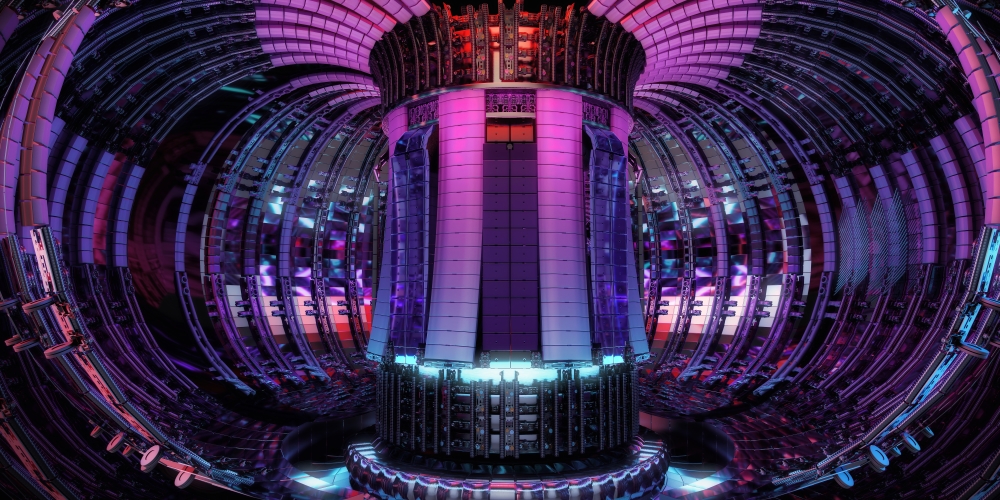
The race to commercialize fusion has stopped being a physics problem and become a real estate story. For economic developers and corporate location teams, the winning sites look surprisingly familiar, and the window to compete is open now.
by Devin Hillsdon-Smith, Founder & Principal Consultant, Hyphen Strategies
There is a tidy irony in where America’s first commercial fusion plants are landing: on the footprints of retired coal plants. In Chesterfield County, Virginia, Commonwealth Fusion Systems (CFS) is developing ARC, a 400-megawatt plant on a 94-acre parcel leased from Dominion Energy. Outside Knoxville, Type One Energy and the Tennessee Valley Authority are converting the decommissioned Bull Run Fossil Plant, 865 megawatts of coal retired in December 2023, into the home of a 350-MWe stellarator called Infinity Two.
The technology that promises to power the future is being sited on the bones of the past. That single fact tells economic developers most of what they need to know.
Fusion was a laboratory problem for most of its history, a perpetual “30 years away” punchline. The constraint has shifted. The question is no longer only whether we can make net energy, but where the plants go, and that is a site selection question governed by the same fundamentals as a hyperscale data center: power, water, workforce, permitting, community and the cold arithmetic of an interconnection queue.
Real Capital, Real Risk
By September 2025, cumulative private investment in fusion had reached roughly $15.2 billion globally across more than 50 companies, per the F4E Fusion Observatory. CFS alone has raised on the order of $3 billion, including $863 million in August 2025. The Department of Energy has eight companies in its Milestone-Based Fusion Development Program and finalized a national Fusion Science and Technology Roadmap in June 2026.
Now to the other side of the ledger: Not one of these plants is delivering power to the grid. Net energy gain at commercial scale is unproven. Industry surveys show financing as the primary challenge, with first-of-a-kind plants likely to require tens of billions more than has been raised.
This is a frontier, not a sure thing. But the capital expenditures are real, $2.5-3 billion at Chesterfield alone, and the location decisions are being made right now. That is exactly when site selection expertise matters.
Five patterns have emerged. None require a physics degree.
- The retired thermal plant is the prize. The binding constraint on new generation is not land or capital. It is the queue. CFS filed its interconnection application in Virginia in April 2026 and expects four to six years before approval. A site that already carries a high-voltage interconnection, a switchyard, water rights and cooling intake, industrial zoning and a host community that has lived next to a power plant for 50 years is worth years on a development schedule. CFS evaluated more than 100 locations worldwide over roughly two and a half years, and has been explicit that proximity to an existing interconnection at a retired coal site was central to choosing Chesterfield. Type One’s logic at Bull Run is identical. TVA is repurposing the site in phases rather than greenfield-developing it. The lesson for EDOs is direct. Inventory your retired and retiring thermal generation, confirm what infrastructure remains live, and market those parcels as energy-ready. The brownfield you have been trying to figure out what to do with may be your most competitive asset.
- The plant follows the load, and the customer signs first. CFS has sold more than half of ARC’s 400 megawatts under power purchase agreements to Google and the Italian energy major Eni. Helion Energy holds the world’s first fusion PPA, 50 megawatts to Microsoft data centers, targeted for 2028. Virginia is the world’s largest data center market. A state legislative analysis put demand at roughly 10,000 MW today, climbing toward 30,000 MW by 2040 if transmission keeps pace. That load is the gravitational field pulling firm, clean generation toward it. The implication for an EDO is almost recursive: The demand you worked so hard to attract is now itself a recruiting magnet for the generation that will serve it. The PPA now comes before the shovel, and regions with concentrated, creditworthy load have a structural advantage.
- The utility partnership de-risks everything. Fusion developers are physics and engineering shops, not power-plant operators or EPC contractors. The smart ones know it, and pair with utilities that bring the unglamorous competencies. Dominion owns the land CFS is leasing and is providing development and technical expertise under a joint development agreement; CFS helps Dominion understand a technology it may one day own and operate. TVA brings operations, maintenance, engineering, licensing and construction capability, and its Power Service Shops in Muscle Shoals, Alabama, are developing the specialized welding and fabrication techniques the stellarator requires. Your incumbent utility is not merely an infrastructure provider to be negotiated with on rates. In this sector it is a recruiting asset that makes your region more credible than a neighbor showing up with land but no power-plant operator at the table.
- Regulatory clarity is now a location variable. In 2023 the Nuclear Regulatory Commission decided to regulate fusion machines under its byproduct-materials framework (10 CFR Part 30) — the same regime that governs particle accelerators and medical isotope facilities — rather than the rules governing fission reactors. Congress reinforced the approach in the bipartisan ADVANCE Act of 2024, and the NRC proposed a formalizing rule in early 2026. Fusion permits more like an advanced industrial facility than a fission plant: no meltdown risk, no long-lived high-level waste. That federal posture makes the state environment a competitive differentiator. NRC agreement states, Virginia among them, handle radiological authorizations directly. Tennessee went further and stood up the nation’s first state-level fusion framework, which is what enabled Type One, TVA and the state environment agency to file a first-of-its-kind license application in January 2026. Washington made fusion eligible for standard clean-energy permitting in 2024. California created a state Fusion R&D Innovation Fund and extended its clean-energy manufacturing tax exclusion to fusion. New Mexico’s State Investment Council strategy helped land Pacific Fusion’s $1 billion campus near Sandia. Tennessee’s Nuclear Energy Fund cut Type One an early $4.5 million grant. If a fusion RFI lands on your desk and your state’s permitting posture and incentive eligibility are still ambiguous, you are already behind.
- The workforce story is more conventional than the headline. The specialized tip of the talent pyramid is real and scarce, which is why R&D and prototype facilities cluster near applied-physics institutions: Pacific Fusion near Sandia, Type One near Oak Ridge, CFS out of MIT.
But the bulk of the jobs at a commercial plant are not exotic. CFS describes its operating workforce in terms any economic developer recognizes: operators, electricians, pipefitters, mechanics, technicians. Construction leans on welders, fabricators, high-voltage specialists and cryogenics techs. Type One is designing its Infinity One prototype to double as the world’s first fusion workforce training platform, and projects 300-plus jobs in East Tennessee. That reframes the workforce play. Your community college, your union apprenticeships and your utility’s O&M training pipeline matter at least as much as a flagship research university. A region with a credible skilled-trades base, and a retired power plant whose former workforce still lives nearby, can compete without a national lab next door.
The Practitioner’s Bottom Line
Fusion is still a frontier bet, and any honest advisor will say so. Timelines are aggressive, the financing gap is large and the science is unproven at commercial scale. No EDO should reorganize its strategy around landing a fusion plant, and no community should bank a budget on one.
But the positioning move costs almost nothing and pays across the board. Energy-ready brownfields, firm power, water, a skilled trades base, a cooperative utility and clean permitting are the same characteristics that win data centers, advanced manufacturing and the rest of the energy-intensive wave reshaping the industrial map. Fusion is a stress test for whether your region is ready for the energy economy already arriving.
The companies have stopped asking whether fusion can work and started asking where to build it. The economic developers with the answer ready, site inventory in hand, utility at the table and regulatory posture settled will be in the room when the decision gets made. The rest will read about it in this magazine.
Read more in the NUCLEAR ENERGY SIDEBAR
Devin Hillsdon-Smith is founder and principal consultant of Hyphen Strategies, an industrial site selection and economic development advisory firm, and host of the podcast Site Selectors Are People, Too.