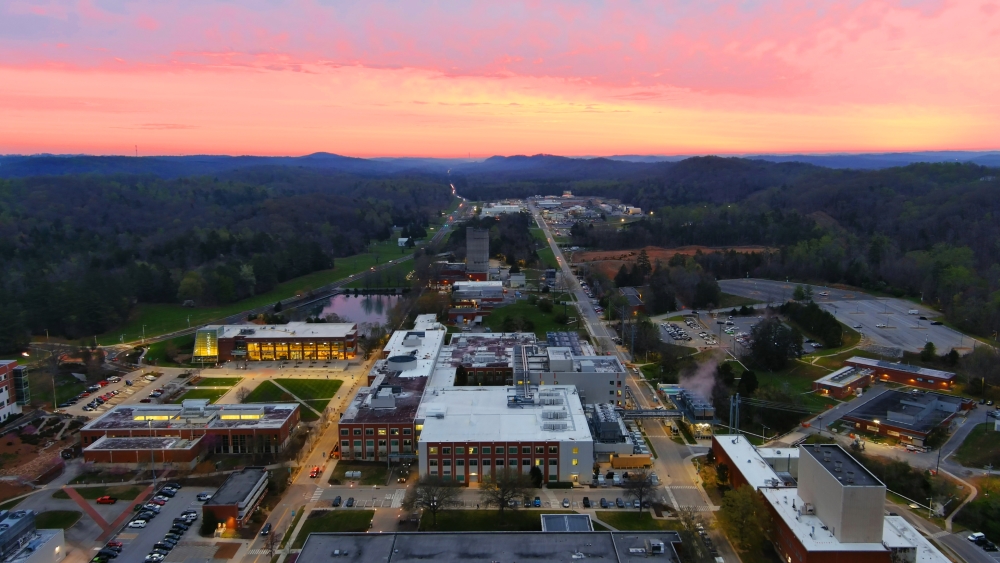
Tennessee is No. 1 in the U.S. for nuclear development. So says the American Nuclear Society, which ought to know.
Christopher Chandler ought to know too. Located at Baker Donelson’s Knoxville office, he is a member of the Corporate Group and leads the firm’s Nuclear Energy practice. He started his legal career as an attorney at the U.S. Nuclear Regulatory Commission before serving for more than 15 years as in-house counsel at a large utility company.
I asked him if Tennessee stands out among other states when it comes to a comprehensive alignment of companies, institutions, governments, physical assets and talent for the nuclear power renaissance.
“It really does,” he said. “To be fair, many states have strengths in some of these categories, but Tennessee’s unique combination of strengths includes a few key features that make it stand out.” Among them: Oak Ridge National Laboratory (ORNL). Another is the combined power of state and federal economic development. “In addition to the state’s economic development authority, which is very active, Tennessee is home to the largest public power entity in the country, the Tennessee Valley Authority,” he said. “TVA has its own economic development arm, also very active, which, for obvious reasons, is very closely associated with power production, since TVA’s wholesale service territory covers most of the state. These two economic development organizations work very well together, and Tennessee benefits.
“Honestly, I can’t think of another state that has the advantage TVA provides,” he said, including its domination of the state’s power provision, which means that, unlike other states, the electric utilities aren’t a patchwork of investor-owned utilities and public power.
There’s a long list of other indicators that show it’s not only a good time to be in nuclear power but also a good time to be in Tennessee.
The International Energy Agency expects nuclear spending to top $100 billion annually. An agreement signed in early 2026 at the White House between Washington and Tokyo included $40 billion to be directed toward small modular reactor development in Tennessee and Alabama.
The hundreds of nuclear power-related firms in the state are part of a $56 billion advanced energy sector that the Tennessee Advanced Energy Business Council says employs more than 42,000 Tennesseans.
TVA recently received a $400 million grant from the U.S. Department of Energy to advance deployment of small modular reactors (SMRs) at the federal power provider’s Clinch River Site.

“There is growing recognition of the need to boost the domestic nuclear fuel cycle, including, but not limited to, enrichment and fuel fabrication.”
— Christopher Chandler, head of the nuclear energy practice at Baker Donelson, on the newest wave of nuclear industry momentum in Tennessee
One other big reason behind the state’s leadership? The state’s unique Nuclear Energy Supply Chain Investment Fund (Nuclear Energy Fund), which aided the Tennessee Department of Economic and Community Development (TNECD) in supporting five projects involving more than $2 billion invested and 1,289 new jobs in 2025 alone. All told, as reported by Site Selection magazine’s Alexis Elmore in early 2026, the $70 million fund has distributed over $40 million to 12 projects in the last two years. Six companies—Type One Energy, Orano USA, BWXT, Master Machine, Oklo and Radiant Industries—have delivered a combined $7 billion in capital investment and upward of 2,000 new jobs.
An additional $25 million was allocated and approved in the 2026 budget, bringing the fund’s total to $95 million.
Project Roundup
The activity has included projects in Roane and Unicoi counties from BWXT totaling nearly $167 million and 258 jobs; investments by Oklo and Radiant also in Roane County; and a 44-job, $11.7 million project from Master Machine in Hamilton County (Chattanooga).
Roane County could be considered a global nucleus of nuclear energy expertise due to the presence of ORNL. In October 2025, Radiant, the company behind the world’s first mass-produced nuclear generator, announced that it will build its first factory on a site in Oak Ridge that helped launch the nuclear age over 80 years ago, thanks to the purchase of portions of the historic K-27 and K-29 Manhattan Project sites from the Oak Ridge Industrial Development Board. Radiant aims to deliver its first mass-produced Kaleidos nuclear generator by 2028, and, within a few years, scale up production to 50 reactors per year.
“We chose Oak Ridge, Tennessee, because of their strong workforce, the community’s rich nuclear heritage and the public’s second-to-none nuclear IQ,” said Radiant COO Tori Shivanandan. “Just as importantly, the state’s business-friendly environment gave us the immediate regulatory certainty we needed to move fast and be up and running to meet growing customer demand for our nuclear generators.”
That demand could quicken now that the U.S. Nuclear Regulatory Commission (NRC) in May 2026 formally accepted Radiant’s license application for the Roane County facility, pledging to review it on an expedited timeline with a goal of completing its work within eight months, approximately 55% faster than the standard schedule for this type of review. “This marks a major regulatory milestone and is a first for the microreactor industry, and a key indicator that America is on the cusp of an energy revolution,” California-based Radiant said in a release.
Christopher Chandler says the state has been developing a robust pipeline for bringing new people to work in the industry, “not just engineering students, though the University of Tennessee, Knoxville is home to one of the best nuclear engineering departments in the country, but there is a concerted effort to boost trades and labor to meet expected workforce needs.” He also offers a shout-out to the East Tennessee Economic Council, a well-established organization that, like the Tennessee Advanced Energy Business Council, fosters awareness and growth in equal measure. “Its longevity and value is evidenced by the sheer number of people that turn up for its weekly meetings, including local business owners, educators and representatives of some of the most well-known nuclear companies in the country,” Chandler said.
When it comes to company growth and standout moments driving the sector’s momentum, he says a series of developments that relate to the nuclear fuel cycle are especially noteworthy.
“There is growing recognition of the need to boost the domestic nuclear fuel cycle, including, but not limited to, enrichment and fuel fabrication,” he said, “and recent project announcements by both existing companies and new entrants to the market reflect that recognition. A lot of ink gets spilled writing about exciting new reactor designs, but a reactor without fuel isn’t very useful. These companies are working to ensure an adequate fuel supply, and that is a good sign for the industry.” It’s also in keeping with the state’s heritage as the place where the nation’s first nuclear fuel enrichment plant was built at ORNL as part of the Manhattan Project during World War II.
Indeed, DOE’s latest SMR funding round is not so much about reactors as about rebuilding the industrial base to support them. Among the Tier 2 recipients of some $94 million in total was Container Technologies Industries, which received approximately $548,000 to expand nuclear quality assurance certifications and manufacturing readiness in Tennessee.
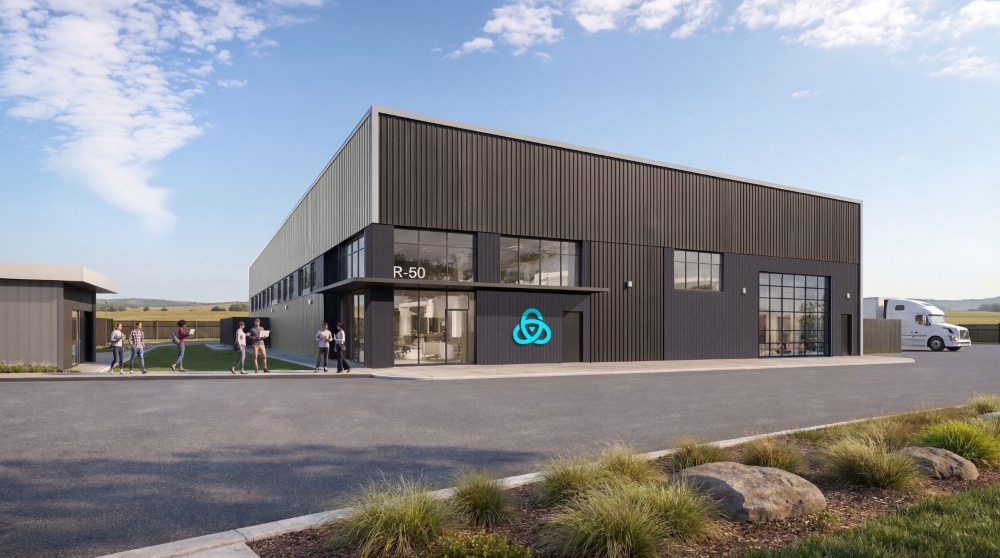
Radiant plans to name its new factory in Oak Ridge R-50.
Rendering courtesy of Radiant
The sector’s supply chain and infrastructure also include developments such as the May 2026 announcement at a Tennessee Tech University conference by Universities Space Research Association (USRA) that its wholly owned subsidiary USRA Energy, LLC, would be located in Oak Ridge. “For more than four decades, USRA has played a significant role in nuclear energy research, analysis and workforce development, supporting federal missions and advancing scientific and technical excellence,” said Dr. Elsayed Talaat, president and CEO of USRA and chair of the board of USRA Energy, LLC. “We are excited about the future and confident that USRA Energy will advance innovations to support the nuclear renaissance.”
BWXT and ORNL recently signed a memorandum of understanding to advance the Domestic Uranium Enrichment Centrifuge Experiment (DUECE) in support of the Department of Energy’s priority to reestablish a reliable domestic supply of unobligated enriched uranium for national defense missions. The MOU follows the National Nuclear Security Administration’s $1.5 billion contract award to BWXT for DUECE licensing, manufacturing development, construction and operations. BWXT’s new Centrifuge Manufacturing Development Facility will support enrichment plant activities in Erwin, Tennessee.
Nuclear’s resurgence is tied to the incredible power demand from data centers and a renewed manufacturing base. But there are other arenas that benefit too, including the towns where new power generation lands.
“The sector that gets the least attention while benefiting greatly from new nuclear is the local community in which a nuclear plant or other industry facility is located,” Chandler said. “Some years ago, I read a fascinating article about the negative economic impact on the local community that resulted from the shutdown and decommissioning of the Maine Yankee nuclear plant. Conversely, a new facility creates long-term, high-paying jobs that benefit the community, and the presence of a facility helps boost local government and improve local amenities.”
With more than 200 companies in Tennessee’s nuclear industry value chain and a pipeline that’s seen more than 2,200 new job commitments and more than $8.5 billion in capital investment since 2023, nuclear power figures to boost and improve the entire state’s competitiveness for years to come.