Avisit to the Cincinnati region in April shed light on one powerful node in a life sciences sector that Ohio Life Sciences reports employs nearly 64,000 people across the state at an average wage of $105,000 and that has produced 7,600 patent awards between 2019 and 2023.
The number of those jobs has risen by 12.8% since 2019. Judging by the momentum at Resilience in West Chester, AtriCure in Mason and Enable Injections in Evendale, the jobs, patents and company footprints will continue to grow.
Resilience, founded during the Covid-19 epidemic, is a contract development and manufacturing organization (CDMO) focused on delivering high-quality, scalable manufacturing solutions for advanced therapies with capabilities spanning biologics drug substance, cell-based therapies and aseptic drug product manufacturing for both small and large molecules. The site in West Chester, formerly part of an AstraZeneca operation until Resilience acquired it in 2023, does formulation filling, device assembly and packaging.
Josh Matson, vice president, general manager and site head for Resilience, says the site was attractive because it had a good regulatory history and a good workforce with a historically low turnover rate. The Midwest location is both affordable and accessible to a lot of potential clients. And Matson says being around so many Fortune 500 companies in the region imparts confidence that the area can support Resilience’s growth.
Last year the company announced a 200-job expansion that includes a 190,000-sq.-ft. location in Blue Ash that will add additional highly automated Device Assembly and Packaging capabilities for drug products filled at the West Chester location. Additionally, the Blue Ash location will add significant cold and ambient storage capacity to support both locations. Significantly, the Blue Ash location will now also serve as Resilience corporate headquarters, which previously was located in San Diego.
“It’s a good, rewarding career, and it’s always good to know you’re doing something that’s positively affecting people’s lives.”
— Josh Matson, Vice President, General Manager and Site Head, Resilience
Resilience was anticipating that the Cincinnati workforce would grow to nearly 1,000 workers with the expansion, but Matson says the head count now is approaching 1,100 already. The company in October 2025 received long-term debt financing of up to $825 million from Oak Hill Advisors that will enable investment in manufacturing in Cincinnati and at a similar site in Toronto.
“Part of the reason for expanding here is the workforce we have access to and the partnership with REDI Cincinnati and JobsOhio,” he says, after introductions by Ohio Life Sciences. “They were able to quickly plug us into technical colleges” such as Butler Technical College. The company has seen value in investing in training, he says, including an on-site aseptic training center. The site has more than doubled in size over the past three years. “As we’ve grown, you see the need to invest in the workforce,” Matson says. The primary task is simply letting people know good-paying careers exist in such fields as operator or maintenance technician in this high-quality environment. “It’s a good, rewarding career, and it’s always good to know you’re doing something that’s positively affecting people’s lives,” Matson says. And there’s value to staying clean. “Years ago I worked at a place that made duct tape and I went home smelling like rubber every day,” he says. At Resilience, “I’m never dirty when I go home.”
Points of Light in Montgomery and Mason
Catherine Pearce, M.B.A., D.HSc., has over 25 years of experience focused on the biotech industry at various organizations. In April 2023, she founded JucaBio, a clinical-stage biopharmaceutical company built on the hub and spoke model and staffed by experienced professionals. Before that she led a number of companies to commercialization and led the clinical stage biotech function of CinCor Pharma, Inc., from its formation through its acquisition by AstraZeneca for up to $1.8 billion in early 2023. At Deeper Roots coffee shop in Montgomery, she explained that JucaBio specializes in buying assets deprioritized by large pharma, sets up subsidiary organizations and moves those assets through proof of concept until they can be commercialized or an acquisition target.
Pearce first returned to the Cincinnati area from Philadelphia in 2015 to begin the activity she continues to do today: acquiring drugs, putting staffing around them, financing them and getting the attention of pharma. After the big sale to AstraZeneca, she says, “the team wanted to stay together. We all had job offers at AstraZeneca, but we liked this work.” And it can be invigorating. “We’re not interested in the 10th or 12th GLP-1, but would like to see a drug that spares the muscle loss from GLP-1s,” she says. “Pharma is quite risk averse. They’d rather see us do the moonshots.”
JucaBio has deep experience on its bench and knows how to deploy it. “We are efficient at floating people across these subsidiaries,” Pearce says, characterizing her team as foster parents for unloved drugs. “It’s very expensive to have someone with 40 years of manufacturing experience dedicated to one company. We’re putting little seeds in the ground and figuring out which can be harvested.”
One example: The company in 2024 licensed the drug behind AllRock Bio — ROC-101, effective for people with pulmonary arterial hypertension and pulmonary arterial hypertension with interstitial lung disease —from Sanofi. In September 2025 the company received $50 million in Series A financing and the drug has gone to Phase 2 clinical trials in 18 months. Pearce says drug development is global, “but I’m a Cincinnati region, love this region and I’m always trying to convince people to spend more time here and invest here. Our investors on the West Coast believe that too. We had someone visiting form a large fund in New York. They said they know the typical regions, and they were deciding what will be the next big biotech city, and they think this is it … The problem is we are very Midwest nice. We don’t promote ourselves. We are more than P&G. It’s a joyful city, a fun place to live, and it’s more productive, with not so many hours in traffic.
She describes the return to Cincinnati from Philly as an exhalation. “One day here, I went to dry cleaning, the DMV and the grocery store in 30 minutes,” she says, which prompted colleagues in other places to ask where she lived. “I said, ‘Cincinnati.’ ” Then she mentions a chief development officer for a pharma company in Copenhagen, Denmark. “He chooses to live here. His kids are here. He’d rather make the plane ride to Copenhagen.”
Flights to Europe are de rigeur for products made by AtriCure, a publicly traded cardiac device company that grew from a local startup into a global leader in atrial fibrillation treatment, with over 200,000 procedures performed. One of Cincinnati’s largest public companies, the company in August 2025 announced a $45 million headquarters expansion in Mason to double its facility and add up to 400 jobs. That’s where I met Salvatore (Sam) Privitera, J.D., who has served as the company’s chief technical officer since January 2017. In the company’s wide open reception area, in one direction sat a tray of sweet treats. In the other was an operating theater of sorts where sales staff dressed in lab coats were being trained on the company’s devices with pig hearts.
Privitera, whose name is on some 50 patents, was recruited to Cincinnati by Mike Hooven, the serial company founder who today leads another expanding company, Enable Injections, based in Evendale.
“I came and built an engineering team and recruited people into it,” Privitera says, “and we’re doing a lot to organically build our own talent. One of our biggest feeders is UC [University of Cincinnati]. Their co-op program is unique. Students will intern here three or four times before they graduate. By the time they do graduate, they hit the ground running.”
The vibrant, positive workplace atmosphere at AtriCure is as palpable as a beating heart, as everyone from offices to the shop floor focuses on ensuring quality before a device is requested by a doctor and then shipped out for a surgery across the country or across the ocean. That sort of vibe is powerful when it comes to attracting and keeping good young talent, whether from UC or other regional schools such as Ohio State University, University of Louisville, the University of Kentucky or Case Western in Cleveland. And when they get hired, they stay. “Seven VPs report to me,” Privitera says, “and four of them I’ve been developing since they came out of school. Those people now have 20 to 24 years of experience in a company that’s 25 years old.
“There are jobs you have to do, jobs you do and jobs you get to do. We are an organization where individuals understand we get to do this job.”
— Salvatore (Sam) Privitera, J.D., chief technical officer, AtriCure
“There are jobs you have to do, jobs you do and jobs you get to do,” he continues. “We are an organization where individuals understand we get to do this job.” Moreover, he says, “We do things that are unique and special. Mike could say the same thing at Enable. We don’t work on ‘me too’ stuff — most of what we create is novel. We tend to work on things that are unique and different here. It’s impactful, and we get to do it in an environment that’s awesome. Every day I drive into work and say my prayers and acknowledge how fortunate I am.”
Around half of AtriCure’s sales are driven by devices that plug into something, “so there is a tech aspect to that we have to be good at,” says Privitera. “A few years ago, we didn’t have the critical mass internally to have a whole software development team. Now we do. Half a mile away there is a company I could tap into, and another few miles away is another. Within a half-hour drive are three companies we leverage to help us.” Sometimes people on contract come to work at the company eventually. But you can’t have everything, he says. “Technologies are changing faster than they ever have, and to think you have all the skill sets you’re going to need in a couple years is myopic. I know I have access to what I need.”
The same principle applies to growing the business. “AtriCure doesn’t exist if it were not for the economic partnerships we’ve had,” he says, whether it comes via support from Cleveland Clinic in developing the company’s first technologies or from JobsOhio, the state’s Third Frontier program, REDI Cincinnati or the City of Mason in making facility expansion decisions easier. The company has a small engineering team in the Bay Area and clinical, regulatory and engineering office in Minneapolis, as well as a commercial office and distribution center in Amsterdam. When it comes to cost, Privitera says those other offices are essential to stay connected to those regions’ ecosystems, but “I can tell you it’s far more efficient to run engineering teams in Cincinnati. Our expectation,” he says while looking out the window, at the expansion site, “is to continue to grow here.”
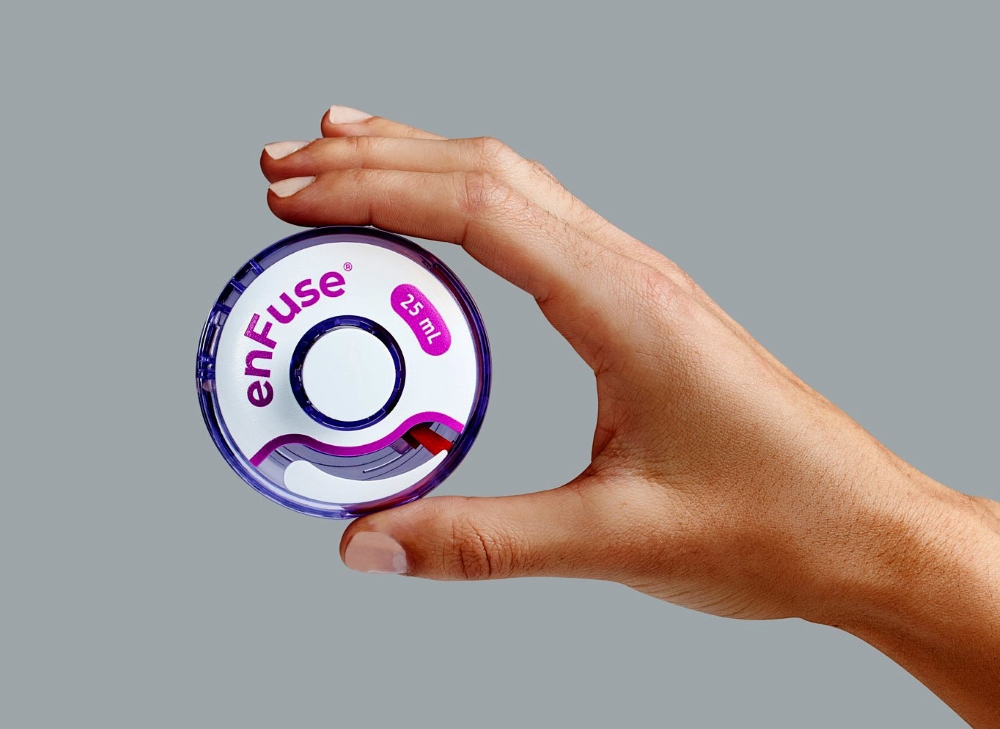
Photo courtesy of Enable Injections
Enabling Growth
Enable Injections, the Cincinnati-area company behind the enFuse® On-Body Delivery Sys-tem (OBDS, pictured), has more than 100 patents to its name, attracted $30 million this year from Sanofi to build out its manufacturing and supply chain and is building a 90,00-sq.-ft. Manufacturing Center of Excellence in Springdale, Ohio, as well as making enhancements to its corporate headquarters in Evendale.
Chairman, CEO and serial founder and innovator Michael D. Hooven notes that “we’ve already hired this year alone over 65 production workers, and we have a total of almost 100 right now.” Hooven says he’s always been interested in moving across different fields in his career and came to the life sciences and medical device world with no experience. He was recruited from Los Angeles without knowing the first thing about Cincinnati. After a meeting, he says, “we looked around and said, ‘My gosh, the people here are so polite.’ ” Their host apologized for the traffic “and we said, ‘What traffic?’” Hooven recalls. “That was 38 years ago, and we’re still in the same house.”
Whether it’s recruiting leaders like him or developing technical staff, he says there’s something magnetic that attracts people from other fields. “What’s wonderful about life sciences,” he says, “is that once people get into life sciences from other businesses, whether it’s aerospace or automotive or software, they tend to stay.” — Adam Bruns
Delivering Today, Prepared for the Future
A Conversation with Lydia Mihalik
By Kelly Barraza
Site Selection Managing Editor Kelly Barraza recently talked to Ohio Department of Development Director Lydia L. Mihalik about the state’s competitive position, project successes, FDI attraction and talent advantages. Prior to her appointment by Governor Mike DeWine in 2019, Mihalik served as the 55th mayor of the City of Findlay in northwest Ohio, a micropolitan area that perennially is found at the top of Site Selection’s annual micropolitan rankings.
Site Selection: What are the factors that make Ohio attractive to business investors and employers?
Lydia L. Mihalik: We probably have four different areas in which we differentiate ourselves. Basically, we’ve built a system that works for economic development at every level. First, we are working hard to prepare for future opportunities. Ohio made some deliberate investments over the last several years — investments in infrastructure and site preparation so that we’re not scrambling at the last minute when a project presents itself to us. Ohio has landed some large projects like Intel and Anduril because we’ve invested in ourselves. We’ve done that through investing in our people and our infrastructure and our communities.
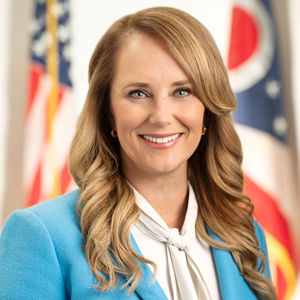
Ohio Department of Development Director Lydia L. Mihalik
The second big element of our success is that we operate as one team. What I think makes Ohio unique is that for large projects, we don’t go at it alone. The Department of Development works with JobsOhio, our local government partners, universities, workforce boards and, of course, our fantastic private sector leaders. When you have an alignment like that, it really signals to companies that we can not only attract investment, but we can deliver on it.
The third point is that we are winning in the right industries. Ohio has been very intentional and strategic. We’re not just chasing trends. We’re competing in sectors that matter for the long term — semiconductors, advanced mobility and aerospace and defense. We know that these sectors drive high wages. They help support supply chain growth and some long-term economic resilience.
The last piece here is that the top line is we’re preparing for future industries. Our strategy that we’ve been deploying now for several years really emphasizes that collaboration and readiness I talked about earlier. That’s ultimately what stands out in site selection decisions. We created the All Ohio Future Fund, which was found to proactively prepare large job-ready sites. We invested over $350 million across 11 sites statewide. We also developed an Innovation Hubs program, which is really helping to position Ohio as a national leader in not only commercialization, but applied research. We spent $125 million statewide and got some great innovation hubs up in Toledo, Dayton, Akron and Youngstown.
“Ohio’s micropolitan success is certainly one of the clearest signs we have that the state’s economic development strategy is working.”
— Lydia L. Mihalik, Director, Ohio Department of Development
Ohio frequently dominates our Top Micropolitans ranking. This year we had Findlay, Wooster, Fremont, Tiffin and Greenville all make the top 10 for landing corporate real estate projects in micropolitan areas. Why do you think that is?
Mihalik: Ohio’s really invested in the basics that matter to smaller cities. Ohio’s micropolitan success is certainly one of the clearest signs we have that the state’s economic development strategy is working.
We have spent the last several years putting more tools in place for communities outside the major metros, which includes site development. We’ve helped to expand broadband access, improve infrastructure and have done significant investment in brownfield remediation. Essentially, we’re helping communities become more market ready before an opportunity arrives.
The other key to our micropolitan success here in Ohio is that much of it comes from the traditional blocking and tackling or — as those of us in the business like to call it — business retention and expansion. In many of our smaller communities, the growth that we see isn’t driven by a single flashy announcement. It comes from existing employers that are already choosing to invest again and to add jobs as they deepen their roots in those communities.
We also like to think that our micropolitans offer a practical advantage, right? Micropolitans offer access to workforce and transportation and suppliers and nearby metros but at a much lower cost and with a lot less complexity.
Walk me through a big project win you have had in the past year.
Mihalik: The Anduril announcement was a game changer for us, particularly in the defense manufacturing space. It was one of the largest job creation projects in Ohio’s history. It’s 4,000 jobs and over $1 billion in investment. Just recently, the company started producing these military defense systems of the future. We think that this project helps leverages some strengths. Ohio’s got expertise in military support in federal missions as well as aerospace manufacturing innovation, which really made Ohio the ideal state for this effort. We were very jazzed about the fact that this really helps signal to not only us here in Ohio, but to others all around the globe, that Ohio can win next-generation industries — that we’re not just a legacy manufacturing state.
How important is foreign direct investment to the state’s economy?
Mihalik: Foreign direct investment from our friendly nations is extremely important because it helps diversify our economies. I can think of no other country that has had a more significant impact on Ohio than Japan. That was why, when Honda announced their new battery venture with LG a couple of years ago, those of us who have been in the economic development space for several decades were absolutely elated that Honda was again doubling down on its investment in Ohio.
From a workforce standpoint, how well do you compete against other states in your region and across the country?
Mihalik: The practical impacts of the policies that we put in place in Ohio are definitely seen in some of these job gains that have come to fruition over the last several years of the administration.
We have a couple of unique systems in place that help make that a reality. The Lieutenant Governor [Jim Tressel] just rolled out WorkOhio, which is this centralized front door for jobseekers. It helps connect Ohioans to not only jobs, but the training that’s necessary to complete them, as well as other regional resources.
The bottom line to all these things is that we’re building a ton of momentum in this state that’s going to continue to pay dividends. It’s going to continue to attract private investment, create jobs and improve the quality of life for Ohio and for Ohioans for decades to come.
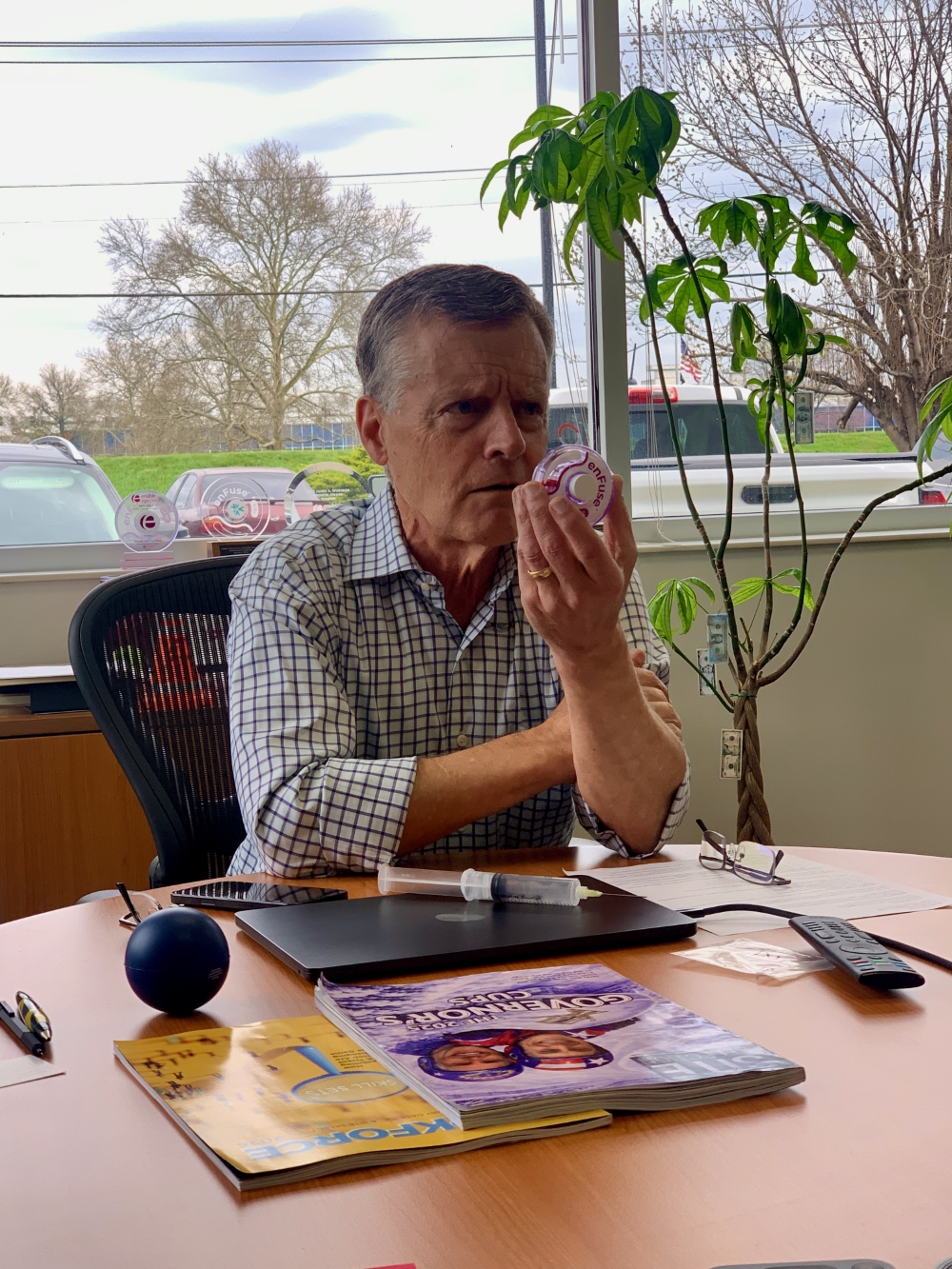
Enable Injections President & CEO Mike Hooven says it’s no contest for a patient choosing between a needle and his company’s enFuse subcutaneous on-body injection device.
Photo by Adam Bruns
Mike Hooven Injects Life into the Life Sciences
Ohio and the Cincinnati region offer plenty of biosciences infrastructure to build on. It includes a new biomanufacturing workforce initiative launched in September 2025 by JobsOhio, the Ohio Life Sciences Association (OLS) and One Columbus to train Ohioans for operator and technician roles in pharmaceutical manufacturing and related biotech careers. As part of the initiative, JobsOhio is working with companies to invest up to $30 million over five years to build a new training center.
The effort joins a portfolio of programs that include the JobsOhio Relocation Incentive that helps employers in 10 target sectors compete for out-of-state STEM and technical talent, and the Ohio Discovery Corridor, which seeks to grow STEM talent through Ohio’s innovation network. Locally, REDI Cincinnati reports the region produces more than 11,000 STEM graduates annually (after increasing that population by 17% between 2018 and 2023), including over 3,400 graduates in engineering alone.
Around 1,000 of those annual STEM grads are affiliated with the University of Cincinnati College of Medicine and Cincinnati Children’s Hospital Medical Center, the latter considered the No. 1 children’s hospital in the nation. Combined into the Cincinnati Innovation District, the University of Cincinnati and Cincinnati Children’s Hospital produce more than $450 million per year in research.
That sort of environment has helped cultivate a life sciences industry comprising some 614 companies employing over 8,600 people and accounting for more than $1.6 billion in gross regional product and a 26% growth spurt in jobs between 2019 and 2024.
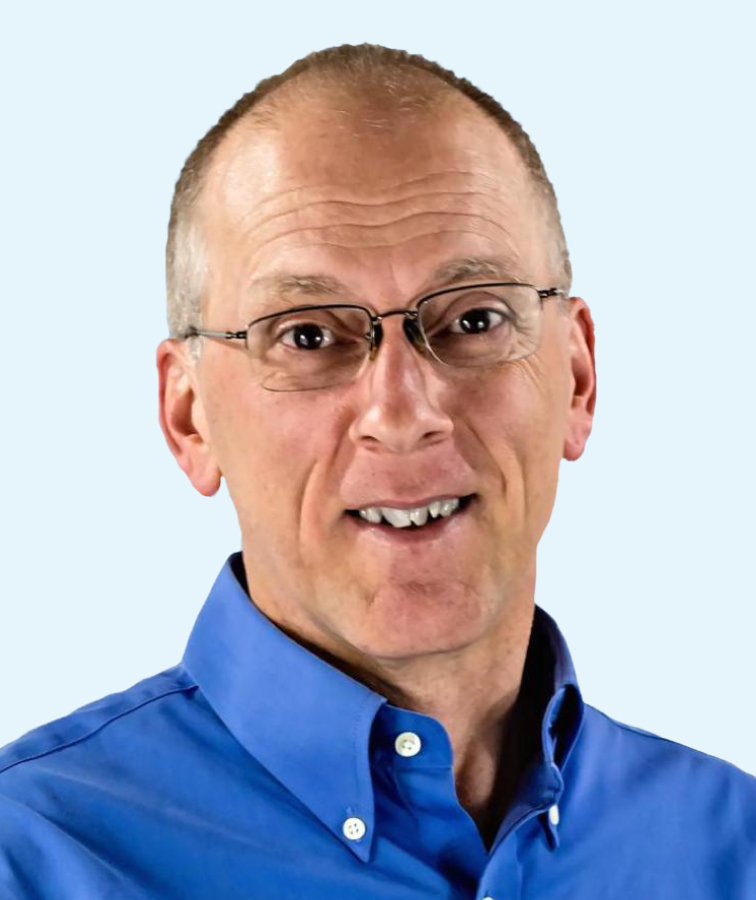
It’s also the sort of environment attractive to entrepreneurs and innovators like Enable Injections Chairman and CEO Mike Hooven. But it’s safe to say there’s nobody like Mike Hooven.
An hour spent in his company earlier this spring revealed a man who can’t and won’t sit still — an ideal catalyst for serial and spinoff innovation. The experienced race car driver is also quick to call out and give credit to people by name, from mentors in his long career to employees he whisks by in the shipping department during a whirlwind tour of Enable’s bustling headquarters.
Even seated at a table, Hooven exudes energy he’s barely able to bottle as he pinballs his way through a life and career infused with a sense of discovery and a drive to pursue one opportunity after another. After time spent in places as diverse as his hometown of Boston, then Ann Arbor and Miami while applying his expertise in mechanical engineering and fluid dynamics, he was drawn to life sciences by hearing a talk by Norman Weldon, the former president and CEO of cardiovascular device company Cordis, makers of the first guidewire and the first drug-eluting stent. Before he knew it, Hooven was heading up the company’s engineering group, developing a new valve for treatment of hydrocephalus in the 1980s.
“It was there that I made the contacts with the most important people in my life,” Hooven says, “the key one being my wife.” From there, like the connections wired into medical devices, it’s been one idea or contact sparking another ever since.

Enable Injections continues to build relationships with pharmaceutical companies wishing to deliver their products via the enFuse device.
Photo courtesy of Enable Injections
Life of a Serial Founder
“What’s wonderful about life sciences,” Hooven says, “is that once people get into life sciences from other businesses, whether it’s aerospace or automotive or software, they tend to stay. Becaue people tend to stay, they tend to be pretty civil to each other. You never know whether the person you are talking to might be working for you, or 10 years from now, you might be working for them. I started in Miami, was there for 5 years, then moved to Los Angeles, and went from neurosurgical to cardiology, then ended up managing pacemaker development for Siemens … a lot of interesting stuff.”
With his wife Sue pregnant and a desire to move back east, Hooven was recruited by Ethicon, a company within Johnson & Johnson that was getting into the medical device field via the acquisition of Senmed. “I said, ‘Cincinnati? Where is that?’ I remember the conversation in my office. ‘Oh, it’s right on the Ohio River by Kentucky. The weather’s not that bad,’ they said, which is a total lie. I said, ‘Nah, not interested.’”
But his wife was interested. “Oh, that’s right by Kentucky. We can go and see the horses,” she told Hooven. “And because they would fly us both out and she wanted to see the horses, that’s the only reason we came out,” he relates 38 years later from the place where his family still resides in the same Sharonville home they purchased on arrival.
Turns out you need an anchor like that if you’re a serial founder.
“When I interviewed with Ethicon they said, ‘Why do you want to work for J&J?’ I said, ‘Well, I want to get the experience and make the contacts so I can start my own business in about five years.’ And they hired me anyway.”
When what Hooven calls “the endoscopic revolution” happened, he was put in charge of a J&J division that J&J’s chairman told him had a mission to do one thing: beat U.S. Surgical. Using ample financial resources, he hired around 200 of the best engineers from all over the country.
“Depending on how you want to count it, we were putting out about a product a month for about four years,” Hooven recalls. “I mean, it was phenomenal. We were just cranking. It was a great, amazing environment.”
Six years in, Hooven found himself at odds with new Ethicon leadership, so he drove down to Miami to meet with his mentor Norm Weldon, who told him if he wanted to start his own company, he’d put up $100,000. He also told Hooven he ought to consider coming back to Florida. But Cincinnati had grown on Hooven and his spouse. Despite a then-lackluster venture capital environment (“If I said, ‘I’m the CEO of my own startup company,’ people would say, ‘When did you get laid off?’ ” Hooven says), he told Weldon that there were a lot of benefits to Cincinnati vs. Miami.
“The people are really, you know, they’re different,” Hooven remembers saying. “When you get people to make a commitment, they really commit. It’s just a different kind of culture. It was like gosh, you know, I just like the people here and I live the idea of starting up a business here.”
Enable Medical was born in 1994 in the Hooven family basement with some design software and a model shop, focused on bipolar radiofrequency technology. Hooven connected with a surgeon at the University of Cincinnati named Dan Smith, formerly chief resident at the Mayo Clinic, to perform around 20 animal labs with various devices. Then Norm Weldon helped lead the investor push, giving Hooven advice he’s never forgotten: Your ability to raise money in later rounds is directly proportional to the quality of your initial investors.
“I’ve always remembered that,” Hooven says. “I’ve probably said that 100 times to people.”
The team raised $250,000 in total, Hooven sold his stock options for $25,000, and they were off to the races, growing to half a dozen high-quality people and expanding into 12,300 sq. ft. of space at Schumacher-Duke in Commerce Park for which Hooven says he paid a ridiculously low price of 73 cents a sq. ft. because the Schumachers (a tennis buddy connection) already had the space and simply told him to draw a line down the middle and not cross it.
“We had this massive place and the business moved forward,” Hooven says. “I said, ‘I’m going to do business to business. We’re going to develop cool technology. And we’re going to license it and manufacture it and sell it to the Ethicons and the Medtronics of the world. And we actually did that.”
People Power
The road has not been without its bumps. One big customer discovered a bug and went to a competitor for six months. Enable had to lay off 50 people. But “the cool thing was we hired 49 of them back over the next two years,” Hooven says. “We had a really, really tough time as startup companies do, but the people supported us. When we laid off those 50 people, Sue was with me, and it was like they were trying to make us feel better, because they were passionate about what you were doing and what they were doing … because they were just great people.”
Hooven has continued to connect with great people, including then-University of Cincinnati Vice Provost Don Harrison, head of the medical school, whom Hooven queried about challenges in cardiac medicine. Harrison told him it was atrial fibrillation and heart failure and set up a meeting for Hooven with an electrophysiologist.
Hooven soon developed a product for atrial fibrillation that today is “the only product FDA-approved for the treatment of chronic persistent atrial fibrillation, and they’ve performed over a million procedures on patients,” Hooven says of the product that sparked the creation of AtriCure, which went public in 2005 and today employs more than 1,400 worldwide. Atricure is headquartered in nearby Mason, Ohio, and is pursuing its own campus expansion. “It’s an amazing company,” Hooven says. “One of the really cool things is they’ve kept their culture. It’s just remarkable. It’s still like a startup company.”
After staying on for a while as chief technology officer, however, Hooven moved on, mulling around 20 ideas for new companies. After finding out some of them were already being pursued and under patents, he still has two — one still awaiting future development and the other now in the form of Enable Injections. Venture capital firm CincyTech was one of the key investors. Hooven was an entrepreneur in residence there for around six months, working on a concept for drug delivery.
“This guy at Children’s Hospital, Eric Wall, a really innovative surgeon, had come up with this concept for a device for eliminating or minimizing injection and vaccination pain for kids. I said, ‘You know, I’m not in love with the specific device technology that’s been invented. But I think this overall area has some real promise, and I want to work with Children’s.’ So he licensed the technology from them and gave them 25% of the business at the time. They have been one of our top financial supporters going forward, and we worked closely with them for two years on developing technology to deliver vaccines that didn’t hurt.”
From there, the technology evolved from intravenous to subcutaneous delivery via a high-volume patch pump that is fastened to the abdomen. Today the company is welcoming a new $30 million investment from Sanofi to accelerate the manufacturing build-out in Springdale, Ohio, for its enFuse hands-free on-body injector. The closing of a Series B round led by Sanofi in 2018 raised $50 million for Enable, followed by an official partnership announcement in 2019. Enable closed a $215 million Series C financing in January 2022 led by Magnetar Capital, including Sanofi and multiple additional new institutional investors. Enable received significant continued support from existing investors including Cincinnati Children’s Hospital Medical Center, CincyTech, Cintrifuse and Ohio Innovation Fund. And a new product release from Sanofi is looming.
The quality investors and quality people, in other words, continue to enable Enable. And the engineering expertise in the area continues to churn, spinning out discoveries and companies.
“That makes this area the best in the country, maybe in the world, for disposable medical device development and manufacturing,” Hooven says. “There is no better place in the world to do this.” — Adam Bruns