For a battery-grade lithium carbonate developer looking to curb the nation’s appetite for importing critical minerals, a centralized location to facilitate seamless reach between feedstock suppliers and offtake partners served as a non-negotiable site selection factor.
Stardust Power Inc. is set to introduce one of North America’s largest lithium refineries in eastern Oklahoma within the next few years. The company selected a 66-acre site near the Port of Muskogee to house these vital operations, a location that provides the flexibility needed to eventually move 50,000 metric tons of battery-grade lithium per year.
At the beginning of 2023, Stardust Power CEO Roshan Pujari — a native Oklahoman — set out to find a prime, central U.S. site featuring a robust transportation and logistics network, access to a proficient workforce and a positive business environment. His knowledge of Oklahoma’s resources brought the company to Muskogee, a city about 40 minutes southeast of downtown Tulsa. By January 2024, the company announced its first refinery investment at Southside Industrial Park.
“Those are the reasons why we looked at Oklahoma initially,” says Stardust Power Managing Director, Oklahoma John Riesenberg. “It seems once we chose it, there were so many additional benefits.”
Critical Movement Begins
Mainline service offered by Union Pacific and Burlington Northern Santa Fe Railway brings a strong rail network to the region, while various interstate access points in the state — including major transcontinental highway I-40 — opens overnight access to 94% of the U.S. population. Along the Arkansas River, the Port of Muskogee supplies inland waterway access to 20 states throughout the U.S. South and Midwest, in addition to international ports in the Gulf of Mexico.
The aforementioned flexibility of this transportation infrastructure ensures a reliable product distribution and supply chain network is formed as production finds its bearing. Key added benefits included access to renewable energy, incentives and skilled talent found at various colleges and universities not only near the site, but throughout the state. Behind the scenes of the company’s first major facility investment, Riesenberg notes the support from state leadership and its agencies resulted in an exceptional experience.
“They’re excited, not just because of the jobs but because they like being on the cutting edge,” he says. “We make a phone call, they’re picking up the phone.”
Stardust secured its air quality construction permit from the Oklahoma Department of Environmental Quality in January 2026. With this approval the company officially moves out of the permitting process and into cementing a Final Investment Decision. The project’s first phase will introduce an initial production line carrying an annual capacity of 25,000 metric tons, doubling to 50,000 metric tons per annum upon full buildout in phase two.
“Once we start initial construction, that process will take about 24 months,” says Riesenberg. “When phase one is completed we can begin phase two, so we’ll be in production as we’re still in construction.”
Brines that have been through direct lithium extraction from upstream producers, resulting in a subsequent lithium chloride solution, will be sent to the optimized Muskogee refinery for impurity removal and the carbonation process that delivers battery-grade lithium carbonate.
Stardust Power’s operation will be the first-of-it-kind at a commercial scale in the U.S., becoming a critical resource for domestically manufacturing EVs and energy storage systems. The company has entered into a commercial arrangement with Sumitomo Americas covering a significant portion of the facility’s product from its first production train, representing between 80% and 100% of the approximately 25,000 metric tons of lithium carbonate capacity expected in the initial phase.
“There’s no shortage of firms who are interested in buying domestic battery-grade lithium,” says Riesenberg. “A lot of these conversations are still ongoing, but there is a lot of interest.”
America’s Onshoring Destination
China’s monopoly on rare earths production, paired with the Trump Administration’s unwavering stance on strengthening the nation’s critical minerals supply chain, uniquely positioned Oklahoma to be a first mover for fresh U.S.-based production. No vigorous mineral deposits required.
Prior to Stardust Power’s arrival, Oklahoma attracted the nation’s first rare earth metal and manufacturing facility in Stillwater from USA Rare Earths, which received a $1.6 billion federal funding boost in January; Green Li-ion’s first U.S. commercial-scale lithium-ion battery recycling facility in Atoka; and Blue Whale Materials’ first lithium-ion battery upcycling plant in Bartlesville.
“Companies are realizing Oklahoma is a great state to do business. There is a long history of oil and gas production in the state and the governor’s push from the beginning has been an ‘all the above’ strategy,” says Riesenberg of Governor Kevin Stitt’s approach. “It’s still a strong oil and gas state, but he’s also looking to the future.”
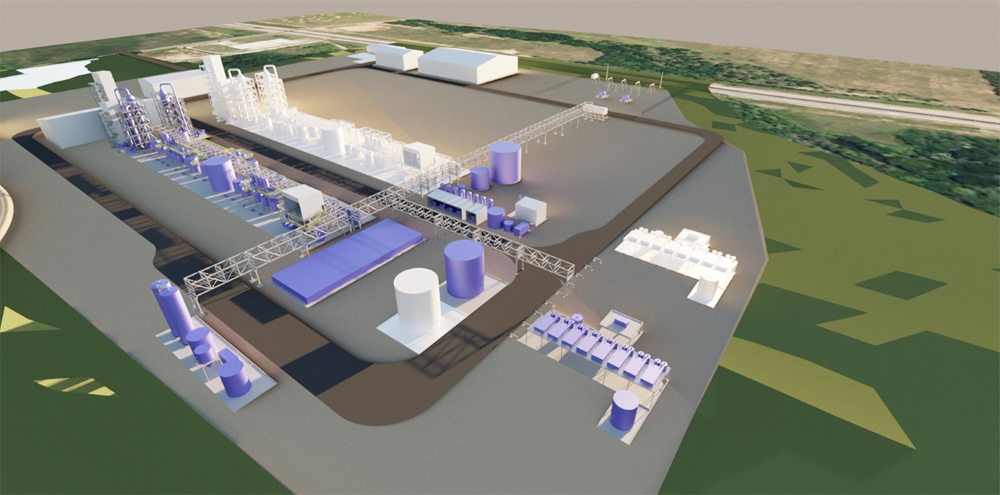
In Muskogee, Stardust Power is moving toward construction of the nation’s largest lithium refinery.
Rendering courtesy of Stardust Power
“We want to build out this ecosystem and create a closed-loop system in the state of Oklahoma,” says Oklahoma Department of Commerce Director of Business Recruitment Jay Shidler, so this critical manufacturing doesn’t “have to go back to China or elsewhere to be resold to us. We can produce it right here, in the central U.S., and then distribute directly through the crosshairs of America.”
Aside from what this activity means for national security, the domestic critical minerals supply chain will become essential to various aspects of production for Oklahoma’s leading industries. Local production of rare earth magnets or availability of battery processing facilities can fill direct needs across aerospace and defense, advanced manufacturing, automotive, traditional and non-traditional energy industries.
Momentum in these industries continues to gain. Oklahoma emerged as the preferred site for the first new U.S. primary aluminum production plant in over 45 years. Emirates Global Aluminium has invested $4 billion at the Tulsa Port of Inola to construct the largest facility of its kind in the nation, announcing U.S.-based Century Aluminum as a partner in its development. The project is anticipated to nearly double current U.S. aluminum production, carrying a 600,000 tons per year capacity.
As these projects plant roots, more than 1,100 direct jobs have been created as a result. Shidler notes Oklahoma’s extensive engineering capabilities across traditional and non-traditional energy sectors — Oklahoma ranks as the No. 3 U.S. state for both natural gas production and renewable energy production — has allowed its skilled workforce to ease into new opportunities.
“We have a workforce that is dedicated,” he says. “They have the expertise and transferable skills from the energy sector to maneuver directly into advanced manufacturing and smelting.”
This Investment Profile was prepared under the auspices of the Oklahoma Department of Commerce. For more information, visit okcommerce.gov.