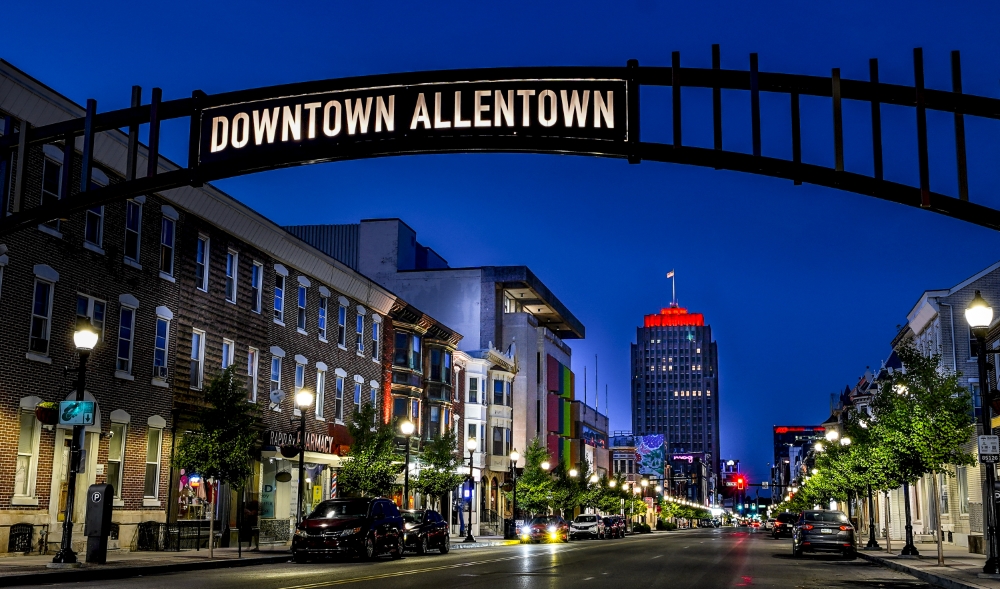
How can devising a targeted tax incentive and financing structure spur a community’s revitalization through private investment? Take notes from the $1.2 billion being invested in Allentown, Pennsylvania.
Nestled within the Lehigh Valley region, the state’s third largest city was once grappling with deindustrialization that crippled the steel industry and a mass exodus of manufacturing jobs well into the 2000s. A revival was imminent, but how?
It began with establishment of the city’s Neighborhood Improvement Zone (NIZ) via state law in 2011. A 128-acre district was identified, encompassing Allentown’s downtown core and western edge alongside the Lehigh River. Within this zone, state and local taxes paid by businesses go toward debt service and bonds issued by the Allentown Neighborhood Improvement Zone Development Authority (ANIZDA), directly applied to economic development projects.
ANIZDA anchored Allentown’s redevelopment by introducing plans for the PPL Center, a 10,000-seat entertainment and sports arena.
Brothers Jim and Rob Brooks oversaw its construction, intent on creating a flexible, multi-purpose venue in a location that caters to community interests and needs. The duo own the Phantoms — a minor league hockey franchise once located in Philadelphia and later Glens Falls, New York — and were planning to relocate to the future PPL Center as the Lehigh Valley Phantoms. They knew the economic and quality-of-life value professional sports teams and venues provide to a city, as their father Robert Brooks Sr. was a part of a collaborative effort to keep the Pittsburgh Pirates from relocating in the 1990s.
“When we got involved with these sports teams our family saw what they could do for the community,” Jim Brooks says. “You pick the right location and it has a huge community and economic impact, especially in our case, coming to a new community that didn’t have a sports team or a venue.”
Both noticed the economic impact that followed cities like Wilkes-Barre and Pittsburgh cultivating sports arenas in a way that cemented civic pride, whether it be fostering a brand-new team or incorporating historic architecture into the design. It led to the vacant Dime Bank building in Allentown’s downtown being tied into the PPL Center’s design. They pulled on popular aspects of major venues, such as perched viewpoints and social spaces, that support diverse uses including concerts, graduations, touring productions and various entertainment events.
The PPL Center opened in 2014, hosting 40 Lehigh Valley Phantoms home games a year and keeping activity downtown ripe with various events. Today, more than 500,000 visitors enter the arena each year. Confidence in the region supported the Brooks’ recent purchase of an indoor professional soccer team, dubbed the Lehigh Valley Spirits, which will kick off its first season in November 2026.
Both brothers couldn’t have anticipated the PPL Center’s greater impact in downtown Allentown, an area once vibrant on its own. Walking around at the arena’s first event — an Eagles concert — they comforted a woman crying who said, “I’m fine, I just can’t believe I’m right here. I can’t believe I’m here for something important again.”
“It gave people a reason to come back downtown. There are heartstrings involved,” says Rob Brooks. “It’s very emotional and I think that has helped bring an emotional tie to the arena, the sports team and any event. It’s special and I think that has attributed to a lot of the stickiness.”
Real estate developer City Center Group was also drawn in by the fresh NIZ legislation. City Center Group Director of Asset Management Maggie Reilly says, as intended, it proved to be a powerful tool to incentivize development in an area — now known as City Center Allentown — that had been heavily blighted.
“We recognized early that an arena alone would not reverse decades of disinvestment. Our strategy was to build complementary uses around PPL Center that would create a vibrant live-work-play environment,” says Reilly. “After decades when relatively few people lived downtown, we knew that creating a true neighborhood meant giving people compelling reasons to call downtown Allentown home.”
Momentum Follows
At the same time the PPL Center was opening in 2014, City Center welcomed two large Class A office towers that were either completely or largely leased prior to construction. Early corporate partners included Lehigh Valley Health Network, now part of Jefferson Health, and National Penn Bank, now Truist. Aside from creating new office space, reestablishing a residential population was vital to generating energy and foot traffic to support future restaurants, retail and entertainment, and other amenities. Strata West, the Group’s first apartment building, opened to stronger demand than initially anticipated in 2015. The developer also partnered with Marriott International to bring the full-service Renaissance Allentown hotel downtown the same year.
“All this generated significant momentum for downtown Allentown and provided insight into which projects we should prioritize from there,” says Reilly. “Over the last 10 years, we have reacted to the market.”
To date, City Center has delivered 1.2 million sq. ft. of Class A office space across six buildings, two hotels, the 35,000-sq.-ft. Archer Music Hall, around 1,800 apartments and diverse retail space. The current office portfolio is 100% leased, although there is about 12,000 sq. ft. for future availability. City Center is in the midst of constructing a new 75,000 sq. ft. building to be primarily occupied by Thomas Jefferson University’s Sidney Kimmel Medical College.
In a vivid memory, Allentown Mayor Matt Tuerk remembers looking out of a broken fifth story window of the vacant Dime Bank building downtown in January 2008 and saying, “My God, we’ve got a ton of work ahead of us.” That same fifth story viewpoint today would position you in the conference room of the Renaissance Hotel.
Prior to being elected mayor in 2021, Tuerk served in roles at Allentown Economic Development Corporation and the Lehigh Valley Economic Development Corporation. He notes that in the early 2000s, Allentown lacked suitable office space, residential offerings or amenities. NIZ investment into downtown bore fruit, in one case enabling ADP to consolidate its operations in the up-and-coming City Center Allentown. Eight years later, these employees continue to contribute to downtown’s heartbeat, eating, working and living in a desirable, purpose-built community.
“What we learned from the NIZ is that investments in place are critically important. If we had not seen the investments in office space in downtown Allentown there’s no way we would see the level of activity seen right now,” says Tuerk. “We welcomed new voices in, we welcomed new industries in. We made sure that this is a place you can come to from anywhere and succeed, and that will always be the story here.”
Nokia Doubles Down on Allentown
Nokia’s acquisition of semiconductor company Infinera brought the company to the Lehigh Valley in early 2025, establishing the facility as a staple in Nokia’s optical networking business and broader U.S. semiconductor footprint.
In June 2026, Nokia announced plans for a major expansion of its Allentown advanced test and packaging (ATP) operations. The plant is one of the few in the U.S. that provides ATP of photonic chips into optical modules for AI and telecom infrastructure. Nokia’s optical technologies supply telecom networks with advanced connectivity solutions while reducing energy usage by up to 75%.
“Because the site already possesses specialized expertise, an established workforce, existing manufacturing operations and a strategic role within Nokia’s supply chain, expanding the existing facility was a natural path to quickly increase capacity and support growing market demand,” says Nokia VP Optical Manufacturing and Allentown Site Leader Darrell Engel. “The investment also reinforces the role of Pennsylvania and the Lehigh Valley as an important hub for advanced manufacturing and semiconductor-related production.”
Engel notes that state support and the federal CHIPS investment tax credit helped create a favorable environment for accelerating this investment and scaling ATP capacity. Although he could not disclose the facility’s current production capacity, Engel states that this expansion will increase capacity by up to 10 times the current levels, reflecting the growing demand for optical networking technologies.
Nokia invested about $30 million into this project, bolstered by approximately $4 million and $10 million from state and federal CHIPS investment tax credits, respectively. Expansion activity will include investment into the latest generation of manufacturing and test equipment, in addition to an expanded manufacturing footprint. New capacity is expected to become commercially available by the end of Q3 2026.
“The region has a strong manufacturing heritage, access to technical talent and an ecosystem that supports advanced technology development,” says Engel. “Nokia is expected to nearly double its Pennsylvania workforce to more than 500 employees. This underscores the company’s long-term confidence in both the local workforce and the region’s role in supporting future growth in AI and optical networking technologies.”