
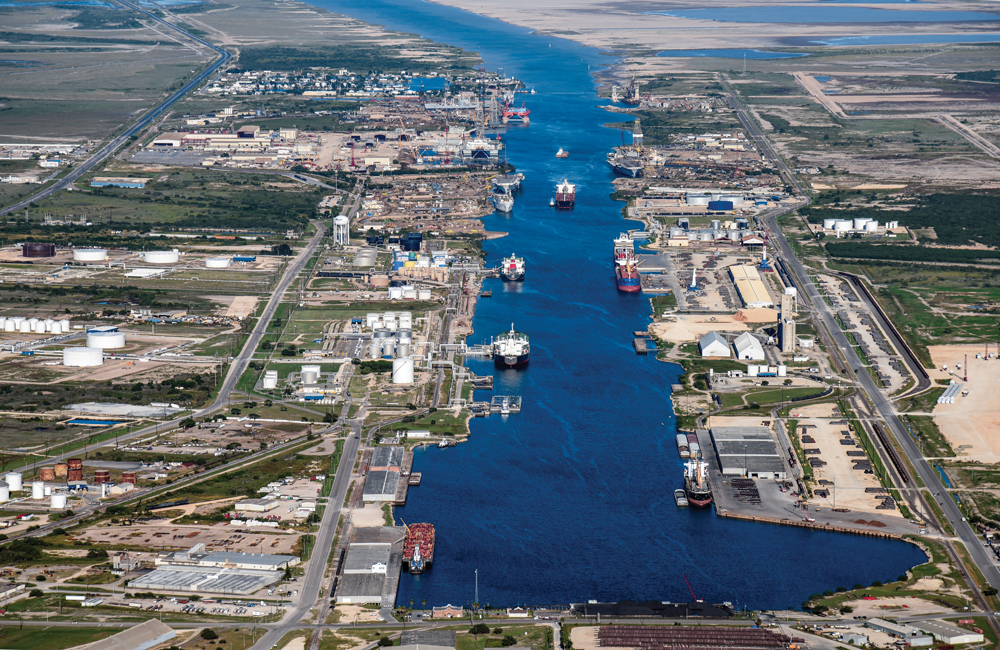
On more than 240 of the Port of Brownsville’s 40,000 acres, President Donald Trump announced March 10, America First Refining will build a refinery to “process 100% domestic shale oil using advanced, hydrogen-powered systems to produce ultralowcarbon fuels,” stated a release from the Port of Brownsville. “According to America First Refining, the project will create 500 direct full-time jobs, with projected annual salaries ranging from $80,000 to $100,000. Thousands more indirect jobs are expected across construction, logistics and long-term operational support industries, representing one of the most significant industrial investments in South Texas history. Port leadership has been working on the project for more than 10 years.”
by ADAM BRUNS & RON STARNER
The first new U.S. Gulf Coast oil refinery in nearly 50 years is coming to the largest land-owning port in the United States.
“This announcement is a defining moment for our region,” said Brownsville Navigation District Chairman Esteban “Steve” Guerra. “America First Refining chose us because we have the land, the infrastructure, the workforce and the commitment to get it done.” A groundbreaking ceremony for the refinery was expected to take place at the Port of Brownsville in April 2026.
The Port of Brownsville provides America First Refining with deepwater channel access, direct dock and rail connectivity, worldclass cargo-handling capabilities and foreign trade zone status advantages (FTZ No. 62) that have positioned the port as one of the fastest-growing industrial corridors on the Gulf Coast. In a ranking of U.S. FTZs in Site Selection magazine based on statistics from the most recent report of the U.S. Foreign-Trade Zone Board to Congress (released in early 2025 after government shutdown-induced delay), FTZ No. 62 ranked in the upper one-third of the nation’s foreign-trade zones. It routinely ranks among the top three of 193 in the nation in terms of value of exported cargo ($7 billion in 2023) and recently ranked No. 13 overall for the value of imports ($3.2 billion). The refinery project also is located in a federally designated Opportunity Zone.
“This project strengthens the Port of Brownsville as a critical U.S. energy logistics hub and elevates the entire Rio Grande Valley on the national and international stage,” said Port Director and CEO William Dietrich in the port’s press release, which noted that the company is currently working with federal, state and local agencies to secure the necessary environmental permits, a process “the port is uniquely positioned to support,” owing to its experience with guiding major investments such as two LNG projects through environmental review and permitting.
News reports say the project, estimated to be an investment of between $3 billion and $4 billion, has received funding from Indian conglomerate Reliance Industries, which has signed an offtake agreement to take up to 80% of the refinery’s product. “Under a landmark 20-year offtake agreement, the project is expected to secure the purchase and processing of 1.2 billion barrels of U.S. light shale oil, valued at approximately $125 billion, and produce up to 50 billion gallons of refined petroleum products valued at an estimated $175 billion,” said a release from the City of Brownsville. “In total, the project is expected to contribute roughly $300 billion in improvements to the U.S. trade balance while significantly expanding domestic refining capacity.”
Petroleum refining and chemicals production
account for 8,878 businesses, 314,810 employees
and annual revenue of $507 billion in Texas.
Source: Texas Economic Development Corporation
The Port said the refinery is expected to produce gasoline, diesel and jet fuel refined at scale using advanced technologies designed for efficiency and cleaner production, while relying exclusively on American-produced shale oil (primarily from the Permian Basin). “The project is also expected to expand regional infrastructure and support the continued growth of the Port of Brownsville as a major hub for energy, manufacturing and logistics,” the Port said.
Multinational Opportunities
Shortly after the announcement, Site Selection magazine’s Ron Starner spoke with two senior officials with the Council for South Texas Economic Progress (COSTEP), a regional partnership that serves a binational border region of more than 3.6 million people. “This will be the first new refinery built in the U.S. in 30 years,” says Adam Gonzalez, CEO of COSTEP. “The jobs created and the logistics investment that will come here because of this project will be huge.”
Gonzalez says that organizers and investors deliberately kept a low profile throughout the negotiations over several years. “The project was organic. The discussions were always behind closed doors,” he says. “When it is all said and done with this record-setting deal, the numbers keep ticking up. It will have one of the biggest impacts on this region. It puts us even more on the map.”
“This project strengthens the Port of
Brownsville as a critical U.S. energy
logistics hub and elevates the entire
Rio Grande Valley on the national and
international stage.”
— William Dietrich, Port of Brownsville Director and CEO,
March 11, 2026 on the new America First Refining Project
Gonzalez says the project proves the wisdom and foresight of regional leaders to assemble the COSTEP partnership comprised of 10 cities in Mexico and seven counties in Texas back in 2020.
“We started out as the regional organization for South Texas,” he says. “In one form or another, this group has been around since the early 1970s. We went back to our roots of promoting our region.” Asked why he thought the refinery investors picked the Port of Brownsville, he says, “Our non-congested traffic is a big draw. Plus, there are a lot of opportunities here for their suppliers in Mexico.”

Summit Next Gen will use Honeywell ethanol-to-jet-fuel technology for production of sustainable aviation fuel at a new facility on the Houston Ship Channel.
Photo courtesy of Honeywell
Rick Carrera, economic development director for COSTEP, says there’s another reason not being talked about but impactful to the deal: “The refinery will be one of the few within proximity to Venezuela,” he says. “Don’t discount that.”
Carrera says the region proved to investors that it has the workforce needed to staff the project. “We’re trying to create more recruitment for advanced manufacturing,” he says. “I don’t want people to think that we are becoming a smokestack place, but one advantage is that this project is far removed from residential areas.”
Gonzalez says the project will help generate ancillary development and recruit more suppliers once the U.S. Trade Representative’s Office completes the new round of USMCA trade agreement negotiations. “We would like to see the new USMCA talks kept trilateral with Canada, Mexico and the United States. We are trying to fix something that is not broken. It benefited Mexico a lot more than anyone else. A lot of suppliers moved to Mexico. We need to be a lot more aggressive. We tell suppliers, ‘We are not looking for you to shut down operations in Mexico. We want you to expand here.’ We are trying to create an option for manufacturing and logistics — in aerospace, automotive, medical devices, energy, etc.”
Gonzalez wants corporate investors to know that “we have the right kind of ecosystem for attracting large manufacturing companies. We have the ecosystem to support that.”
From Houston to Bonham
Texas as a state has the ecosystem, too. The Texas Economic Development Corporation says petroleum refining and chemicals production account for 8,878 businesses, 314,810 employees and annual revenue of $507 billion in the state.
Which may explain why another refinery making and refining sustainable aviation fuel is also situating itself along the Texas Gulf Coast. Summit Next Gen, which in early 2025 qualified for the then-new Texas Jobs, Energy, Technology and Innovation (JETI) program, comes with a $1.6 billion investment on 60 acres along the Houston Ship Channel in Harris County and is expected to be one of the largest ethanol-to-jet fuel production facilities in North America when complete.
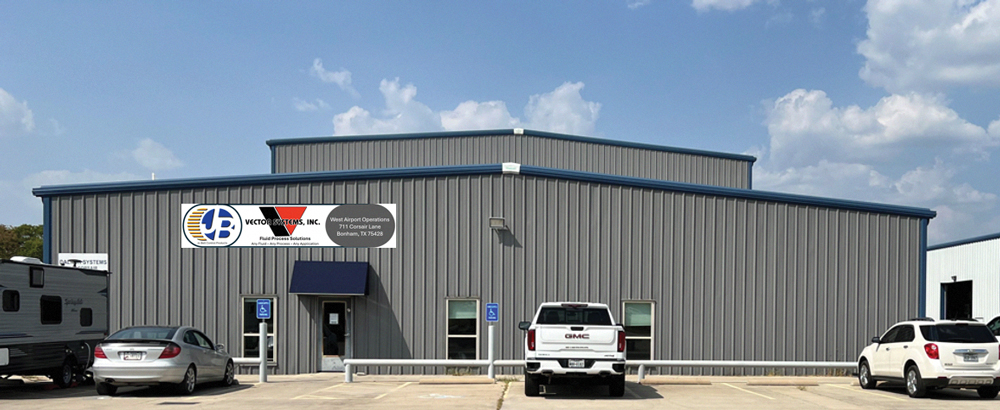
Vector Systems Inc.’s operation near Jones Field Airport in Bonham, Texas, is about to see a few more vehicles in the parking lot.
Photo courtesy of Vector Systems Inc.
“We believe this investment fits squarely within the strategic framework of unleashing American energy through technological innovation as our facility will play a critical role in revolutionizing the global aviation industry by providing a scalable supply of low-carbon jet fuel,” said Summit Next Gen CEO Robert Halpin. “The incredible leadership and support of Governor Abbott and his team, along with the Galena Park ISD Board of Trustees and Superintendent Dr. Moore and his team, played a tremendous role in selecting Houston as the right location for our project and future headquarters. Strategically located on the Houston Ship Channel, this new production facility enables Summit Next Gen to leverage the existing large-scale energy infrastructure required to better serve our customers’ demands, and most importantly, access to the deep network of highly talented energy industry professionals present in the Houston region.”
Those professionals can be found throughout the industry’s supply chain and in other Texas regions too. Just ask Vector Systems, a global manufacturer of industrial process equipment for sectors ranging from power, oil and gas, chemical and petrochemical refining to semiconductors and data centers. An expansion of the company’s operations and new headquarters in Bonham will take the company’s footprint from 15,000 sq. ft. to over 56,000 sq. ft. eventually.
A release from Bonham Economic Development Corporation (BEDCO) stated production at the company’s new Bonham headquarters “will leverage global data center growth, as well as the company’s work in the renewable energy, power generation, emerging technologies and refinery sectors. Vector Systems is projected to reach $100 million in revenue within three years (from $35 million today), with plans to increase its workforce from 129 employees to approximately 230 during this period.”