New reports shed light on which ports perform best and the resilient status of globalized trade.
As of the third week of August, there had been 185 Federal Register notices logged into the U.S. International Trade Administration’s Foreign-Trade Zone website. That’s quite a spike from 135 during the entire year of 2025, 168 in 2024 and 167 in 2023. Which means interest in FTZs is high indeed.
Why?
“There’s an increased level of interest overall in U.S. FTZ participation,” says National Association of Foreign-Trade Zones (NAFTZ) Director of Advocacy & Strategic Relations Melissa Irmen. “We’re seeing more warehouse operators wanting to get into the program to provide services to their smaller importing customers. That’s definitely on the increase in the last couple of years. Then just general U.S. importers looking to activate their own operations, either a manufacturing site or a warehousing site. The board has reported an increased level of site designation applications. There’s also been an increased number of production notifications. I think all of it goes to the value of the program.”
The value is heightened every time tariffs are in the news, which these days means on a daily basis.
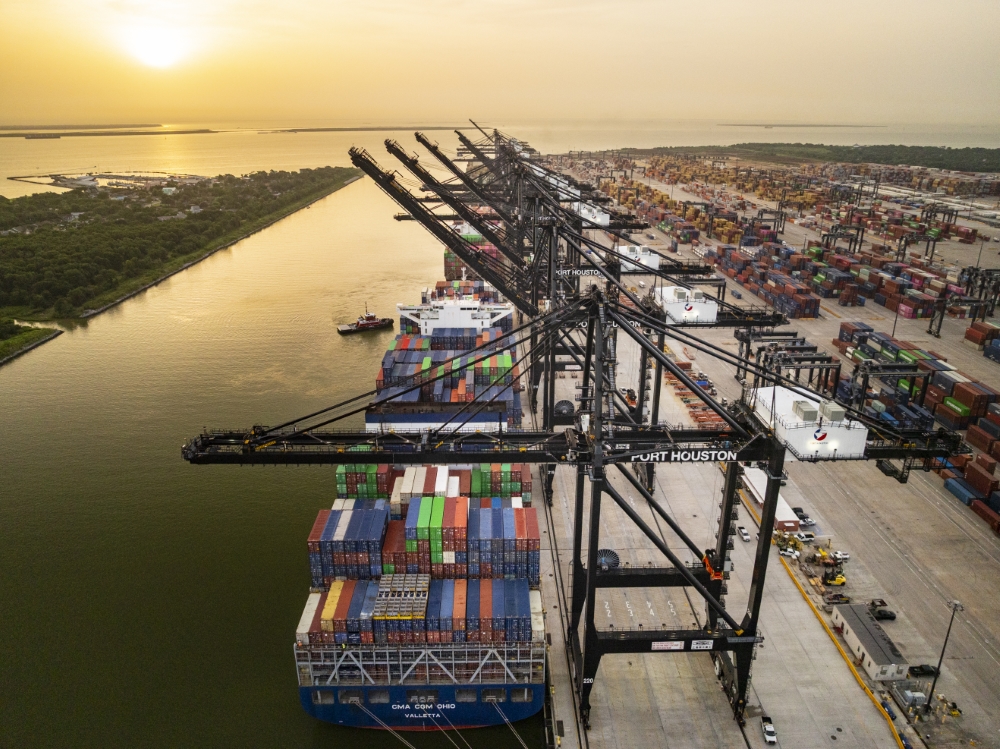
A Martin Associates economic impact study released in August shows marine cargo activity through the public and private facilities along the Houston Ship Channel, collectively known as the Port of Houston, supported $986.9 billion in total U.S. annual economic value in 2025 and 3.53 million jobs. The Port of Houston Authority is the grantee of U.S. Foreign-Trade Zone 84, one of a handful of Texas FTZs leading the nation in activity.
Photo ©Chris Kuhlman, CK Productions, courtesy of Port Houston
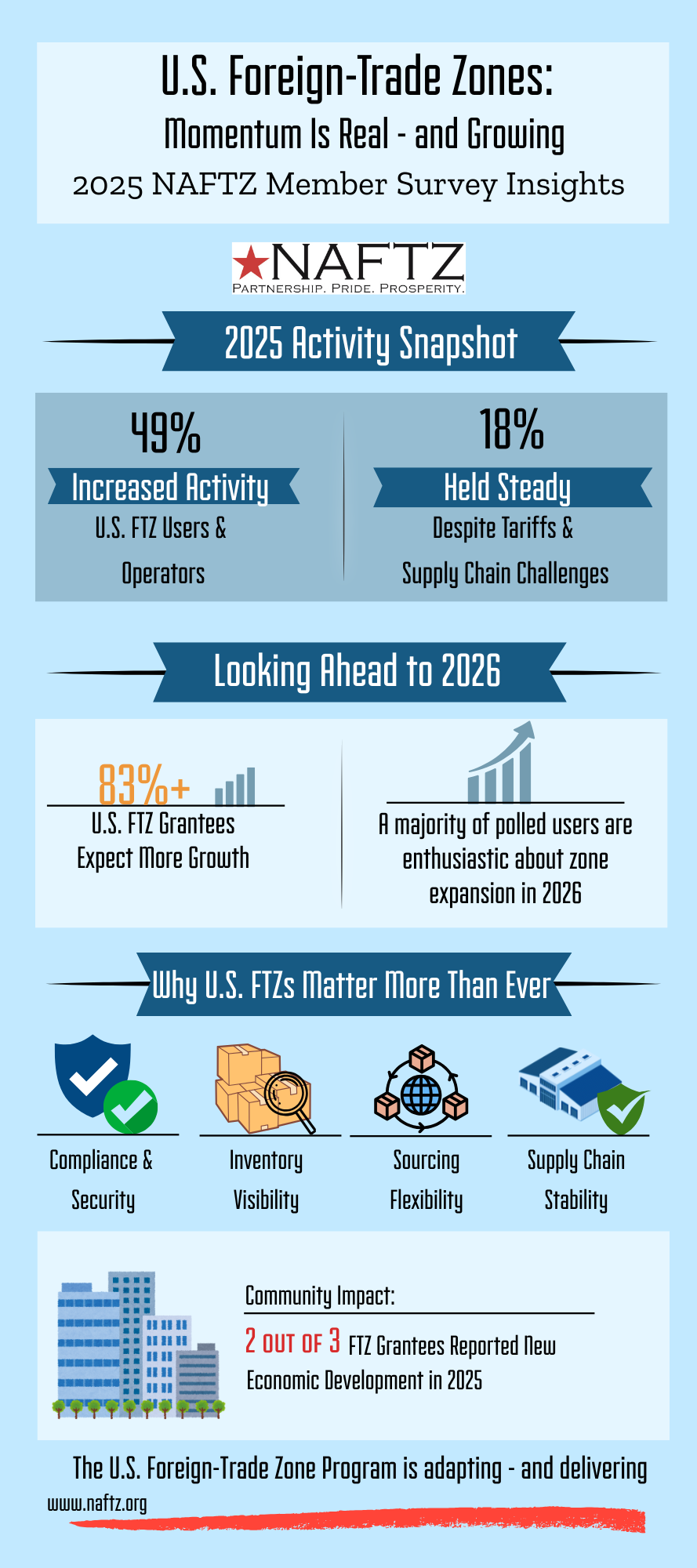
In 2024, more than 543,000 Americans were employed across approximately 1,300 active U.S. FTZ operations nationwide, with related exports accounting for roughly 6.5% of total U.S. output.
Source: NAFTZ
So it’s not a stretch to see why the NAFTZ annual conference in San Diego in October sold out registrations and had a significant waiting list. The FTZ program has been around since 1934 but, just as economic development fundamentals need to be explained and re-explained to citizens and business leaders, so too do the fundamentals of FTZs.

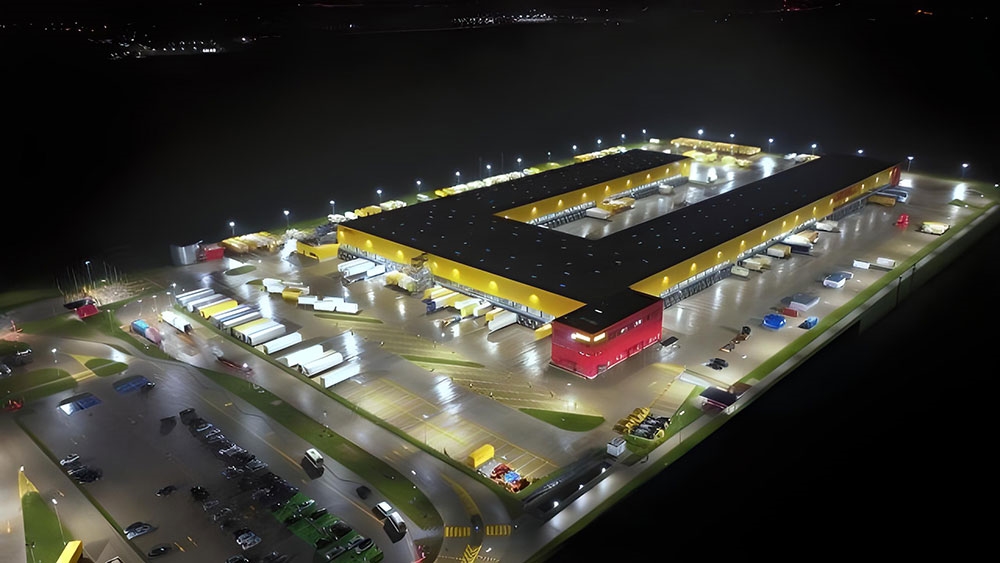
“Central and Eastern Europe is becoming increasingly important to global trade flows and supply chain networks, with Poland in particular emerging as one of Europe’s most dynamic logistics and manufacturing hubs,” said John Pearson, CEO of DHL Express in October. DHL opened this international logistics center in Poznan in 2024, located in one of Poland’s 14 special economic zones.
Photos courtesy of DHL
Indeed, says Irmen, the fundamentals track at the NAFTZ conference is receiving a lot of attention, and her team speaks more and more frequently about those fundamentals to audiences around the country. A refresher:
“The idea behind the zone is that you can bring materials in and, in the U.S. case, both foreign and domestic materials can be co-mingled and can be warehoused for an indefinite period of time,” Irmen says, “and it’s not until you actually put those materials into U.S. commerce when [a product] leaves the zone that you pay the duties, taxes and fees.”
“From the time that you’re bringing in some of those base materials until you actually are shipping a finished semiconductor can be several months,” Irmen explains. Being in the zone allows a company to hang on to that tariff money until the sale and then apply incoming cash flow from the purchase to the tariff. “That’s more and more becoming a benefit that we see companies trying to leverage just so they can manage the tariff payments,” she says. “We’re hearing a lot from our members about the value of the cash flow management and the benefit of paying tariffs when you sell a product and put it into U.S. commerce as opposed to when you’re buying a product. Being able to manage that cash flow has always been a big benefit in the program. But it is especially so now when you’re talking double-digit tariffs on a lot of imported goods. We’re definitely seeing some instances where companies are using U.S. FTZ warehouses to store goods as they’re building out data centers or production lines.”
Irmen points out one of the distinctions between the U.S. FTZ program and other special economic zones around the globe. Those zones abroad, she says, “are areas that the government has designated as having tax benefits or certain incentives, and you must locate within that pre-approved footprint. It’s usually more narrow in scope than what we use here with the alternative site framework — it’s usually a city or sometimes an area around a port, and they’re insisting that the companies move to that location, a location that prior to this designation hasn’t had economic activity. The U.S. Foreign-Trade Zone model is built around this idea that companies that want to operate within the FTZ system can designate their own locations, their own sites, their own warehouses, and they don’t have to move them to another location. Our alternative site framework just helps pre-approve some of the application process.”
In September, the NAFTZ convened the first meeting of the new, bipartisan Congressional U.S. Foreign-Trade Zones Caucus co-chaired by U.S. Representatives Aaron Bean (R-Florida) and Marilyn Strickland (D-Washington). NAFTZ is actively engaged with congressional offices and federal agencies on several issues affecting U.S. FTZ operations, including:
- The implications of ongoing tariff actions under authorities including Sections 301 and 232;
- The ongoing U.S.-Mexico-Canada Agreement (USMCA) review — advocating for policies that address longstanding competitive disadvantages facing U.S. FTZ companies exporting to Canada and Mexico, including legislation designed to restore parity for qualifying U.S. exports;
- The need for directed funding for U.S. Customs and Border Protection (CBP) to support recent growth in the usage of the U.S. FTZ program — even as CBP has put forward an advance notice of proposed rulemaking to increase supply chain visibility and prevent illicit imports. That notice is inviting public comment through the end of November. “I would definitely encourage any U.S. importer to read through the advance notice and provide comments,” Irmen says.
“U.S. Foreign-Trade Zones are not an abstract trade policy, they are operating in communities across America, supporting employers, investment and jobs,” said Patty Cannon, incoming chair of the NAFTZ Board of Directors, director of special projects for the Delaware Division of Small Business and grantee administrator for U.S. FTZ No. 99, which encompasses the entire state. “As a grantee administrator in Delaware, I see firsthand the value these operations can bring to a region. The caucus creates an important avenue for members of Congress and their staff to hear those real-world stories and better understand how the program supports economic activity in their own districts.”
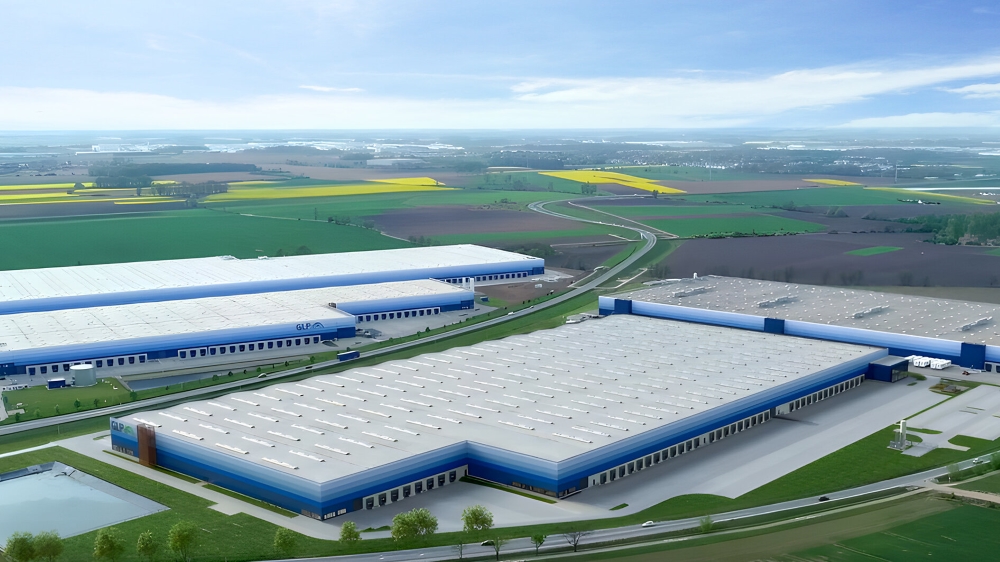
Among projects attracted to Poland’s 14 special economic zones is a €230 million, 400-job manufacturing facility in Wałbrzych, Lower Silesia, from PV inverter and energy storage system provider Sungrow.
Rendering courtesy of Sungrow
Global Zones Work Too
October saw the release of the DHL Globalization Tracker report by DHL and New York University’s Stern School of Business. Based on more than 30 million data points, the report analyzes international flows of trade, capital, information, and people.
“The report shows that global goods trade grew faster in the first half of 2026 than in any half-year in the past 15 years, apart from the exceptional Covid rebound,” a release from DHL and NYU stated. “A major driver was strong demand for goods used to build AI infrastructure, such as semiconductors and data-transmission equipment. Trade in AI-enabling goods drove 42% of goods trade growth in 2025, and this share rose to 76% during the first quarter of 2026, according to WTO and OECD analysis.”
The report was released at an event in Poland, where DHL Express CEO John Pearson said, “The headline says, ‘Trade Disruption’ but the data says ‘Resilience.’ ” He went on to posit that the biggest story in global trade is not tariffs, but AI. “Every AI query ultimately depends on logistics,” he said. “Chips, networking equipment and the many other goods behind this technology must be in the right place at the right time.”
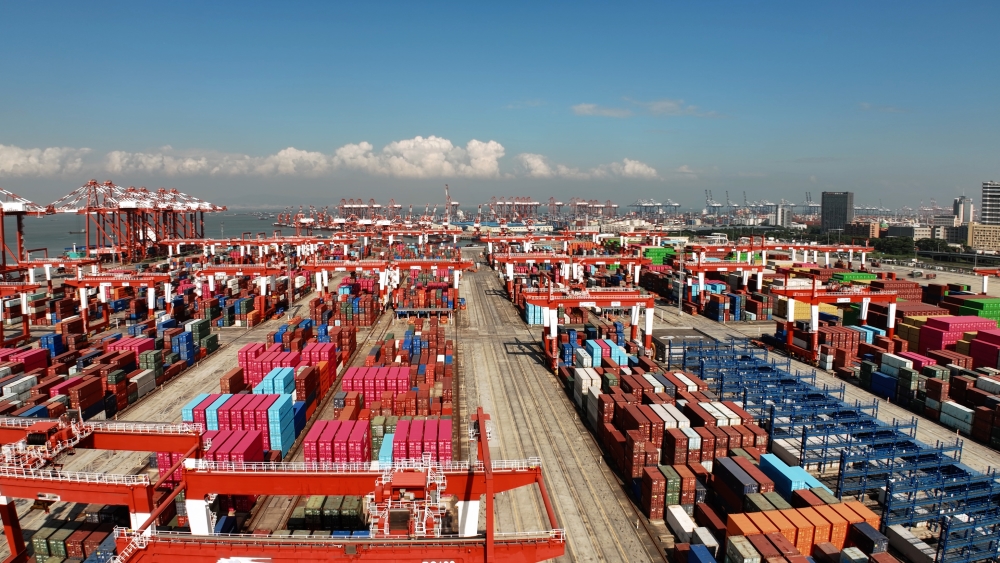
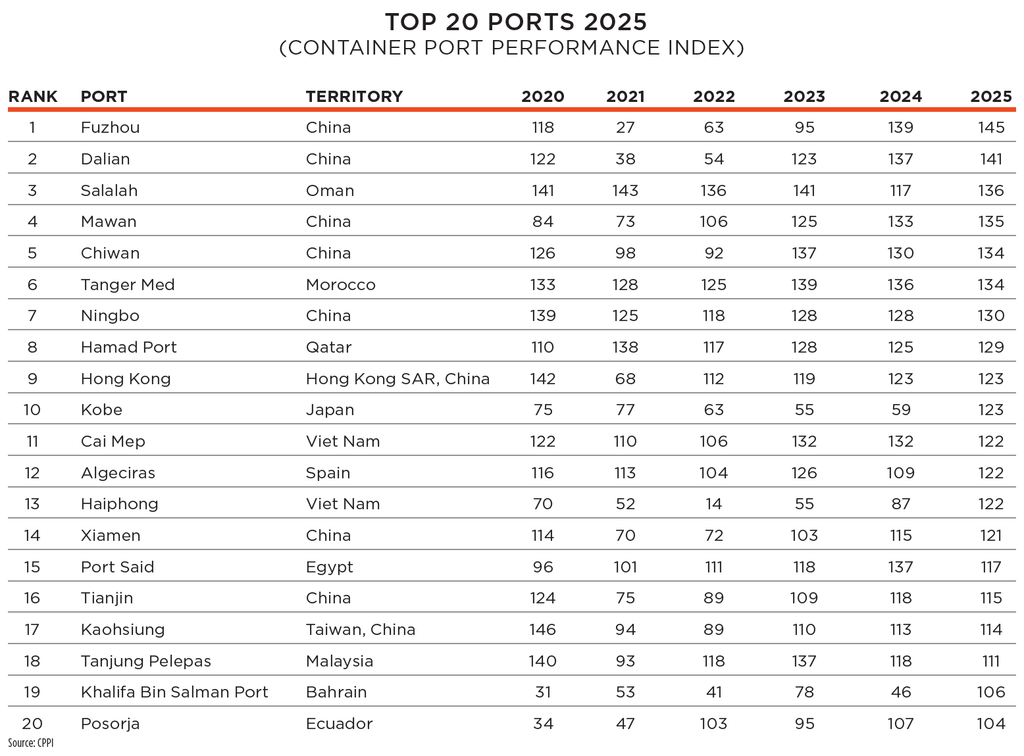
Led by No. 1 Fuzhou Port, Chinese ports accounted for four of the top five positions in the 2025 Container Port Performance Index released in June 2026.
Photo by Sergei Novak | Getty Images
Concurrent with the report’s release came DHL’s announcement that it plans to invest more than €400 million through 2030 in Central and Eastern Europe with a particular focus on Poland, a country where DHL has operated for 35 years, employing more than 10,000 people. “Under DHL Group’s Strategy 2030, Poland, Czechia, Hungary and Romania have been identified as markets benefiting from powerful ‘geographic tailwinds’ driven by their growing importance in European manufacturing, trade and distribution networks and longer-term shifts towards nearshoring by overseas companies seeking greater proximity to the European consumer market,” DHL stated in a release.
The Globalization Tracker findings “underscore Poland’s remarkable economic transformation and growing importance as a European trade and manufacturing hub,” DHL stated. “Between 2016 and 2025, Poland’s goods trade grew 2.1 times faster than global trade and 2.7 times faster than EU trade. Looking ahead, Poland’s goods trade is forecast to grow 28% faster than world trade and 91% faster than EU trade between 2026 and 2029.”
A key element promoting global trade in Poland has been its system of 14 special economic zones (known as Polish Investment Zones or PIZs). As it happens, on December 31, 2026, those zones, in operation since 1994, will cease operations and their permits will expire, as policy changes made in 2018 effectively declare all of Poland to be a special economic zone, with companies no longer restricted to specific geographic areas nor to government-controlled lands only.
I asked DHL about the importance of zones to the flow of global trade in today’s fraught trade environment.
“Certainly, a more dynamic trade environment has emerged over the past two years, and this has made the evaluation of free zones more important,” says Ann-Christine Gräber, spokesperson for DHL Global Forwarding. “Previously, a relatively smaller subset of companies saw advantages in free zones, before the introduction of tariffs and other trade measures. Today, however, these zones are being viewed as a viable option by a broader range of businesses than we have seen in the past.”
For companies with highly dutiable products, the benefits can be more material to their bottom line, Gräber says. “Free zones offer flexibility and speed, enabling companies to reroute goods or adapt as global events and supply chain conditions change. Companies across the logistics sector, as well as our customers moving goods around the world, are managing supply chains that are often less predictable than in the past. As a result, the relevance of free zones continues to grow.”
Findings: DHL Globalization Tracker 2026 Update
The DHL Globalization Tracker 2026 Update found the following, among other results:
“East Asia and the Pacific saw the strongest trade growth among all regions. The value of its trade rose 24% in the first five months of 2026 compared with the same period in 2025. Europe followed with 12% and Sub-Saharan Africa with 11%.”
East Asia and the Pacific also saw a larger share of its trade stay within the region. “This share increased from 57% in 2025 to 60% in the first five months of 2026. Strong Asian supply chains serving the AI boom contributed to this increase.”
“At the country level, a look at the 50 largest trading nations — which together account for 92% of global trade — shows that Uzbekistan saw the fastest trade value growth, up 122%. Uzbekistan’s goods trade boom reflects industrial growth supported by economic reforms, as well as wider regional developments. The next largest increases were in Malaysia (51%) and Taiwan, China (44%), both benefiting from electronics demand boosted by AI investment.”
“The only countries with declining trade values (among the 50 largest) were Saudi Arabia (-37%), Ireland (–16%), and United Arab Emirates (–7%). Saudi Arabia and the UAE were both affected by the closure of the Strait of Hormuz, while Ireland’s trade declined back to a more normal level after spiking in early 2025 due to frontloading of pharmaceutical exports to the U.S.”
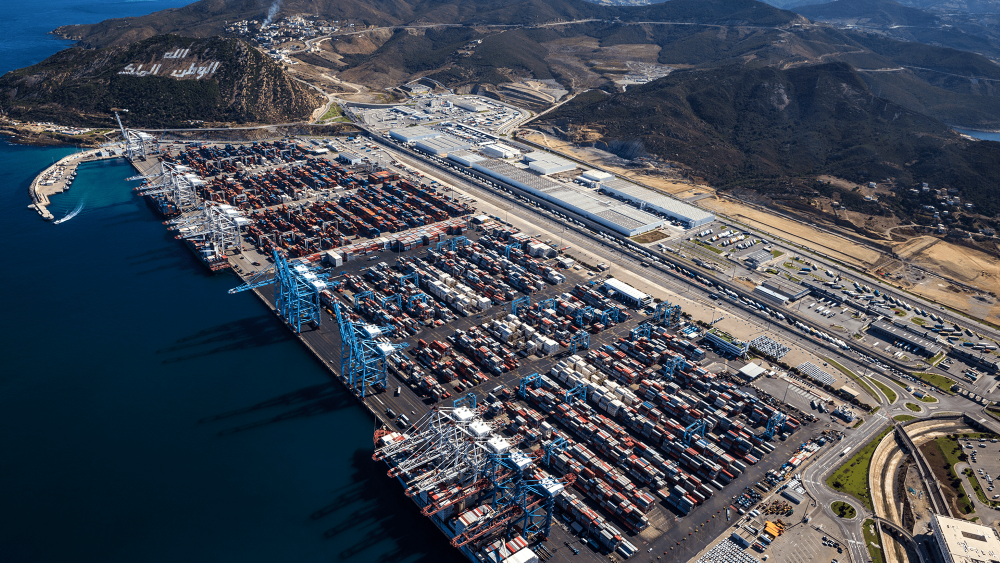
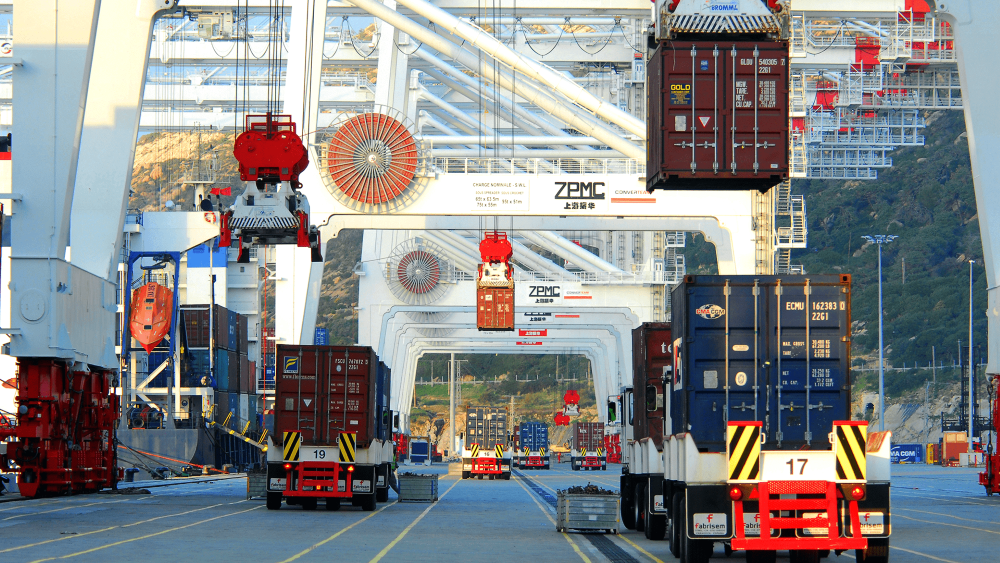
Thanks in part to an APM Terminals expansion, the four container terminals of Tanger Med Port Complex in Morocco handled 11,106,164 TEUs in 2025, representing an 8.4% increase compared with 2024. With 1,000 hectares (2,471 acres) at its disposal, the complex is one of the highest-ranking container ports in the Container Port Performance Index (No. 6) that is associated with a special economic zone.
Photos courtesy of Tanger Med
“At the trade-lane level, a look at the world’s 100 largest trade lanes — which together account for more than 40% of global trade — shows that the fastest growth was in exports from Switzerland to the United Kingdom (+292%). Exports from Switzerland to China (+212%) followed, then exports from the United Arab Emirates to Switzerland (+175%). The steepest declines were in exports from Ireland to the United States (–67%), from Switzerland to the United States (–56%), and from India to the United States (–11%). These trade lane developments were all influenced by U.S. tariffs and related uncertainty, with gold trade swings playing an especially prominent role for Switzerland.”
“The largest upgrade to the trade growth forecasts since January 2026 was in North America, reversing much of the sharp downgrade that followed U.S. tariff increases in 2025. The large-scale AI buildout in the U.S. has fueled U.S. import growth, while imports of other goods have declined. One study estimates that without the AI investment boom, U.S. imports would have declined 10% in 2025 rather than increasing modestly. The second-largest upgrade was in East Asia & Pacific, supported by that region’s leading role in producing AI-enabling hardware.”
“The most consequential shift in global flow patterns is the weakening of ties between the world’s two largest economies … On average, China’s share of U.S. trade, capital, information and people flows has fallen by 48% since 2016, while the U.S. share of China’s flows has fallen by 44%.” However, U.S. imports from other countries contain rising amounts of materials and components made in China, with the share of “value added” from China in U.S. imports — including Chinese content embedded in goods imported from other countries — falling only slightly through 2024 (the most recent year with available data). “This implies that a substantial share of U.S.–China interdependence via trade has been redirected through third countries rather than truly reduced,” DHL stated.
Moreover, the company points out, “most of the recent decline in China’s share of U.S. imports occurred between October 2024, immediately before President Trump’s re-election, and May 2025. This period included a brief escalation in which tariffs on U.S.–China trade rose above 100%, followed by a trade truce in May 2025. Since April 2026, China’s share of U.S. imports has increased modestly. This may reflect the narrowing gap between U.S. tariffs on Chinese goods and those on alternative suppliers after the U.S. Supreme Court ruled tariffs imposed under the International Emergency Economic Powers Act (IEEPA) unconstitutional.”
Notably, the NAFTZ stated it was instrumental in implementing system-wide changes to International Emergency Economic Powers Act (IEEPA) tariff entries in the wake of the Supreme Court’s ruling striking down the tariffs. NAFTZ also has “advocated for updates and clarifications tied to tariff and trade policy implementation, including matters related to inverted tariff treatment, Section 301 tariff actions, Customs modernization, and revisions to trade frameworks such as the United States-Mexico-Canada Agreement (USMCA).”
DHL offered this advice for corporate leaders: “For businesses, it is crucial to assess the competitive impact of potential reshoring, nearshoring or friendshoring moves. While the risk of future disruptions to global flows calls for stress-testing exposure to such disruptions, the resilience of international flows today suggests that the importance of global markets and supply chains has not diminished substantially in most industries. A company that withdraws from international engagement when its rivals do not could put itself at a competitive disadvantage.”
Zones or No Zones, These Ports Perform
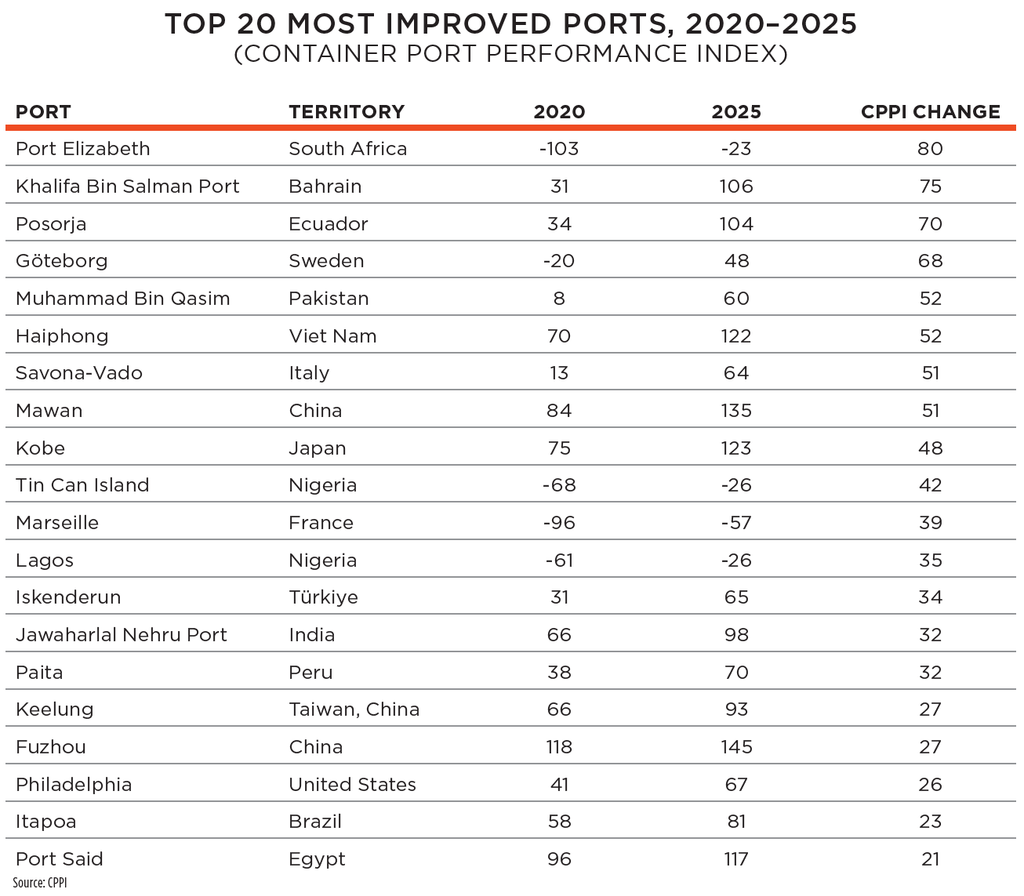
Summer 2026 saw the release of the latest Container Port Performance Index by the World Bank Group and S&P Global Market Intelligence. Covering over 400 ports worldwide from 2020 to 2025, the index assesses vessel time in port, a “key indicator of operational efficiency and supply chain reliability.” Among the findings:
- “Longer vessel turnaround times, often driven by rerouting and congestion, both reflect and exacerbate supply chain fragility. Conversely, ports that improve their operational resilience can help dampen disruptions and support more fluid global trade.”
- “East Asian ports continue to perform strongly in the rankings, while the report also highlights promising improvements in ports across Africa, Latin America and South Asia.”
“Ports are not just passively exposed to external shocks; they also dynamically shape how those shocks are transmitted,” said World Bank Group Global Director for Transport and Logistics Bertrand De la Borde. “They can either amplify disruptions or help contain them. Investing in port efficiency and digital management is not only beneficial to shipping lines — it is a core requirement to build more resilient supply chains and reduce the impact of volatility on economies and communities.”
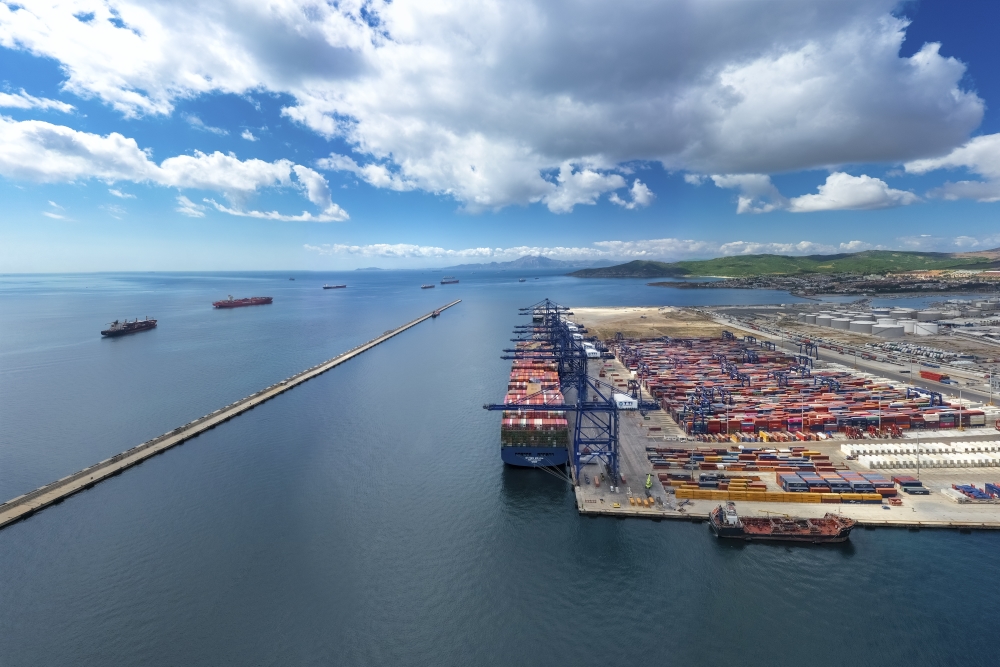
The highest-performing European port in the 2025 CPPI (No. 12), the Port of Algeciras along the Strait of Gibraltar in Spain is home to two container terminals including Total Terminal International Algeciras S.A. (TTI Algeciras), which is undergoing a major expansion to increase its handling capacity to 2.1 million TEUs by 2028.
Photo courtesy of Kalmar Corporation, which in September signed a crane maintenance services agreement with TTI Algeciras
I asked Jan Hoffmann, global lead for maritime transport and ports at the World Bank, how the presence or absence of special economic zones affects port performance. “I don’t really see how free trade zones would significantly impact the CPPI,” he says. “What I see more is that exporting ports tend to have better CPPI than importing ports.” He likes the idea of Poland becoming one big free zone, but admits, “I am not such a big fan of physical free zones. They are the second-best solution. Ideally, we would have many, many AEOs [Authorized Economic Operators, a form of business pre-approval], with customs checks done with risk management and digital solutions, post clearance audits, etc.”
Among the CPPI’s latest findings:
“Ports in higher-income economies typically benefit from lower capital costs, better port and hinterland infrastructure, including deeper channels, higher crane intensity, modern terminal layouts, and more reliable energy and ICT systems. These conditions are often complemented by wider adoption of digital tools, such as Terminal Operating Systems, Port Community Systems and data sharing between shipping lines, terminals and public authorities. In addition, higher-income economies tend to benefit from stronger institutional capacity, more predictable regulation and better coordination between public and private actors, all of which support shorter vessel turnaround times and therefore higher CPPI values.”
“Trade structure plays a complementary role. Ports in regions that are more export-oriented than import-oriented tend to record higher CPPI scores, as export operations allow containers to be prepositioned in yards in sequence for loading, improving crane productivity and reducing idle time.”
“When disruption causes ships to arrive together off-schedule, ports face sudden ‘burst congestion’ events … In such surges, even top-performing ports can be stretched beyond capacity … Recent geopolitics illustrate how quickly bursts can form and migrate.”
“Global supply chain stress has a direct negative impact on port performance. Periods of disruption (such as pandemic-induced trade shocks or conflict-related rerouting) have empirically been associated with container vessels spending longer in port, ultimately leading to lower CPPI … When disruption causes ships to arrive together off-schedule, ports face sudden ‘burst congestion’ events. Rather than a steady flow, multiple delayed arrivals converge at once, rapidly overloading berths and yards. Surges in vessel arrivals erode planning and degrade schedule integrity. In such surges, even top-performing ports can be stretched beyond capacity … Recent geopolitics illustrate how quickly bursts can form and migrate. In 2026, disruption in the Strait of Hormuz reduced shipping flows to a trickle, reinforcing the risk of sudden schedule dislocation and arrival compression. As carriers re-sequence networks to bypass these zones, congestion often shifts to ‘relief’ nodes, which can quickly become overwhelmed by the ‘clumping’ or synchronized arrival of diverted vessels.”
“The impact of supply chain stress on vessel time in port is not automatic, however. Several ports that have been able to expand capacity, attracted private investment or otherwise improved operations could reduce vessel time in ports even when they were close to regional supply chain disruptions. Even though the Red Sea crisis led to volatility in the Indian Ocean, ports such as Djibouti and Dar Es Salaam managed to improve their CPPI score in 2025.”

U.S. FTZ & Top FTZ State Rankings
Coming in Early 2027
The U.S. Foreign-Trade Zone Board’s annual report to Congress has been deferred for the second year in a row from late summer until the end of the year. Site Selection’s rankings of top-performing FTZs and top-performing FTZ states will be published in early 2027.