Business-friendly ecosystem supports a series of big project wins.
Site selection consultants who have done business with Oklahoma say that the state consistently wins major investment projects because it understands better than most what prospective investors need in a business location and surrounding environment.
One site selector who has done business for many years in the Sooner State is Courtney Dunbar, director of site selection for Burns & McDonnell. In a recent video interview posted on the Oklahoma Department of Commerce website, Dunbar described how the state has created an ecosystem conducive to long-term business investment.
Dunbar says that “anytime I go into a state, I am looking not just for a particular attribute. I am looking for an ecosystem. Oklahoma makes it very easy to work there. They understand what they are competing against, especially in the surrounding states.”
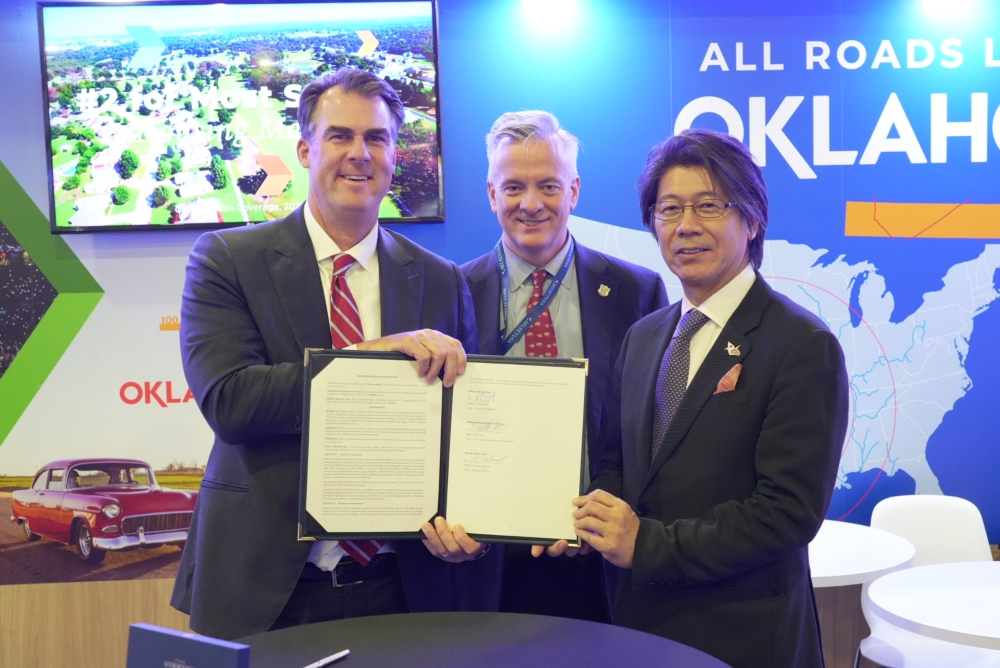
Photo courtesy of Oklahoma Commerce
She then lists the principal advantages of doing business in Oklahoma:
- “It is a great place to live, work, play and be.”
- Oklahoma’s central location gives businesses a unique advantage.
- “It is easy to get permits, and there are no hiccups in construction.”
- Oklahoma offers not just ready sites, but shovel-ready sites that are master-planned.
- The local workforce has a culture of industry and a deep level of experience in manufacturing.
- “Quality STEM programs” have prepared young people to pursue rewarding careers in the skilled trades, engineering and manufacturing.
- “Oklahoma provides a supportive ecosystem for companies.” This enables investing firms to succeed over the long term, which makes them likely to invest again. “The state has set up policies to make this happen,” she notes.
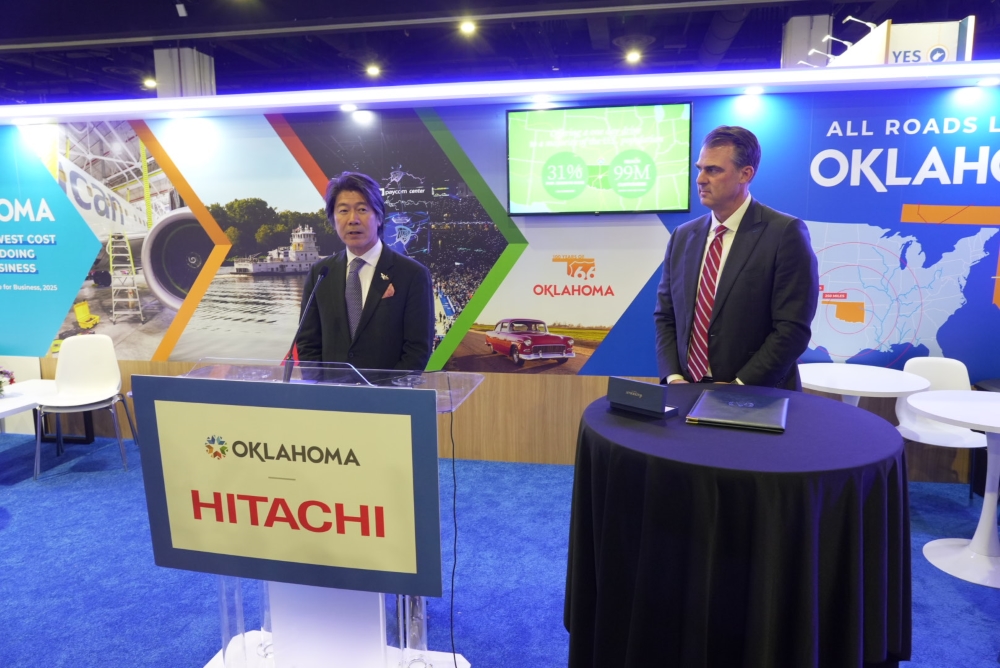
Everything Dunbar noted as Oklahoma advantages came into play on May 4 when Gov. Kevin Stitt announced that the state had signed a memorandum of cooperation with global tech leader Hitachi Ltd. to expand in Oklahoma.
With 40 years of history of investing in Oklahoma, Hitachi currently employs more than 200 workers in Norman. Under terms of the MOC, Hitachi will work with the state to explore additional investment and expansion opportunities in energy infrastructure, advanced manufacturing and digital solutions.
One of those projects is already in the works, as Hitachi agreed to invest $4 million in new machinery and equipment to expand production capacity and reduce energy costs at the firm’s site in Norman. Hitachi is receiving a Business Expansion Incentive Program benefit as part of this deal.
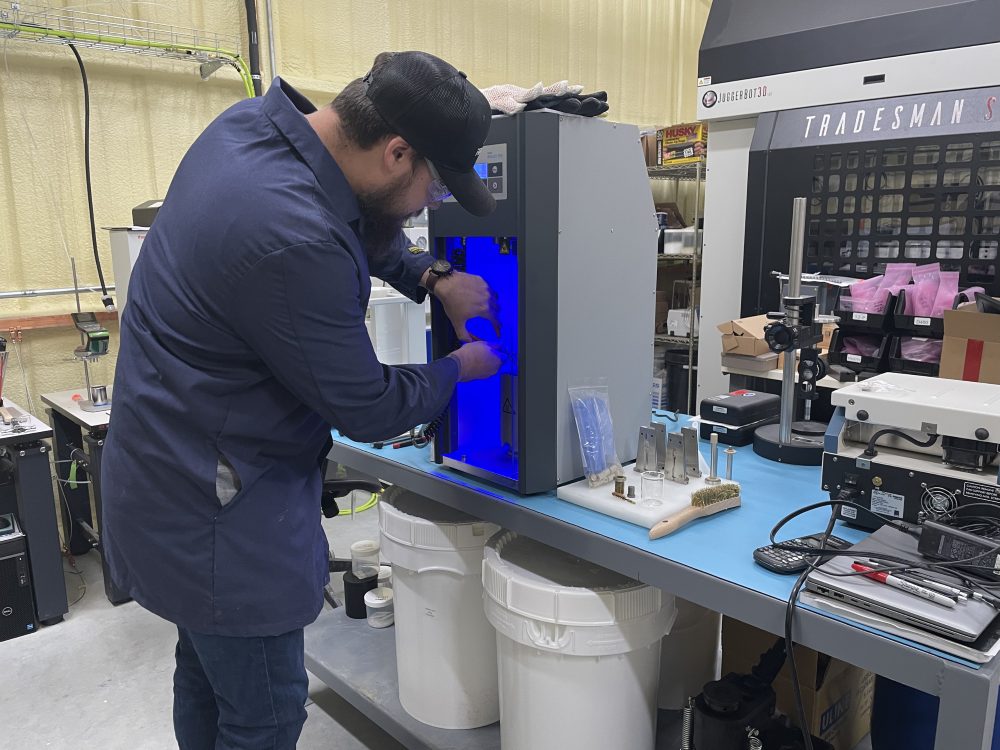
Firehawk Aerospace talent in action
Photo courtesy of Firehawk Aerospace
Business by the Billions
Other recent business wins of note include Google, EGA, CBC Global Ammunition, Firehawk Aerospace, and Kratos Defense & Security Solutions.
Last August, Google announced that it had acquired 400 acres in Stillwater for the global search engine’s latest data center development. An estimated $3 billion will be invested by Google to build an AI-focused data center campus. That same month, Google announced it planned to spend $9 billion building out cloud and AI infrastructure in Oklahoma by 2027, including the Stillwater project.

“Anytime I go into a state, I am looking not just for a particular attribute. I am looking for an ecosystem. Oklahoma makes it very easy to work there. They understand what they are competing against, especially in the surrounding states.”
— Courtney Dunbar, Director of Site Selection, Burns & McDonnell
On May 16, 2025, Emirates Global Aluminium (EGA) announced that it had selected 350 acres at the Tulsa Port of Inola to build a $4 billion aluminum factory — the first new aluminum smelter to be constructed in the U.S. in 45 years. The project is expected to create 1,000 direct jobs and 1,800 indirect jobs.
CBC Global Ammunition added to a record-setting month of activity last May by announcing it would establish a $300 million munitions factory at MidAmerica Industrial Park in Pryor, Oklahoma, where the firm plans to hire 350 workers at a 550-acre site.
CBC was one of three major aerospace and defense projects to pick Oklahoma last year. The other two came from Firehawk Aerospace and Kratos.
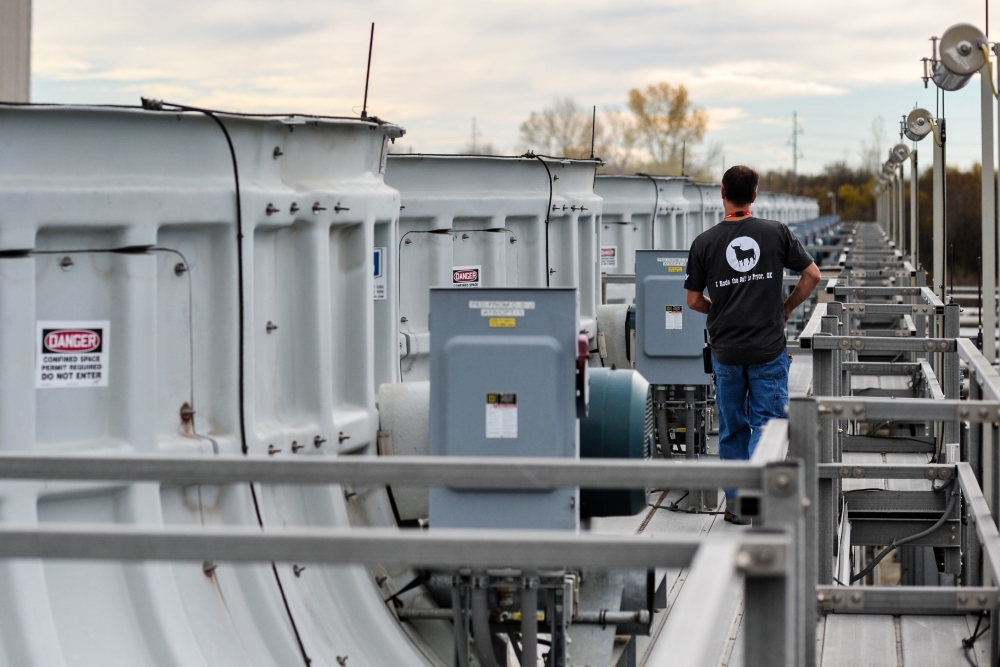
A Google worker inspects air handlers on the rooftop of the Mayes County data center.
Photo courtesy of Google
Firehawk Aerospace announced a $22 million project in Lawton. The new additive rocket fuel manufacturing plant is expected to create 100 new jobs that pay an average annual salary of $93,500. On May 5 of this year, the first fast-track construction contract on the Firehawk complex was awarded by the Lawton Economic Development Authority.
The Addison, Texas-based company began operations in 2019 and uses 3D-printed solid rocket fuel to produce safer and more efficient hybrid engines. The company said the Lawton location is a perfect fit because Fort Sill is the training base for the missile systems for which Firehawk is developing its design concepts.
Kratos Defense & Security Solutions, meanwhile, announced plans to open a new advanced manufacturing plant in Bristow. Kratos is reinvesting in Oklahoma by building a 50,000-sq.-ft. factory that will create 60 new jobs.
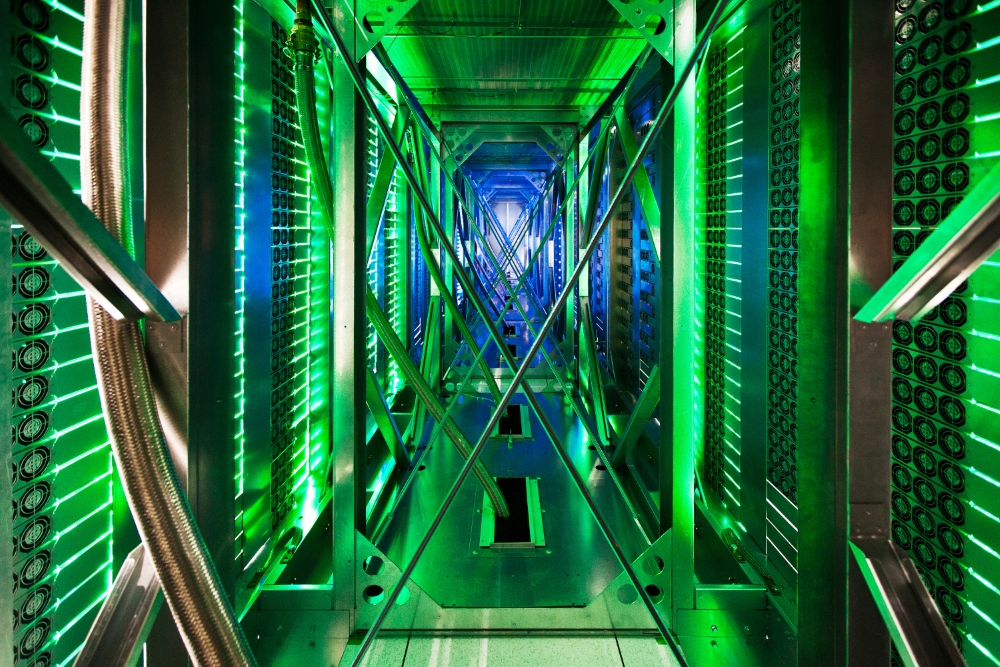
Google’s data center site in Mayes County
Photo courtesy of Oklahoma Commerce
From Mecad to Meta
Other recent big business wins in Oklahoma include the following:
- Dollar Tree announced plans to rebuild its distribution center in Marietta and create 400 jobs. The 1 million-sq.-ft. facility is slated to open by spring 2027.
- Quantum Space announced May 12 that it will build the next generation of advanced maneuverable aircraft for defense and commercial space operations in Tulsa. The 40,000-sq.-ft. facility is expected to create 50 high-wage jobs when it opens in the first quarter of 2027.
Google has announced that it plans
to spend $9 billion building out cloud and
AI infrastructure in Oklahoma by 2027.
- Meta broke ground in April on a new $1 billion data center in the Fair Oaks Innovation Park in Tulsa. The planned 2 million-sq.-ft. campus is expected to create 100 new full-time jobs at the site. The project will be Meta’s first data center in Oklahoma, 28th in the U.S. and 32nd in the world.
- Advanced manufacturing and engineering firm Mecad USA selected the Tulsa Port of Catoosa in February for its new U.S. headquarters. Mecad USA CEO Candido Romero said that “the flexibility provided by Oklahoma’s new behind-the-meter law significantly de-risks our energy strategy.” Senate Bill 480 allows industrial and commercial entities to develop on-site power generation and storage systems without public utility oversight. Mecad says this can reduce its lead times, improve resiliency and reduce costs.