
Across Illinois, regional economies create different paths to investment and expansion.
by Savannah Yawn
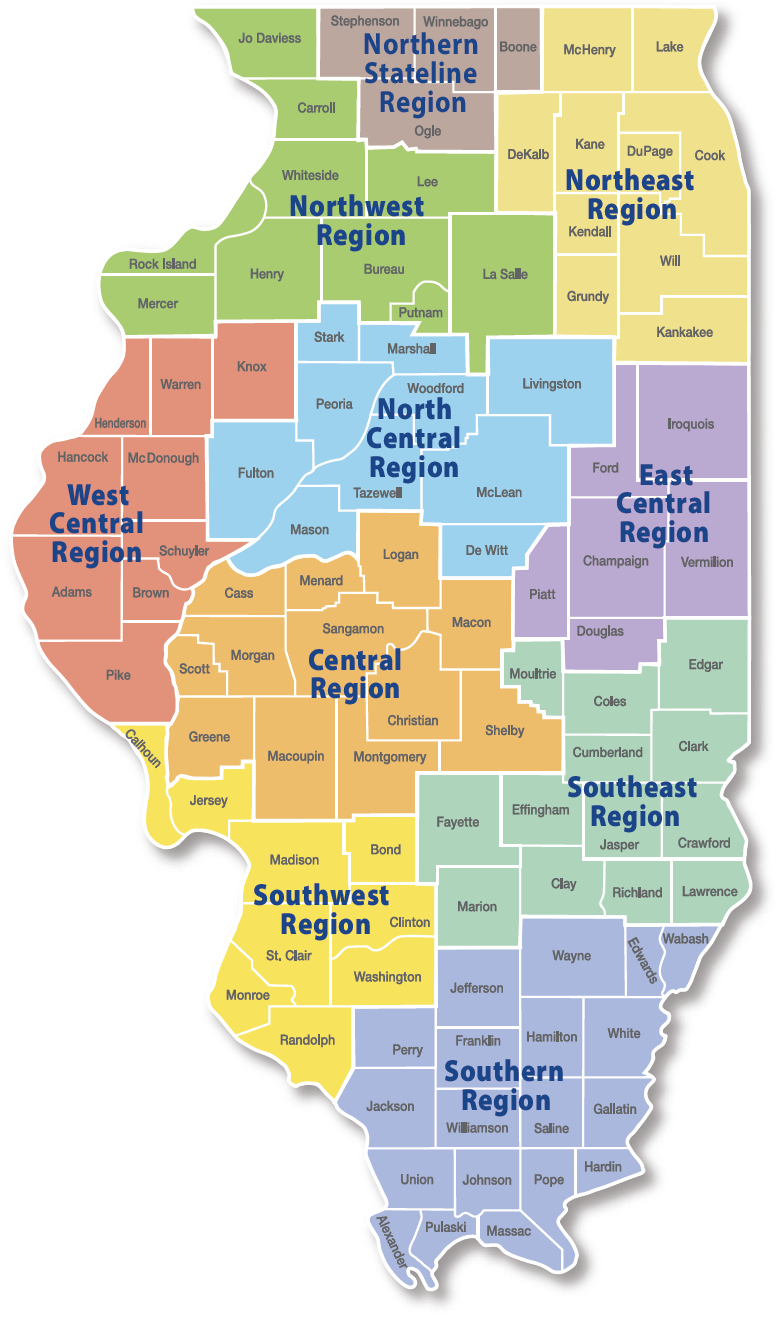
Illinois is often viewed through the lens of Chicago, but the state’s economic story is much more expansive. Across 10 regions, different combinations of talent, infrastructure, industry and geography have produced places with their own business identities.
In Northeast Illinois, global headquarters and major research institutions operate alongside manufacturing, life sciences and emerging quantum technologies. Farther south and west, agricultural production feeds large-scale processing, ingredient manufacturing and distribution networks. University communities are turning research into commercial technology, while generations of industrial knowledge continue to shape aerospace, automotive, machinery and metalworking centers.
The following profiles examine the employers, investments and local advantages shaping each regional economy. Together, they show how much of Illinois’ economic strength comes from the differences between its regions.

All photos courtesy of the Illinois Department of Commerce and Economic Opportunity, Enjoy Illinois, unless otherwise noted.

Big Bets in the Nation’s Third-Largest Market
Anchored by Chicago and extending through the city’s suburbs and surrounding seven counties, Northeast Illinois offers an economic scale few regions can match. Corporate headquarters, financial services, technology, life sciences, food production, transportation and one of the nation’s deepest manufacturing bases all converge here, supported by a population of more than 7.65 million.
That scale is amplified by the region’s global connectivity. O’Hare and Midway international airports, extensive freight and passenger rail networks, interstate highways and access to the Great Lakes give companies direct links to markets across North America and around the world. Chicago is also home to 13 Fortune 500 company headquarters, more than 150 higher education institutions and a workforce of over 4.8 million, according to World Business Chicago.
Recent announcements span transportation equipment, food brands and pharmaceutical manufacturing.
Hyundai Translead announced a $450 million investment to establish new trailer manufacturing facilities in Will County, creating nearly 2,500 new full-time jobs. A subsidiary of South Korea-based Hyundai Motor Company, Hyundai Translead manufactures transportation equipment including dry and refrigerated van trailers, flatbeds, truck bodies and dollies.
Mars Snacking announced plans to create 600 new jobs while expanding its global headquarters presence in Chicago. The company will add its North America Region, Accelerator Division and Global Functions to its Chicago operations, including a new North America regional hub in Fulton Market with capacity for more than 1,000 associates. The expansion builds on an existing regional footprint that supports more than 4,000 Mars Snacking jobs, produces more than 20 iconic brands and includes the company’s Global Innovation Center.
AbbVie announced a new $380 million investment to construct two active pharmaceutical ingredient manufacturing facilities at its North Chicago campus. The facilities will integrate advanced manufacturing technologies with artificial intelligence to support production of the company’s next-generation neuroscience and obesity medications. Construction started in spring 2026, with both facilities expected to be fully operational in 2029. AbbVie plans to hire 300 engineers, scientists, manufacturing operators and lab technicians.
The region is also central to Illinois’ push into quantum computing and microelectronics. The Illinois Quantum and Microelectronics Park on Chicago’s South Side is being developed as a place where researchers, manufacturers, suppliers and technology companies can move emerging technologies toward commercial scale.
Few regions can match Northeast Illinois’ combination of international reach, research capacity or large-scale production.
From Caterpillar Country to EV Land
North Central Illinois encompasses 10 counties, connecting Peoria’s deep manufacturing expertise with the university communities of Bloomington-Normal and the agricultural economy that surrounds them. Its population of more than 650,000 and workforce exceeding 300,000 are employed across heavy equipment, electric vehicles, food production, healthcare, insurance, logistics and professional services.
Peoria’s industrial identity was shaped in large part by Caterpillar, whose presence helped cultivate generations of engineering, machining and production expertise. Caterpillar employs more than 17,000 people across Illinois, including at major manufacturing sites and the company’s downtown Peoria offices. In July, the company announced the Illinois launch of its workforce commitment, the latest investment in its five-year, $100 million Building the Future Workforce Initiative. With an allocation of up to $10 million, the effort aims to prepare workers across Illinois for the modern manufacturing and industry technician jobs of the future.

In Bloomington-Normal, Rivian has established a major electric-vehicle manufacturing operation and is continuing to expand its regional supply chain. In May, the company announced that it is constructing a new 1.2 million-sq.-ft. supplier park in Normal. Rivian will invest nearly $120 million in the development and create nearly 100 new direct jobs. The park is expected to attract electric-vehicle suppliers and generate hundreds of additional jobs while strengthening the manufacturing ecosystem surrounding Rivian’s Illinois operation. Construction is underway and expected to be completed in 2026.
Transportation manufacturing is only part of the picture. Ferrero and Nestlé add major consumer-product operations, while Beer Nuts, Country Financial, Growmark, OSF Healthcare and State Farm maintain headquarters in the region.
Higher education institutions help sustain that range of industries. Illinois State University, Bradley University, Illinois Central College, Heartland Community College and the University of Illinois College of Medicine contribute technical, professional and healthcare talent. Peoria’s growing healthcare and innovation ecosystem also includes the 48,000-sq.-ft. Peoria NEXT Innovation Center, which supports entrepreneurial and technology-focused businesses.
Regional transportation assets connect North Central Illinois to major Midwest markets. Bloomington-Normal’s Amtrak station is among the busiest in the region, linking the area to Chicago, Milwaukee and St. Louis. Central Illinois Regional Airport provides commercial passenger service and air cargo operations, supported by major carriers and FedEx logistics infrastructure.

Decatur Doubles Down on What It Does Best
Central Illinois is a 12-county region where agriculture, manufacturing, government and transportation intersect. Decatur and Springfield play different but complementary roles. Decatur anchors the processing and manufacturing economy, while Springfield contributes government, healthcare and professional services. Across the surrounding counties, food manufacturing, heavy machinery, energy, packaging, healthcare, business services and transportation contribute to a broad economic base.
The region sits in the heart of Illinois’ agricultural belt and the country’s corn belt, giving businesses direct access to the crops and other inputs needed for large-scale food production and biomanufacturing. More than 10,000 people work in food manufacturing and fabricated metal manufacturing, while paper manufacturing, printing and related support activities are 20% more concentrated than the U.S. average.
ADM’s longstanding presence in Decatur connects the region directly to global agricultural and food markets. In June, the company announced that it will invest over $103 million to modernize key facilities at its North American headquarters, where ADM has maintained a presence since 1939. The investment will create 50 new full-time jobs and retain over 1,000 existing full-time jobs, reinforcing Decatur’s role as a global center for agriculture and manufacturing.
Primient has also continued to invest in plant-based ingredients, fermentation and more efficient production at its Decatur operations. Founded in the city in 1906, the company was recently recognized by the Illinois Manufacturers’ Association as a Centennial Manufacturer, a designation honoring Illinois manufacturers that have operated for 100 years or more.
ADM and Primient operate within a larger processing economy supplied by Illinois farms and connected by rail, highway, utilities and the Illinois River system.
Transportation infrastructure extends that reach. Central Illinois provides access to 90 million people within a day’s drive and is served by multiple airports, including Decatur Airport, one of four components of the Midwest Inland Port. These assets help connect agricultural products, manufactured goods and industrial inputs with customers and markets beyond the region.
Central Illinois has a population of more than 550,000 and a labor force of almost 270,000. The University of Illinois Springfield, Millikin University, Richland Community College and Lincoln Land Community College help prepare workers for manufacturing, government, healthcare and professional services.
Springfield adds particular strength in healthcare and business services. Healthcare employs 55,000 people across the region, and the city is home to the Mid Illinois Medical District.
That service-sector base is reinforced by major corporate headquarters, including CCB Credit Services, Horace Mann, Levi, Ray, & Shoup and Bunn-O-Matic Corp.
Where the Farm Becomes the Lab
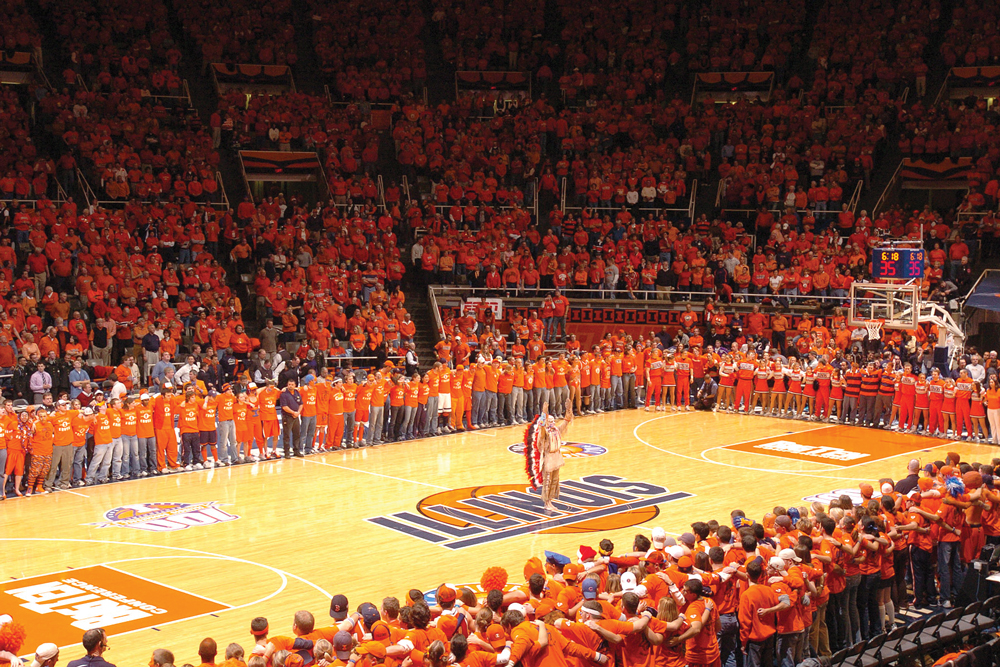
East Central Illinois brings together six counties, some of the world’s most productive farmland and a major research university. Across Champaign, Urbana, Rantoul, Danville, Tuscola and surrounding communities, research and development operate alongside manufacturing, distribution, healthcare, food processing and agriculture.
At the center of that economy is the University of Illinois Urbana-Champaign, consistently ranked among the top public universities in the nation. Research in engineering, computer science, agriculture, medicine and energy moves toward commercial application through partnerships with companies, entrepreneurs and public institutions. Champaign-Urbana’s international university community also gives East Central Illinois a cultural and recruiting profile that stands apart from many comparably sized Midwest markets.
The University of Illinois Research Park is where much of that research meets the private sector. Home to more than 120 companies, the Research Park supports more than 2,100 employees and 800 student interns working across corporate innovation centers, startups and university-affiliated ventures. Companies located there gain access to faculty expertise, laboratories and a large pool of students trained in technical disciplines.
That environment has helped Champaign-Urbana earn recognition as one of Silicon Prairie’s top five startup cities and rank among the nation’s top 10 cities for the number of venture capital firms per capita.
One recent arrival puts that university-industry relationship into practice. In 2025, Mondelez International, one of the world’s largest snack companies, opened an innovation center at the University of Illinois Research Park, its first on a college campus. FutureLab provides interns with campus resources, flexible innovation processes and support to help materialize their innovations. FutureLab opened with a small team of research and development professional leaders from within the company and will host a team of University of Illinois student interns working year-round.
In May, Combe Inc. announced that it will invest $30 million in its Rantoul facility as it relocates operations from California to Illinois. The project will create more than 20 new full-time jobs and retain more than 100 existing full-time jobs, expanding and securing the company’s manufacturing presence in East Central Illinois.
In late 2025, Cache Energy announced a $2.5 million expansion at its 10,000-sq.-ft. manufacturing facility in Champaign, creating 20 new jobs and retaining its current workforce. Supported by a Reimagining Energy and Vehicles (REV) in Illinois agreement, the startup develops long-duration clean energy storage technology using limestone as its feed material. Its thermochemical process converts lime powder into pellets that can store renewable energy for months under ambient conditions and release heat when exposed to water.
In East Central Illinois, university research does not stay on campus for long. It moves into farm fields, startups and manufacturing facilities across the region.
Rockford’s Next Manufacturing Chapter
Centered on Rockford and extending through Winnebago, Boone, Ogle and Stephenson counties, Northern Stateline Illinois has built its identity around precision manufacturing. Its population of 436,000 and workforce of 228,600 support strong concentrations in aerospace, automotive production, metalworking, fasteners, machinery, food processing and logistics.
Rockford’s aerospace cluster is one of the region’s most distinctive strengths. The metropolitan area has the sixth-largest concentration of aerospace employment in the nation, with more than 250 aerospace companies located within a 90-mile radius. Major employers and suppliers include Collins Aerospace Systems, GE Aviation and Woodward, connecting Northern Stateline Illinois to significant commercial and defense aviation programs.
The same aerospace base is now being used to test future propulsion systems. In 2026, Collins Aerospace began testing a megawatt-class hybrid-electric powertrain at The Grid, the company’s electric-power systems laboratory in Rockford. The work supports the development of more efficient hybrid-electric propulsion systems for future aircraft and demonstrates how the region’s established manufacturing capabilities are being applied to emerging aviation technologies.
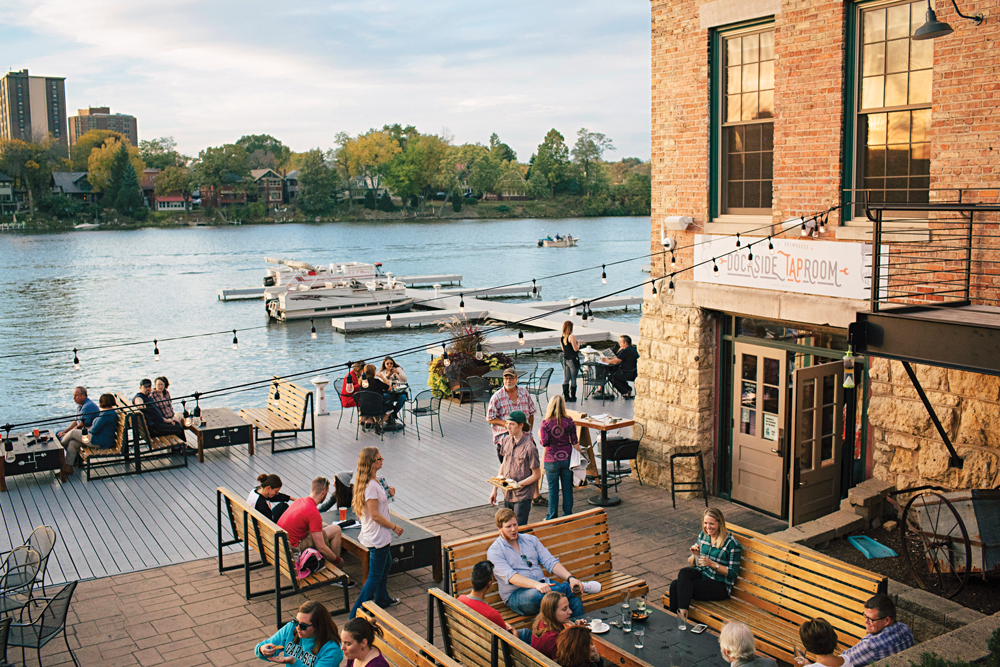
The Rockford metropolitan area is home to more than 4,000 engineers (30% more than the national average) with more than 56,000 engineers located within 90 miles. Northern Illinois University, Rock Valley College, Highland Community College, Rockford University and the University of Illinois College of Medicine at Rockford contribute to the region’s talent base. Together with regional workforce organizations, these institutions provide education and training in aviation maintenance, manufacturing, healthcare and the skilled trades.
Belvidere will soon restore another pillar of the regional manufacturing economy. Stellantis has announced plans to invest more than $800 million to reopen the Belvidere Assembly Plant and expand production of the Jeep® Cherokee for the U.S. market. With an initial production launch expected in 2028, the project is anticipated to create around 3,300 new jobs.
In Rockford, another investment is preserving a manufacturing operation with roots extending back more than 170 years. Four former employees of Gunite Corporation have formed Rockford Brake Manufacturing and are investing $6.6 million to purchase and reopen the historic factory after Gunite’s parent company, Accuride, closed it in February 2025.
The company plans to restore production of brake components and cast parts for the heavy-duty trucking industry at a site that began operating as a foundry in 1854. Rockford Brake Manufacturing will operate one of the Midwest’s most vertically integrated foundries, providing end-to-end production under one roof.
Rockford Brake Manufacturing is also expected to become one of Illinois’ largest recyclers. Some 85% of its products will be made from recycled materials, and 100% of its finished products will be recyclable.
The region’s manufacturing base is supported by extensive transportation infrastructure. Chicago Rockford International Airport is home to the second-largest UPS air cargo hub in the United States. Northern Stateline Illinois also offers access to five international airports, seven Class I railroads and four interstates.

Moline Turns Industrial History Into New Technology
Northwest Illinois is bordered by the Mississippi River and its rich farmland, as well as the industrial legacy of the Quad Cities. Across the 10-county region, riverfront cities and manufacturing communities are closely tied together, supporting an economy built on agricultural equipment, metals, defense, logistics and other forms of industrial production.
John Deere & Company’s world headquarters in Moline anchors this manufacturing network. The company’s Illinois operations connect equipment production with engineering, technology, parts distribution and customer support for markets around the world. At Harvester Works in East Moline, John Deere invested $149 million to renovate 385,000 sq. ft. and introduce advanced equipment used to produce the John Deere X9 combine. The company also completed a $10 million, 60,000-sq.-ft. expansion of its John Deere Seeding facility in Moline, improving workspaces and visitor experiences.
John Deere is part of a large industrial base that gives the Quad Cities region a presence of 150 Fortune 1000 companies and the highest concentration of production workers in the U.S. KONE is another major regional employer, with the KONE Center in Moline serving as the company’s home for U.S. operations.
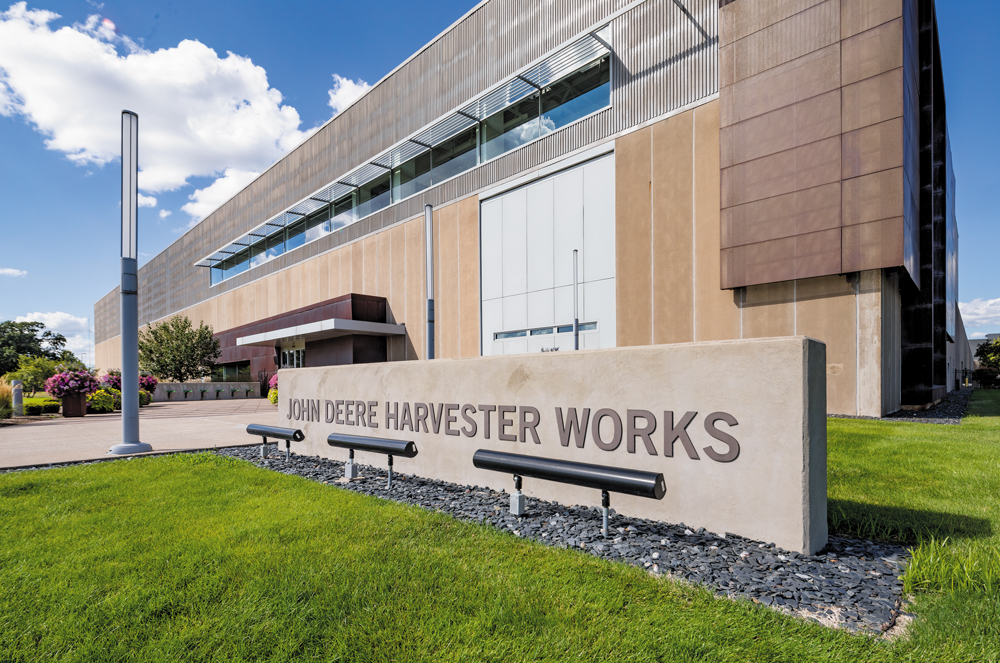
Photo courtesy of John Deere
One of Moline’s best-known industrial landmarks may now help launch the elevator industry’s next generation. The city is collaborating with Silicon Valley startup Hyprlift, Inc., and the National Science Foundation to convert the historic Montgomery Elevator test tower into a hub for vertical-mobility innovation. Constructed in 1966, the tower will be used to test and certify Hyprlift’s next-generation elevator systems as part of the Moline River Front + Centre redevelopment plan.
In exchange for access to the tower, the City of Moline became Hyprlift’s commercial partner in the successful receipt of a National Science Foundation Technology Enhancement for Commercial Partnerships award. The collaboration brings federal innovation funding to Moline while preserving a structure tied to the city’s industrial history. Montgomery Elevator Company, founded as Moline Elevator Co. in 1892, operated in the community for more than a century.
Manufacturing in the Quad Cities also extends into national defense. The Rock Island Arsenal is located on a 946-acre island in the Mississippi River. The active U.S. Army installation connects Northwest Illinois to federal defense, logistics and advanced-manufacturing operations and supports 7,000 federal and contractor employees.
Those operations are connected by an unusually broad transportation network. Interstates 39, 88, 74 and 80 connect Northwest Illinois to the North American market, while three Class I railroads, one Class II railroad, Quad Cities International Airport and the Mississippi River Ports of Eastern Iowa and Western Illinois provide access by road, rail, runway and river. The region is also a U.S. Customs Port of Entry, and distribution centers can reach 80% of U.S. households within a 24-hour drive.
Public investment is supporting the region’s next phase of development. The Illinois Department of Transportation is delivering nine Quad Cities projects representing more than $44 million, while Moline’s River Edge Redevelopment Zone makes projects across about 3.4 square miles of downtown eligible for incentives intended to reduce development costs and attract private investment.
With a population of 475,667 and a workforce of more than 247,000, Northwest Illinois offers more than industrial capacity alone. Manufacturing communities along the Mississippi coexist with productive farmland, smaller historic towns and Galena’s tourism economy. That combination gives the region both manufacturing depth and a recognizable river identity extending well beyond the Quad Cities.
A Crossroads Between Two Rivers
Southern Illinois occupies a strategic position between the Mississippi and Ohio rivers, giving the region a natural role in several key industries including transportation, distribution, manufacturing and agriculture. Interstate highways, Class I rail service, inland ports and regional airports connect its communities with major metro areas like neighboring St. Louis, Memphis, Nashville and markets throughout the Midwest and Southeast.
That access has helped manufacturers in automotive components, tires, filtration products, food production and other industrial sectors establish operations throughout the region. Recent investments in Mount Vernon show how Southern Illinois’ traditional strengths in manufacturing and logistics are being adapted for a more automated and energy-conscious industrial economy.
Continental plans to invest approximately $76 million in a highly automated finished-goods warehouse at its Mount Vernon manufacturing campus. Designed to store roughly 500,000 tires, the facility will strengthen the company’s North American distribution network while building on more than five decades of tire production in Southern Illinois.

The project connects two of the region’s most important advantages. Continental can continue manufacturing from an established Southern Illinois operation while using the new warehouse and the region’s transportation network to move finished products to customers across a multistate market.
Mount Vernon is also home to a new manufacturing investment tied to electric vehicles. Manner Polymers has invested in a 108,000-sq.-ft., 100% solar-powered manufacturing facility that will produce electric vehicle PVC compounds, components for solar panels and materials used across a range of industries.
The facility will expand the company’s production capacity to 100 million pounds and create more than 60 high-quality jobs in Southern Illinois. It also represents a notable sustainability milestone as a first-of-its-kind solar-powered PVC compounding plant using clean energy generated on-site. Manner Polymers will produce a wide range of flexible PVC compounds at the facility.
Together, the Continental and Manner Polymers projects point to a shift that’s underway in the regional economy. Southern Illinois remains a place where companies can manufacture and distribute products at scale, but new facilities are also bringing greater automation and cleaner energy to emerging supply chains.
Carbondale provides the region’s principal research and higher-education anchor through Southern Illinois University. Regional community colleges complement that role by training workers for manufacturing, transportation, healthcare and the skilled trades. Those institutions help supply the technical and operational talent needed by both longstanding employers and newer industrial projects.
Southern Illinois is also distinguished by a landscape unlike much of the rest of the state. The Shawnee National Forest, river lowlands, wooded hills, lakes and smaller communities create a setting more closely associated with the Upper South than the flat prairie terrain often linked with Illinois.
Rural King Builds for Its Next Generation
Rural King began in Mattoon in 1960. More than six decades later, the farm and home retailer is preparing a $75 million headquarters investment that will retain 719 full-time jobs in Coles County and create 100 more.
The project fits the economy around it. Southeast Illinois is a broad rural region where agricultural businesses operate alongside manufacturers, food processors, warehouses and trucking companies. Its population of more than 272,400 and workforce of over 121,600 are connected to Midwest markets by Interstates 70 and 57, rail service from Canadian National and CSX, and multiple public-use airports.
Eastern Illinois University and Lake Land College provide education and customized training in business, technology, healthcare, education and the skilled trades.
Rural King’s $75 million investment will go toward constructing a new Store Support Center Campus in Mattoon. The campus will house the company’s leadership and support departments, including merchandising, IT, finance, operations, marketing, human resources, legal and other key business functions. By the end of 2026, Rural King will operate more than 160 stores across 18 states. The company currently employs more than 9,500 associates nationwide, including more than 400 employees at its existing Store Support Center and 270 employees at its attached distribution center and transportation hub in Mattoon.
Public infrastructure improvements will support the new campus and continued growth in the surrounding area. In addition to support from the State’s Economic Development for a Growing Economy (EDGE) program, the Illinois Department of Transportation is working with the City of Mattoon to provide grant funding to extend Swords Drive north from Broadway to Dewitt Avenue, providing access to the development.
IDOT is also anticipated to break ground later this year on an $82 million reconstruction of the nearby Interstate 57 interchange with Illinois 16. The Rebuild Illinois project is intended to improve traffic flow and safety while increasing clearances for freight and commercial vehicles.
About 70 miles southwest, Centralia is landing a very different kind of expansion. Intermountain Electronics announced that it will invest more than $15 million to add more than 108,000 sq. ft. of manufacturing space. The expansion will create 60 new full-time jobs, retain the company’s current workforce and bring total employment at the Centralia location to more than 200.
“This expansion is a massive win for Centralia’s economy and our local workforce,” said City of Centralia Economic Development Director Rob Jackson. “By bringing 60 new full-time, high-wage jobs to our community, and expanding their total workforce at the Centralia location to over 200 employees, IE is proving that Centralia has the infrastructure, the business-friendly climate and the skilled workforce necessary to compete on a national level. We have thoroughly enjoyed working with Tim, Brenda and the rest of the team at IE, and look forward to a continued partnership.”
The project will significantly increase Intermountain Electronics’ capacity to produce Power Distribution Units, critical infrastructure components supporting renewable energy integration and artificial intelligence applications. The company’s units help deliver consistent, clean power by leveling fluctuations from renewable sources such as wind and solar.

Metro Access, Industrial Power
Southwest Illinois occupies a strategic position on the Illinois side of the St. Louis metropolitan area, giving companies access to a major labor market with ample available space for large-scale operations. The region’s economy is built on long-established industries including metals, aerospace, logistics, agriculture, warehousing and advanced manufacturing.
Southern Illinois University Edwardsville (SIUE), Southwestern Illinois College and Lewis and Clark Community College contribute talent and workforce training across engineering, healthcare, logistics, cybersecurity and aviation.
Within the St. Louis metropolitan labor market, communities including Edwardsville, Belleville, East St. Louis, Granite City and Alton offer companies a range of operating environments.
Alton is also using new infrastructure and university partnerships to support entrepreneurship and the digital economy. In 2025, The Wedge and Southern Illinois University Edwardsville launched “The Wedge Powered by SIUE,” a partnership centered on a 55,000-sq.-ft. social impact hub, research lab, think tank and workspace.
The project builds on AltonWorks’ community revitalization efforts while bringing SIUE research, programming and talent into closer contact with businesses, local agencies and community organizations.
The Wedge is supported by a $20 million 10G fiber network made possible by State of Illinois funding, giving the project digital infrastructure intended to support research, data analytics, technical assistance and new business activity.
Industrial strength and innovation
Southwest Illinois lies within 500 miles of one-third of the nation’s population. That market access matters, but the region’s case rests on more than proximity. It offers the industrial sites, infrastructure, muti-modal connections and technical workforce required for major manufacturing, while investments in laboratories, fiber infrastructure and university partnerships are creating room for new forms of growth.
That combination is visible in East Alton, where Wieland broke ground in 2025 on a $500 million modernization of its copper operation. The project will install advanced production equipment, including a new hot-rolling mill, while retaining approximately 800 manufacturing jobs. The investment reinforces the region’s longstanding role in metals production while upgrading the facility for a new generation of industrial demand.
Galesburg Adds Capacity for the Long Haul
West Central Illinois is a place where agriculture still sets the rhythm of daily life, but it is far from the whole story. In communities including Quincy, Galesburg, Macomb and Monmouth, farm production connects directly to a larger network of food processing, equipment manufacturing, transportation, healthcare and professional services. Together, these industries support a population of more than 213,370 and a workforce of 95,000, forming an economy that is both deeply local and connected to national markets.
Companies including Dot Foods, Titan International, Smithfield Foods, The Maschhoffs and Niemann Foods connect the region’s agricultural base with national manufacturing, food production and distribution markets.
Moving products to market is one of West Central Illinois’ clearest advantages. West Central Illinois offers access to interstates and four-lane highways, the Mississippi and Illinois rivers, Class I and short-line rail service, commercial airports and an established trucking network. Adams County alone is home to more than 20 trucking firms, allowing products to reach two-thirds of the U.S. and parts of Canada within a three-day period.
Quincy serves as a regional commercial and healthcare center along the Mississippi River, while Galesburg’s rail history and industrial infrastructure continue to support manufacturing and distribution. That rail capacity is now receiving a significant upgrade as part of BNSF’s $3.6 billion capital investment plan for 2026.
Galesburg has been central to BNSF operations since the 1850s and is home to the second-largest hump yard on the company’s 32,500-mile network. At the hump yard, railcars are sorted and reassembled into outbound trains serving destinations across the network.
BNSF is adding a second hump lead track to increase switching capacity and improve the terminal’s overall performance. Once completed, the upgraded yard will be able to process approximately three additional trains per day, or about 300 cars. The added capacity is intended to improve terminal fluidity and support more consistent merchandise service across the BNSF network.
Additional industrial development opportunities are available at a BNSF certified site southeast of Galesburg. The industrial park provides convenient access to the railroad’s mainline and nearby highway infrastructure. The available site and expanded yard capacity give Galesburg room to accommodate additional industrial and freight activity.

Learning on the Job
West Central Illinois’ workforce is strengthened by Western Illinois University, Knox College, Monmouth College, John Wood Community College, Carl Sandburg College, Quincy University and Spoon River College.
In Macomb, Spoon River College’s new campus is designed as a modern hub for education, career training and community engagement. Its academic and vocational offerings include general education courses, healthcare certifications and technical training, supported by updated classrooms, labs and student resources.
The campus also strengthens connections among the college, local businesses and area schools. Those partnerships are expected to expand workforce-development opportunities and dual-credit programs for high school students while improving access for both traditional and non-traditional learners.
John Wood Community College and regional employers are creating another direct pathway into the workforce through the Great River FAME program. Students divide their time between technical instruction and paid employment with companies including Dot Foods, Knapheide and Titan International. They graduate with an associate degree as well as practical experience in robotics, industrial maintenance and lean manufacturing.