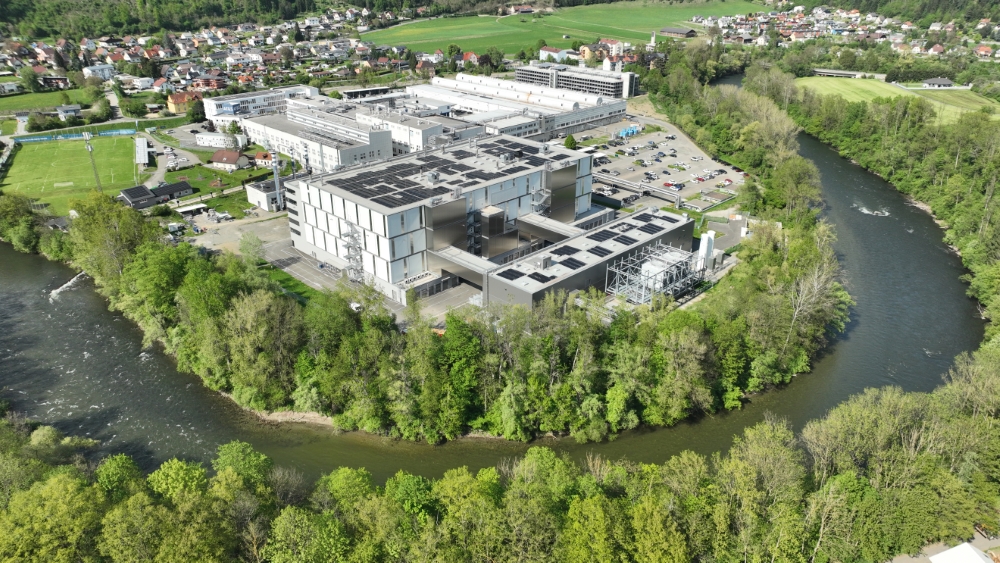
Behind the massive (and massively expensive) semiconductor fabs rising around the globe from Phoenix to New York to Vietnam, Taiwan, China and India lies an equally massive supply chain comprising companies like AT&S, the Austrian company that’s gone from a merger of state-owned electronics firms nearly 40 years ago to a global company employing around 14,000 people.
A look through the lens of the company’s investments since the year began provides a glimpse of where the broader action is.
AT&S (Austria Technologie & Systemtechnik Aktiengesellschaft) in June announced an investment of between €1.5 billion and €2 billion at its site in Kulim, Malaysia, based on agreements with customer AMD and another unnamed company. “Building on the successful ramp-up of plant 1, the expansion includes the fit-out of the existing structure of plant 2 and the construction of a new manufacturing site for IC substrate cores and advanced PCBs [printed circuit boards],” AT&S announced. “The expansion comes amid unprecedented demand driven by the global build-out of an artificial intelligence (AI) infrastructure.”
The company said the evolution of semiconductor architecture is “fundamentally reshaping” demand for IC (integrated circuit) substrates, with the transition from monolithic chips to chiplet-based designs already driving “significant demand growth.”
AT&S operates production sites in Austria (Leoben and Fehring), China (Shanghai and Chongqing), Malaysia (Kulim) and India (Nanjangud) while maintaining its European competence center for R&D and IC substrate production in its headquarters town of Leoben, a historic university and mining community northwest of Graz along the Mur River in Styria.
Fortifying ‘Europe’s Technological Sovereignty’
In February, the company announced it would invest more than €30 million in new technologies, sustainability and additional jobs at the site in Fehring, including an apprentice workshop for skilled worker training. With a focus on applications in e-mobility and semiconductor test equipment as well as in the fields of medical technology, aerospace and defense, the investment builds on €16.5 million invested in Fehring over the past two fiscal years, with €14 million more planned. Around 50 new jobs will be created, building on a recent hiring wave that saw 35 positions added. Over the past two financial years, AT&S has already invested €16.5 million in the plant, with a further €14 million planned.
The apprentice program dovetails with a new research initiative initiated by AT&S at Graz University of Technology (TU Graz) in February in the field of microelectronics with a focus on IC substrates and advanced packaging technologies. Financed by AT&S for five years, the research group will be anchored at the university’s Institute of Electronics, Institute of Electrical Drives and Power Electronic Systems and Institute of High Frequency Technology. The initiative follows the opening of the first European competence center for research, development and IC substrate production in Leoben (“Hinterberg 3”) last year. Leoben also saw recent investment in the mid-single-digit million-euro range to expand and modernize existing PCB plants and triple cleanroom space. The company has added 150 new jobs recently in Leoben.
“This research initiative is a targeted investment in our technological future,” said AT&S Chief Technology Officer Peter Griehsnig of the TU Graz partnership. “Since semiconductor chips alone can no longer enable rapid progress, microelectronics must now be considered as a complete system. Only in combination with highly developed substrates and packaging technologies the full innovation potential of microelectronics can be exploited. It is precisely this complementary knowledge that we want to systematically expand together with TU Graz.”
“The close interlinking of scientific excellence and industrial innovative strength brings new technologies into application much faster,” said TU Graz Rector Horst Bischof. “The common goal of AT&S and TU Graz is to make systems with integrated circuits more powerful, more compact, more reliable and more energy-efficient. With this initiative, we are jointly taking an important step towards strengthening Europe’s technological sovereignty and the competitiveness of the location in the long term.”