
by Lisa Bastian
When states compete to land major corporate projects, making the initial short list is the most difficult hurdle to clear.
Increasingly, the states and regions achieving the greatest success are not only investing in comprehensive site-readiness programs; they are also applying proven practices from across the country.
The strongest programs do more than identify available land. Rather, they show that properties have been carefully evaluated and/or prepared, site data is current and reliable, and development teams are ready to move quickly to close deals.
For site selectors juggling multiple states on tight deadlines, that level of attention makes all the difference. By reducing uncertainty, such site-readiness programs allow companies to identify leading communities faster, and with greater confidence.
Illinois has fully embraced this customer-centric approach. After studying what works best nationwide, the state is now applying those lessons to better prepare, fund and market its own sites for future investment.
Illinois Launches Historic Initiative to Spur Economic Development
In 2025 alone, the state recorded 680 qualifying corporate expansion and relocation projects and ranked No. 2 nationally for the fourth consecutive year. Illinois’ nominal GDP grew 5.85% year over year. The state also ended the year with 200,000 job openings, while hires increased 7.45%.
Those results prove Illinois already is generating strong business demand. The next challenge is converting that momentum into more projects across more communities.
To expand its ability to capture future investment, Illinois committed $500 million in FY26 to the largest site readiness initiative in state history. The funding moves idle or underprepared properties closer to development readiness, allowing more communities to compete for projects that drive statewide growth.
The half-billion-dollar site-readiness investment is more than a one-time infusion of grant dollars. Rather, it represents a structural shift in how Illinois prepares sites and competes for investment through two major initiatives.
The “Surplus to Success” program, operated by the Illinois Department of Central Management Services, receives $300 million to prepare underused state-owned properties for private development.
“Site Ready Illinois,” administered by the Illinois Department of Commerce and Economic Opportunity, receives the remaining $200 million for planning, infrastructure and industrial site development across the state. Abby Powell of the Springfield Sangamon Growth Alliance says this initiative is important as it helps Illinois communities “compete on a national scale.”
One key component, the “Illinois Regional Site Readiness Program,” offers two distinct avenues to readiness. Its $61.5 million is made available to Illinois communities, economic development organizations and landowners to prepare industrial properties for future investment. The advantage for site selectors? They gain access to a larger inventory of credible, better-prepared sites much earlier in the search process.
Site Readiness Program Accelerates Decision-Making Process
The $60 million Capital Ready track moves promising properties closer to full development readiness by supporting improvements in grading, roads, rail connections, drainage, utilities and water/sewer infrastructure. In April 2026, Illinois announced the first seven Capital Ready awards, totaling $25.9 million.
The $1.5 million Planning track supports environmental reviews, engineering, utility studies, surveys and site plans. This work answers critical questions about infrastructure, access, environmental conditions and development constraints.
For example, the City of McHenry received $120,000 to conduct environmental due diligence on about 235 acres planned for industrial development. This project illustrates that site readiness begins long before roads or utilities are installed.
For businesses working under tight deadlines, the Regional Site Readiness Program offers significant advantages by addressing development risks before any capital is committed. They appreciate gaining access to more Illinois sites with due diligence completed, infrastructure needs identified and major development obstacles already addressed.
The timing of these investments is strategic. Illinois recorded about 189,000 new business applications in 2025, an 11% increase. From 2021 through 2025, its economy added 368,000 jobs, with gains across every focus industry.
Companies attracted by that momentum still require sites capable of supporting investment without costly delays.
“Winning large-scale, generational projects requires an economic development strategy that balances short-term adapt-ability and long-term growth,” says Christy George, president and CEO of the Illinois Economic Development Corporation (Illinois EDC). “And that’s what Illinois is doing with the Regional Site Readiness Program.
It’s simplifying and accelerating the site selection process for businesses and decision-makers.”
Third-Party Vetting Narrows a Much Larger Inventory
Before investing potentially millions of dollars, a company needs reliable facts about the land on which it may build. Illinois EDC helps site selectors begin that search with a statewide database containing over 1,650 available properties. Within that broader inventory, over 70 have earned designation through its Vetted Sites program. Each of those sites is evaluated across eight characteristics: acreage, utilities, logistics, permitting and entitlement, workforce, ownership, incentives, and environmental and topographical conditions.
Illinois EDC retains independent experts to examine the properties, then organize their findings into detailed site packages. The process gives companies with fast-moving projects the solid data they need while identifying improvements communities can make to strengthen a property’s overall market competitiveness.
“[The experts] do a deep-dive analysis, and then we market the sites,” explains Paulina San Millan, senior vice president of business development for Illinois EDC. “We know that in the global economy today, if you don’t have the sites, you can’t compete for projects.”
For site selectors, the Vetted Sites program clarifies property conditions, speeds comparisons, and makes it easier to identify the strongest locations for further consideration. The 70 designated properties offer diverse acreage and usage options for different project sizes and industries.
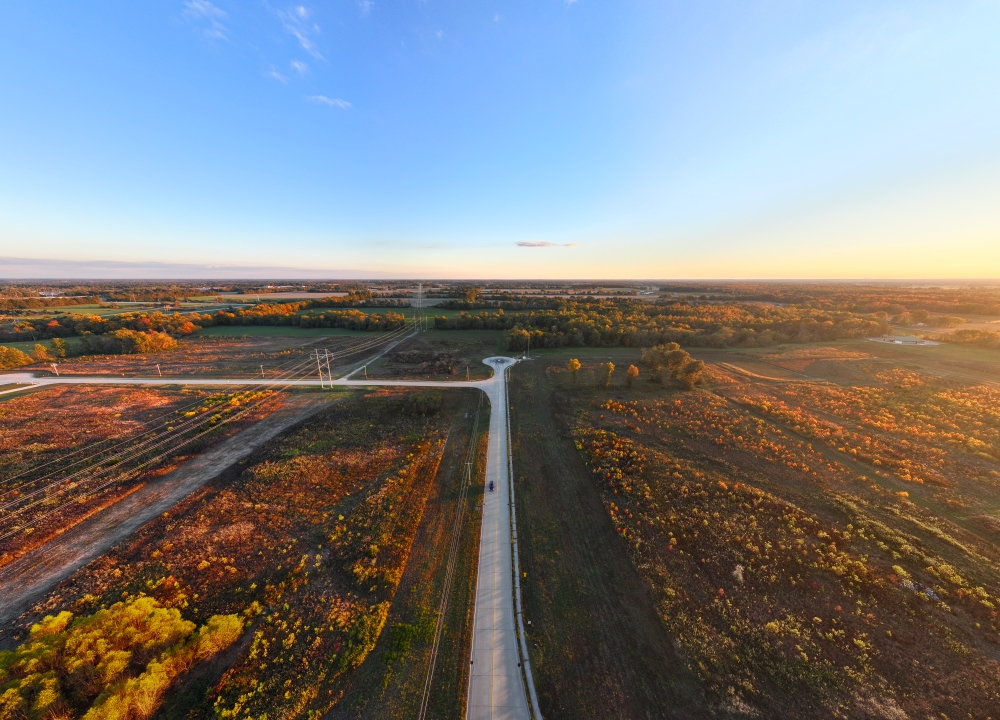
The 95-acre Chesley Industrial Park on Neon Drive in Mount Vernon, Illinois, is close to Interstates 57 and 64 and is accessible via Exits 94 or 95.
Photo courtesy of Illinois EDC and SO il Cinema
Smaller sites include Bourbonnais Industrial Gateway, a 180-acre site in Kankakee County with heavy industrial zoning, rail access and strong proximity to I-57. In the St. Louis metro, the 330-acre University Park at Southern Illinois University Edwardsville is one of the stronger, more established sites in the program for tech, R&D, light industrial and corporate users. Then there’s the 416-acre I-80 Logistics Park in Grundy County. It offers an excellent logistics location along I-80 and proximity to Chicago.
Over two dozen properties are designated as “megasites” because most exceed 500 acres and are best-suited for large manufacturing projects. For example, the 500-acre Hartford Industrial Center offers strong utility capacity plus excellent access to interstates, rail and river transportation. Another is the 1,000-acre Dual Rail Megasite in Rochelle, served by BNSF and Union Pacific, with another 500 acres available for expansion. In Hennepin, the 3,300-acre Marquis Industrial Complex provides on-site rail, barge access and more than 100 megawatts of electric capacity.
Utility Partnership Adds Another Layer of Preparation
Ameren Illinois delivers electricity to 1.2 million customers and natural gas to more than 800,000 customers across Illinois.
In December 2025, the company gave Illinois’ broader site-readiness strategy a utility-led component when it launched the Ameren Site Acceleration Program (ASAP).
ASAP addresses one of the biggest sources of project delay: unanswered utility questions. It front-loads due diligence, utility and infrastructure analyses, conceptual site plans and industry targeting so foundational work is completed before a prospect calls.
Ameren funds the work, while Illinois EDC and regional partners market each property to industries best matched to its capabilities. Interested prospects use this utility information to quickly determine if sites can support proposed projects.
Still in pilot phase, the program currently focuses on three high-potential properties in Champaign, Decatur’s Commerce Park and Ottawa Industrial Park.
Coordination Strengthens Illinois’ Investment Case
“Site readiness is a crucial step in redevelopment that creates jobs for hardworking Illinoisans and breathes new life into communities,” says Gov. JB Pritzker. “By expanding the number of Illinois properties ready for development, we’re setting the stage for long-term economic growth, revitalization and opportunities for the entire state.”
Recent rankings already position Illinois as “one of the best states in the country for business,” adds Lt. Gov. Juliana Stratton. Through these new site investments, she says, “we’re doubling down on that success. This is how we build an economy that works for all of us.”